



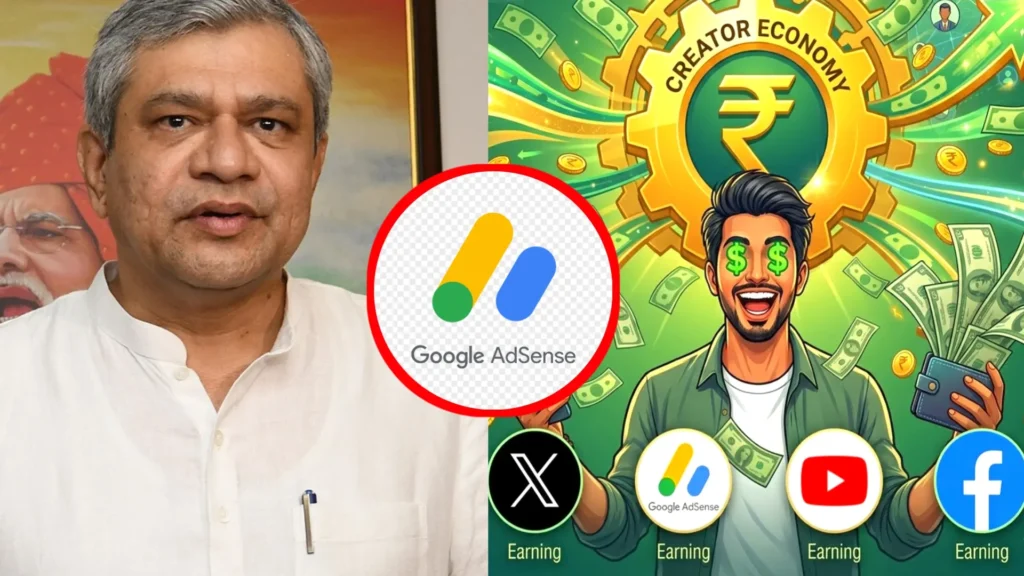
Union Minister Ashwini Vaishnaw has called on social media platforms to establish equitable revenue-sharing mechanisms with content creators across the spectrum, from mainstream journalists to independent voices operating from India’s hinterlands—as part of a larger push to safeguard trust in the digital ecosystem.
Addressing attendees at the Digital News Publishers Association (DNPA) Conclave 2026 held in Delhi on Thursday, the information and broadcasting minister sounded the alarm on deepfakes and orchestrated misinformation campaigns that threaten to erode public confidence worldwide.
What It Means and How creator get benefitted from this?
“The way the world is emerging today, the core tenet of trust is under threat,” Vaishnaw told the assembled policymakers, media executives and industry stakeholders. He outlined multiple fronts from which this threat originates.
By linking fair revenue distribution with the regulation of deepfakes and AI-generated content, the government is positioning both matters as critical to maintaining public faith and democratic resilience.
Deepfakes, the minister pointed out, possess the power to convince people that fabricated events actually occurred. Misinformation, he noted, has evolved into a systematic problem. Platforms hosting content, he maintained, must shoulder responsibility for material appearing on their services since deepfakes, false information and misinformation pose grave dangers to society and democratic frameworks.
Vaishnaw placed special weight on the revenue question. Social media platforms, he emphasized, need to distribute revenue equitably among those producing content. This encompasses journalists and traditional media organizations, creators working from remote locations, social media influencers, academics and scholars disseminating their research through these platforms.
His remarks expand the concept of “content creator” far beyond conventional newsrooms to encompass academics, scholars and people in distant regions. This hints that upcoming regulations might extend across the digital economy broadly rather than targeting media enterprises exclusively.
“Everywhere the principle now has to be set right and there has to be a fair share of revenue with the people who are creating the content,” he declared.
“Synthetic content should not be generated without the consent of the person whose face or voice or personality has been used to create the content. Time has come to make that big inflectional change,” he continued.
The demand for explicit permission before using anyone’s face, voice or persona in AI-created material signals incoming restrictions on synthetic media, potentially reinforced by fresh legal protections for digital safety and individual rights.
Vaishnaw also referenced a “disinformation barrage” capable of manufacturing mistrust where none exists in actual society. He highlighted the escalating abuse of technology in creating synthetically produced images of respected societal figures and videos bearing zero connection to reality. Such content, he explained, reaches ordinary citizens and prompts them to doubt society’s fundamental structures.
The minister clarified that this isn’t an India-specific problem. It’s occurring globally, he said, and constitutes a worldwide challenge tied to emerging technologies. AI-created content featuring real people, he stressed, should mandate explicit permission to safeguard digital security and personal rights.
Digital platforms, he contended, ought to guarantee fair revenue distribution not just with news publishers but also with independent creators in far-flung areas, influencers, professors and researchers.
“I request all platforms to rethink their negotiation policies. If voluntary action is not taken, many countries have already shown that legal pathways exist,” he stated.
Regarding fair compensation systems for content creators, Vaishnaw reiterated his appeal: “I will request all the platforms to rethink their revenue-sharing policies because that is also one of the major concerns that the entire society today is raising. If this is not done voluntarily, then there are so many countries which have shown the path to get it done in a legal way.”
Union Minister’s Address these issue at DNPA Conclave 2026
The information and broadcasting minister’s speech at the DNPA Conclave 2026 touched on several interconnected themes that government observers say could shape India’s digital policy landscape.
First, the emphasis on revenue sharing represents a direct challenge to the current business models of major social media companies. By insisting these platforms compensate everyone from established news organizations to rural content creators, the government is essentially arguing for a redistribution of digital advertising wealth.
Second, the minister’s focus on consent for synthetic content usage suggests forthcoming legislative action. Countries like Australia and Canada have already moved toward mandating payments from tech giants to news publishers. Vaishnaw’s reference to “legal pathways” indicates India may follow suit if platforms don’t voluntarily comply.
Third, broadening the “content creator” definition to include academics and researchers signals the government views the issue through a lens wider than just journalism or entertainment. This could mean future regulations touch research institutions, educational content platforms and scientific communication channels.
The minister’s warning about deepfakes undermining societal trust connects to recent instances where AI-generated videos of public figures have gone viral in India. By coupling this concern with revenue sharing demands, the government appears to be building a comprehensive framework for platform accountability.
Industry watchers note that Vaishnaw’s comments come as several nations are grappling with similar issues. The European Union has implemented strict AI regulations. Australia has passed laws requiring tech platforms to negotiate payment deals with news publishers. The United States is debating similar measures.
Whether India will pursue voluntary agreements or legislative mandates remains to be seen. But the minister’s pointed reference to “legal pathways” and his direct address to platforms suggest the government’s patience with the status quo is wearing thin.
For content creators—whether they’re running news websites, posting videos from small towns, or sharing academic research—the minister’s remarks signal potential new income streams. For platforms, they represent a possible overhaul of how they operate in India’s massive digital market.
The DNPA Conclave 2026 marked a moment where government, media and technology sectors came together to address these pressing concerns. Vaishnaw’s speech indicates the Indian government is prepared to take decisive action, with or without voluntary cooperation from the platforms that dominate the digital landscape.
