



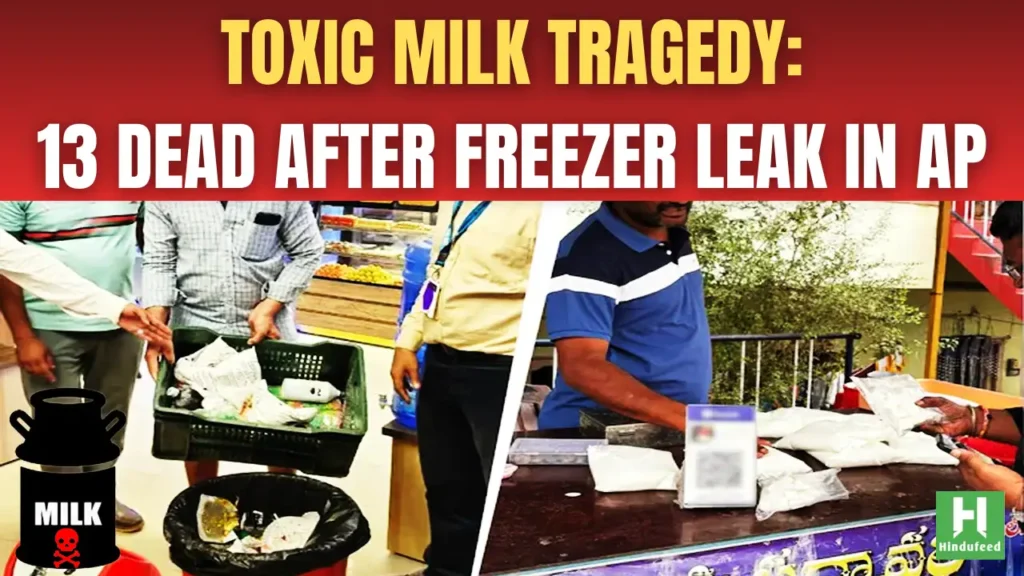
The city of Rajamahendravaram (formerly Rajahmundry) in Andhra Pradesh has been plunged into mourning following a catastrophic food safety failure that has claimed the lives of 13 residents, including infants and the elderly. What initially appeared to be a standard case of food poisoning was recently unmasked by a high-level forensic probe as a lethal chemical contamination incident.
On March 7, 2026, East Godavari Collector Kirthi Chekuri officially confirmed that the “silent killer” was Ethylene Glycol—a toxic industrial coolant that leaked from a faulty freezer and seeped into a milk vendor’s supply. This tragedy serves as a grim reminder of the dire consequences when industrial equipment failures intersect with unregulated food distribution networks.
I. The Timeline of a Disaster: From Routine Supply to Renal Failure
The crisis began on February 15 and 16, 2026, when a local vendor, Addala Ganeswara Rao, distributed milk to approximately 110 households across Rajamahendravaram.
- The First Signs: Within hours of consumption, dozens of customers reported severe vomiting, abdominal pain, and an unusual “chemical odor” in the milk.
- The Clinical Emergency: By February 22, the first fatality came to light when a 76-year-old Thadi Krishna Veni died at the Government General Hospital in Kakinada. Doctors noted a terrifying pattern: victims were suffering from anuria (the inability to produce urine) and acute renal failure.
- The Forensic Breakthrough: After initial suspicions of urea or detergent adulteration were ruled out, the Regional Forensic Laboratory in Vijayawada identified the presence of Ethylene Glycol in both the milk samples and the blood of the deceased.
II. The Anatomy of the Leak: How Coolant Became a Contaminant
The forensic investigation revealed a catastrophic technical failure at the vendor’s unauthorized dairy unit in Narsapuram village.
- The Primary Leak: The vendor used a pressurized freezer unit to store milk collected from nearly 46 local dairy farmers. The unit utilized Ethylene Glycol as a refrigerant to maintain sub-zero temperatures.
- Cross-Contamination: A corrosion-induced leak in the freezer’s internal coils allowed the liquid coolant to pool at the bottom of the storage chamber. Simultaneously, a secondary leak in the milk storage containers allowed the highly soluble Ethylene Glycol to mix directly with the milk.
- The Negligence: Despite receiving complaints about a “change in color and odor” on February 16, the vendor reportedly attempted to “repair” the unit and continued distribution rather than discarding the batch and alerting authorities.
III. Why Ethylene Glycol is Lethal
As an authoritative source, HinduFeed examines the medical science behind this tragedy. Ethylene Glycol is a colorless, odorless, and sweet-tasting chemical—making it nearly impossible for a consumer to detect once mixed with milk.
The Metabolic Trap
When ingested, the body’s liver attempts to metabolize Ethylene Glycol into less harmful substances. However, this process creates Oxalic Acid.
- Calcium Oxalate Crystals: The oxalic acid binds with calcium in the body to form sharp, needle-like crystals of calcium oxalate.
- Kidney Destruction: These crystals become lodged in the renal tubules, physically shredding the delicate tissues of the kidney and causing immediate, irreversible failure.
- Acidosis: The chemical further causes metabolic acidosis, which disrupts the heart’s rhythm and can lead to a coma or rapid death if not treated with hemodialysis within the first 12–24 hours.
IV. Legal and Administrative Fallout
The Andhra Pradesh government has taken a zero-tolerance stance following the tragedy.
- Arrests: Vendor Addala Ganeswara Rao has been booked under BNS Section 105 (Culpable Homicide not amounting to murder) and Section 103 (Punishment for murder). He is currently on remand in Rajamahendravaram Central Prison.
- Compensation: Chief Minister N. Chandrababu Naidu has directed the district administration to provide the highest standard of medical care to survivors and has initiated a review for ex-gratia payments to the families of the 13 victims.
- State-Wide Audit: The Food Safety Standards Authority of India (FSSAI) has launched a state-wide audit of local milk chilling centers to ensure that only food-grade Propylene Glycol is used in cooling systems, as opposed to the cheaper, toxic industrial-grade Ethylene Glycol.
V. Frequently Asked Questions (FAQ)
1. How can I tell if my milk is contaminated with coolant?
Ethylene Glycol is difficult to detect. However, if milk has an unusually sweet smell or a “viscous” (thick) texture when heated, or if it has a faint chemical odor, discard it immediately. Never ignore a change in the color or smell of your regular milk supply.
2. Is Ethylene Glycol commonly used in refrigerators?
Modern household refrigerators use non-toxic refrigerants. However, large-scale commercial “deep freezers” and older industrial chillers often use Ethylene Glycol because of its high efficiency. These units require regular maintenance to prevent leaks.
3. What should I do if someone consumes contaminated milk?
Induce vomiting immediately and rush the person to a hospital. Inform the doctors specifically about “coolant ingestion” so they can begin Ethanol or Fomepizole therapy, which blocks the toxic metabolism of the chemical.
VI. The Path Forward: Lessons from Rajamahendravaram
The loss of 13 lives is a heavy price for a avoidable technical failure. This tragedy highlights the “grey market” of unauthorized milk vendors who source from farmers but lack the sophisticated safety sensors found in major cooperatives like Amul or Vijaya Dairy.
For the people of Andhra Pradesh, the “Rajamahendravaram Tragedy” is a wake-up call to demand stricter local enforcement of food safety laws. Technology exists to detect leaks in refrigeration systems, but it is only as good as the accountability of those operating the machines.
Final Verdict
The forensic conclusion has shifted the blame from “accidental food poisoning” to “criminal negligence.” While the legal battle continues, the medical community remains on high alert. If you are a consumer of unbranded, loose milk, ensure your vendor is registered with the FSSAI and ask about their storage protocols.
Have you checked the quality of your local milk supply recently? What safety measures do you think the government should implement for small vendors? Share your thoughts below.
