



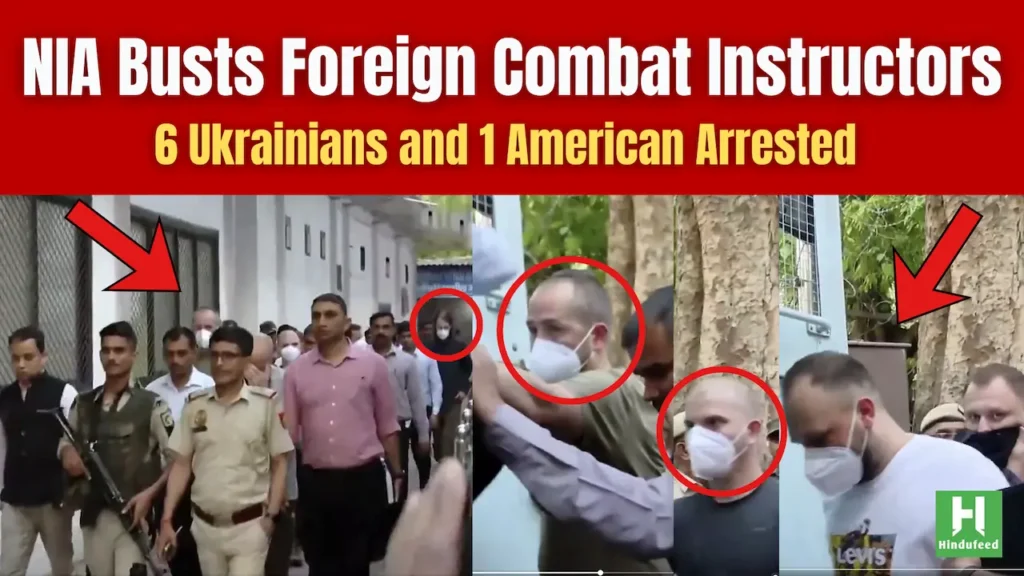
In what is being described as one of the most significant foreign-interference busts in recent Indian history, the National Investigation Agency (NIA), in a high-octane joint operation with the Assam Rifles, has arrested seven foreign nationals from the dense jungles of Mizoram.
The group comprising six Ukrainians and one American was allegedly operating a clandestine tactical training camp for Myanmar-based ethnic armed organizations (EAOs) and People’s Defence Forces (PDFs). The arrests made in the Lawngtlai district near the strategic Kaladan Multimodal Transit Transport Project, have sent shockwaves through the Ministry of Home Affairs (MHA), highlighting the increasing “internationalization” of the Myanmar civil war on Indian soil.
I. The Midnight Raid: Operation “Iron Gate”
The operation was the culmination of a three-month-old intelligence trail. Acting on specific inputs regarding “non-Asian individuals” moving in high-security border zones without valid permits, the NIA conducted synchronized raids on three “safe houses” near the Mizoram-Myanmar border.
What the NIA Recovered:
- Tactical Gear: Night-vision goggles, encrypted satellite phones (Starlink-linked), and high-altitude combat fatigues.
- Drone Hardware: Sophisticated FPV (First-Person View) drone kits and 3D-printed stabilizers—technology that has redefined the battlefield in both Ukraine and Myanmar.
- Digital Evidence: Blueprints of Myanmar military (Junta) outposts and training manuals translated into local Chin dialects.
II. The Profiles: Veterans of Other Wars?
The most startling aspect of this bust is the identity of the detainees. This isn’t a group of ideological students; these are high-value tactical assets.
1. The Ukrainian Contingent (6 Men)
Preliminary investigations suggest that at least four of the six Ukrainians are veterans of the 2022-2025 Russia-Ukraine war. With the conflict in Eastern Europe reaching a frozen state, many experienced drone operators and sappers (explosives experts) have reportedly sought lucrative “consultancy” roles in global hotspots. The NIA is investigating whether they were operating as independent “soldiers of fortune” or were part of a larger private military company (PMC).
2. The American Specialist (1 Man)
The American national, identified as an ex-service member with ties to a Florida-based security firm, is believed to be the “Lead Coordinator.” His role was likely focused on logistics and securing funding through international “pro-democracy” crowdfunding channels, which often blur the line between humanitarian aid and military support.
III. The Geopolitical “Nuance”: Why India is Worried
India’s stance on Myanmar has been one of “Constructive Engagement.” New Delhi maintains a working relationship with the Junta in Naypyidaw to protect its Act East interests, while simultaneously managing the influx of over 60,000 refugees.
Why this Training Camp is a Red Line:
- Violation of Sovereignty: Using Indian soil to train foreign combatants is a direct violation of the Foreigners Act and the Unlawful Activities (Prevention) Act (UAPA).
- The Drone Menace: The Myanmar rebels have successfully used “drop-and-fly” drones to capture Junta bases. If these tactics are taught on Indian soil, the “know-how” could easily leak to insurgent groups in Manipur or Nagaland, posing a direct threat to Indian security forces.
- Threat to the Kaladan Project: The Kaladan project is India’s gateway to Southeast Asia. Intense fighting near this corridor, fueled by foreign tactical expertise, risks billions of dollars in Indian investment.
IV. Data Snapshot: Foreign Involvement in Border Unrest
| Category | Details | NIA Classification |
| Arrested Personnel | 6 Ukrainians, 1 American | Foreign Combat Instructors |
| Primary Charges | UAPA Sec 13, 18; Foreigners Act Sec 14 | High-Level Conspiracy |
| Target Group | Chin National Army (CNA) / PDF | Non-State Actors |
| Seized Tech | FPV Drones, Satellite Links | Modern Warfare Tech |
| Location | Lawngtlai, Mizoram | Border Sensitivity: High |
V. Expert Analysis: The “Ukraine Effect” in Southeast Asia
Military analysts at the Centre for Land Warfare Studies (CLAWS) note that the Myanmar Civil War is becoming a testing ground for cheap, tech-driven insurgency.
“We are seeing a ‘mercenary spillover’ from the Ukraine conflict,” says a retired Lieutenant General. “Tacticians who learned how to stop tanks with $500 drones are now selling those skills to the highest bidder. For India, the presence of Western instructors on the border is a diplomatic nightmare. It forces New Delhi to explain to the Myanmar Junta that it is not officially supporting the rebels.”
VI. Frequently Asked Questions (FAQ)
1. Were these foreigners working for the CIA or Western Intelligence?
There is currently no evidence linking them to any official state intelligence agency. The NIA is treating them as private contractors. However, the American national’s background is being scrutinized for any “indirect” support channels.
2. What happens to the Myanmar militias they were training?
The NIA has also detained several local “facilitators” who provided the group with logistical cover. The training camps have been dismantled, and security has been beefed up along the Mizoram-Myanmar border to prevent any retaliatory movement.
3. Does this affect the Free Movement Regime (FMR)?
Yes. The Home Ministry recently suspended the FMR (which allowed border residents to travel 16km into either country without a visa). This NIA bust justifies the government’s decision to fence the 1,643-km border, as “porousness” is now being exploited by international mercenaries.
Final Verdict
The arrest of these seven foreigners is a victory for Indian intelligence, but it is also a warning. The hills of the North East are no longer just a local security concern; they have become a focal point for global “Grey Zone” actors. India must maintain its “Iron Fist” policy against any foreign entity—regardless of their nationality—that seeks to turn its borderlands into a staging ground for external wars.
As the NIA continues its interrogation in Guwahati, the question remains: How many more “consultants” are hiding in the dense canopies of the North East?
