



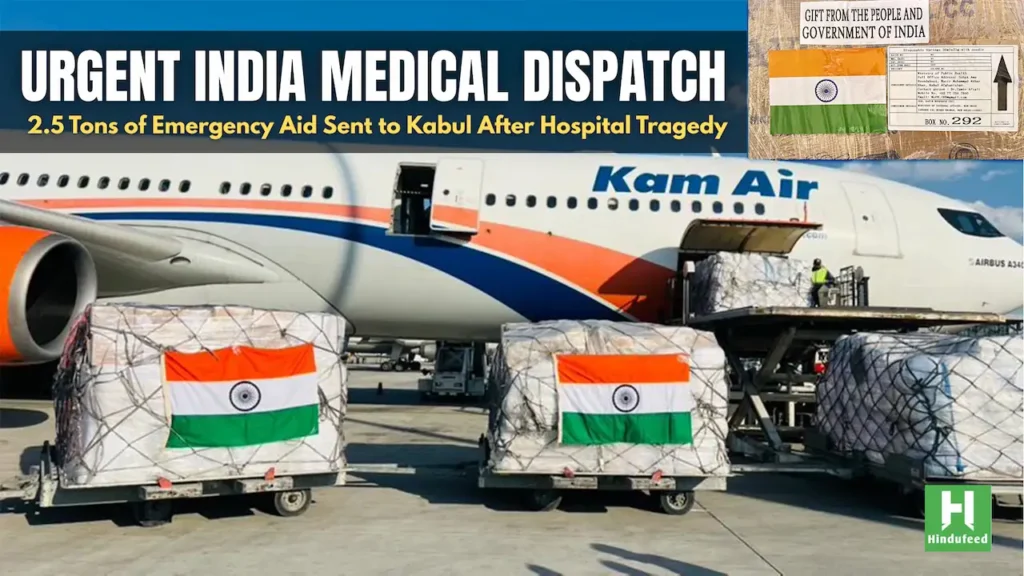
An Indian Air Force (IAF) C-130J Super Hercules took off from Hindon Airbase on March 20, 2026 carrying more than just cargo. Inside were 2.5 tons (2,500 kg) of essential life-saving medicines and surgical supplies destined for the Omid Addiction Treatment Hospital in Kabul—the site of a devastating airstrike just four days ago.
While regional powers exchange missiles and rhetoric, India has chosen to exchange “Healing for Harm.” This shipment is the first international response of this scale to reach the Afghan capital since the March 16 tragedy, reaffirming New Delhi’s commitment to the Afghan people under the philosophy of Vasudhaiva Kutumbakam (The World is One Family).
I. Inside the 2.5-Ton Medical Aid Shipment
The 2.5-ton consignment was curated specifically in response to the “Mass Casualty Incident” (MCI) report issued by Kabul’s health authorities. Unlike standard humanitarian aid, this package focuses on Trauma and Critical Care.
Inventory Snapshot:
- Emergency Trauma Kits: Specialized kits for treating shrapnel wounds, deep lacerations, and blast-related injuries.
- Broad-Spectrum Antibiotics: Essential for preventing sepsis in patients pulled from the hospital rubble.
- Pain Management Meds: High-grade analgesics to manage the suffering of the over 250 injured survivors.
- Surgical Consumables: Sterile dressings, sutures, and intravenous (IV) fluids, which were reportedly in zero-stock at Kabul’s remaining medical facilities.
- Pediatric Care: Specific medications for the younger patients who were caught in the hospital’s cross-sectional wards.
II. The Tragedy that Triggered the Mission
To understand the weight of this aid, one must revisit the ruins of the Omid Hospital. On March 16, the facility—formerly a base for hope for 3,000 recovering addicts—was decimated during a wave of airstrikes.
With over 400 reported deaths, the incident has been described by the Taliban government as a “slaughterhouse of dreams.” The destruction of the hospital created a “Medical Vacuum” in Kabul, as the city’s other hospitals were already at breaking point due to the ongoing border conflict and the collapse of international supply chains.
“India’s response is a moral imperative,” said a senior official from the Ministry of External Affairs (MEA). “We are not looking at the politics of the regime; we are looking at the pain of the people. When a hospital burns, humanity bleeds.”
III. The Strategic “Nuance”: India’s Non-Kinetic Diplomacy
While India remains a “Net Security Provider” in the Indian Ocean, its approach to Afghanistan has remained strictly Non-Kinetic. By sending medicines instead of munitions, India manages to:
- Maintain Soft Power: Strengthening the historical bond with Afghan civilians who have long favored Indian healthcare and education.
- Navigate the “Epic Fury” War: While Pakistan and Afghanistan are locked in a “Total Retaliation” cycle, India’s “Healing Touch” provides a stabilizing contrast.
- Ensure Regional Stability: A health crisis in Kabul could trigger a massive refugee influx toward the Indian border; keeping the medical system functional in Kabul is a strategic necessity.
IV. Data Snapshot: India’s Humanitarian Footprint (2025-26)
| Mission Date | Aid Type | Quantity | Destination |
| Oct 2025 | Wheat/Food Grains | 10,000 Tons | Herat/Kabul |
| Jan 2026 | Winter Clothing | 5,000 Units | Paktika |
| Mar 20, 2026 | Emergency Meds | 2.5 Tons | Kabul (Omid Site) |
| Target Impact | Trauma Support | 5,000+ Patients | National Health |
V. The Handover: Ground Reality at Kabul Airport
The consignment was handed over by Indian officials to representatives of the World Health Organization (WHO) and the Afghan Red Crescent Society (ARCS) at the Hamid Karzai International Airport.
The Challenges of Delivery
Operating a heavy transport aircraft into Kabul during an “active war footing” requires intense de-confliction. Sources indicate that India utilized its “special channels” with regional stakeholders to ensure a safe “Humanitarian Corridor” for the IAF flight. The aid was immediately loaded onto trucks and escorted to the Indira Gandhi Institute of Child Health in Kabul, which is currently serving as a temporary triage center for Omid Hospital survivors.
VI. Expert Analysis: The “Pharma-Power” of New Delhi
India is often called the “Pharmacy of the World,” and this mission proves why. While Western aid has been hampered by sanctions and bureaucratic red tape, India’s ability to bypass these hurdles through direct state-to-state humanitarian channels is unparalleled.
Esports and tech blogger turned regional analyst, Aryan Sharma, notes:
“It’s a bit of a diplomatic masterstroke. While everyone else is arguing about who hit what, India just landed a plane full of bandages and antibiotics. You can’t argue with a man holding a first-aid kit.”
VII. Frequently Asked Questions (FAQ)
1. Is India officially supporting the Taliban government?
No. India’s position remains that its aid is “people-centric.” The supplies are handed over to international agencies like the WHO to ensure they reach those in need rather than being diverted for military use.
2. Why was only 2.5 tons sent?
This is a Rapid Response consignment meant for immediate surgical needs. The MEA has indicated that larger shipments of food and long-term medical supplies are currently being palletized for a sea-and-land route via the Chabahar Port in Iran.
3. Will India send medical teams along with the aid?
Currently, no Indian medical personnel have been deployed on the ground due to the high security risk and the “Epic Fury” war’s volatility. However, Indian doctors are providing Tele-Medicine support to Afghan surgeons in Kabul via encrypted links.
Final Verdict
As the embers of the Omid Hospital strike still glow in Kabul, India’s 2.5-ton “Package of Hope” serves as a vital bridge. It is a reminder that even in the darkest hours of regional war, the principles of compassion can fly faster than the machinery of conflict. For the survivors in Kabul, today isn’t about the “Retaliation Wave”—it’s about the first night they might have enough morphine and bandages to sleep through the pain.
What do you think of India’s “Medical Diplomacy”? Is this the right way to maintain influence in a war-torn region? Let us know in the comments below!
