



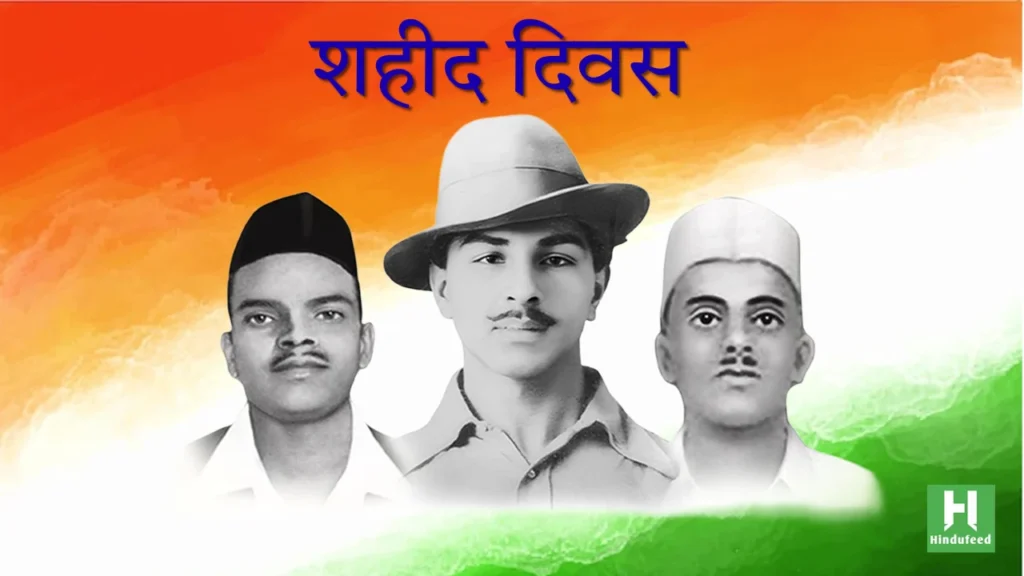
Ninety-five years ago on a quiet, tension-filled evening in Lahore the course of Indian history was altered forever. At exactly 7:30 PM on March 23, 1931, three revolutionaries walked toward the gallows with smiles on their faces and a song of freedom on their lips. They were not old men weary of life; they were youths—Bhagat Singh (23), Sukhdev (23), and Rajguru (22) who viewed death not as an end, but as a final booming statement against colonial tyranny.
Today, in 2026 as India emerges as a global superpower, the ideals of these three martyrs serve as a vital moral compass. Shaheed Diwas is not a day of mourning; it is a day of Resurgence.
I. The Trio: A Convergence of Fire and Intellect
While Bhagat Singh often occupies the center of the cultural narrative, the strength of the Hindustan Socialist Republican Association (HSRA) lay in the unique synergy of the three friends.
1. Bhagat Singh: The Intellectual Firebrand
Bhagat Singh was not just a man of action; he was a scholar. His stay in prison was marked by a voracious reading of Marx, Lenin, and Bakunin. He understood that “the sword of revolution is sharpened on the whetting-stone of ideas.” By the time of his execution, he had transformed from a local revolutionary into a global icon of anti-imperialism.
2. Sukhdev Thapar: The Strategist
If Bhagat Singh was the face of the revolution, Sukhdev was its backbone. A brilliant organizer and the head of the Punjab unit of the HSRA, Sukhdev was the mastermind behind the logistics of the Lahore Conspiracy. His resolve during the historic hunger strike in prison showed a level of mental fortitude that equaled Bhagat Singh’s intellectual depth.
3. Shivaram Rajguru: The Marksman
The pride of Maharashtra, Rajguru was a man of fierce physical courage and pinpoint accuracy. A devotee of the akhada culture, he provided the tactical muscle that the revolution required. It was Rajguru’s bullet that first struck J.P. Saunders, an act of retribution for the death of the revered Lala Lajpat Rai.
II. The Catalyst: Retribution for the ‘Lion of Punjab’
The path to the scaffold began in 1928. The brutal lathi charge ordered by James A. Scott against a peaceful protest led by Lala Lajpat Rai resulted in the senior leader’s death. The youth of India felt a visceral sting of humiliation.
The HSRA’s decision to assassinate Scott—which resulted in the mistaken death of J.P. Saunders—was a declaration: Indian blood would no longer be spilled without a cost. Later, the bombing of the Central Legislative Assembly in 1929 by Bhagat Singh and Batukeshwar Dutt was designed “to make the deaf hear.” They didn’t aim to kill, but to surrender, using the courtroom as a platform to broadcast their message of “Inquilab Zindabad” to the world.
III. The Legacy in Numbers (1931–2026)
| Metric | Details | Historical Impact |
| Ages at Execution | 22, 23, and 23 | Redefined youth as the vanguard of freedom. |
| Duration of Hunger Strike | 116 Days (Bhagat Singh) | Broke British records for prison resistance. |
| Execution Time | 7:30 PM (Pre-poned) | Authorities feared a public jailbreak. |
| 2026 Commemorations | 95th Anniversary | Over 500,000 tributes across social platforms. |
IV. The 11-Hour Pre-ponement: A Cowardly Act
One of the most poignant aspects of Shaheed Diwas is the cowardice shown by the British authorities. The execution was originally scheduled for the morning of March 24. However, fearing a massive public uprising and the thousands of protestors surrounding the Lahore Jail, the administration moved the execution forward by 11 hours.
The trio was denied a final meeting with their families. They were led to the gallows under the cover of darkness. Even in death, the British were terrified of them. The secret cremation of their bodies on the banks of the Sutlej River in Ferozepur only served to cement their status as eternal legends.
V. Relevance in 2026: The “Inquilab” of the Mind
In modern India, the “revolution” is no longer against a foreign monarch, but against internal stagnancy, corruption, and inequality.
- Educational Impact: In 2026, the curriculum across Indian schools has integrated the prison diaries of Bhagat Singh, shifting the focus from just their “acts of violence” to their “vision for a socialist, egalitarian India.”
- The “Inquilab” Anthem: The slogan “Inquilab Zindabad” has transcended politics to become a motivational cry for Indian entrepreneurs, athletes, and scientists. It represents a spirit of “Continuous Growth.”
- National War Memorial: The 95th Shaheed Diwas saw record footfall at the National War Memorial in New Delhi, where the flame for the 1931 martyrs burns as brightly as those for the soldiers of 1971 or 1999.
VI. Frequently Asked Questions (FAQ)
1. Why is March 23 celebrated as Shaheed Diwas?
It marks the anniversary of the day Bhagat Singh, Rajguru, and Sukhdev were hanged in Lahore Jail. It is a day to honor all those who laid down their lives for the sovereignty of India.
2. What was Bhagat Singh’s last wish?
Bhagat Singh reportedly spent his final hours reading Clara Zetkin’s biography of Lenin. When the guards came to fetch him, he famously remarked, “Wait, one revolutionary is meeting another.”
3. Where is the main memorial for the three martyrs?
The National Martyrs Memorial is located at Hussainiwala (Ferozepur, Punjab), at the site where their bodies were secretly cremated by the British.
Final Verdict
Ninety-five years later, Bhagat Singh, Rajguru, and Sukhdev are more than just historical figures; they are a vibration. They proved that a person can be killed, but an idea is bulletproof. As we celebrate Shaheed Diwas in 2026, we do not just look back at the gallows of Lahore; we look forward to the India they dreamed of—a nation that is strong, self-reliant, and fiercely independent.
Which of Bhagat Singh’s ideals do you find most relevant in today’s India? Is it his quest for social equality or his uncompromising courage? Let us know in the comments below!
