



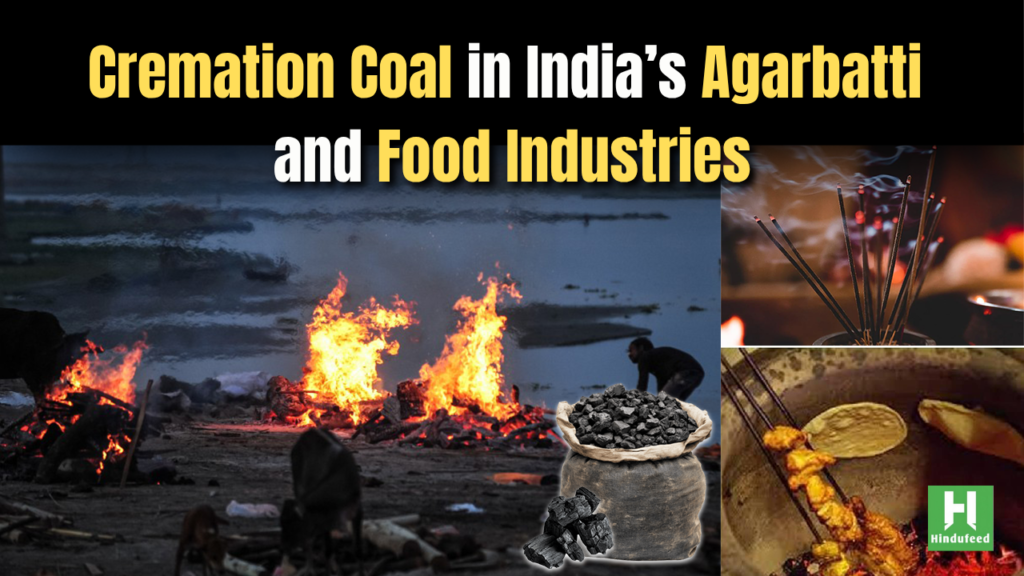
In the cultural fabric of India, the Antyesti (last rites) is the most sacred transition of the human soul. The burning pyre at a Muktidham or cremation ground is viewed as a site of ultimate detachment. However, a harrowing investigation, dubbed “Operation Koyla Part-2,” has revealed that for a shadowy network of middlemen and unscrupulous businessmen, these sites of mourning have become profitable mining grounds.
The investigation has uncovered a systematic “coal laundering” ring where the unburnt or partially burnt wood and coal from funeral pyres are being collected, processed, and sold to the masses. The destinations? The very incense sticks (agarbattis) used in household prayers and the tandoors of local restaurants. This is not just a story of a black market; it is a story of a profound breach of human dignity and public health.
I. From the Pyre to the Prayer Room: The Agarbatti Connection
The Indian incense stick industry is a behemoth, valued at nearly ₹12,000 Crore annually. In states like Bihar alone, the trade accounts for a staggering ₹800 to ₹1,500 Crore. The core component of an agarbatti is high-quality charcoal powder, which provides the slow-burn necessary to carry fragrances.
The “Zero-Cost” Raw Material
Under the cover of night, “coal pickers” enter cremation grounds to gather the remains of the day’s pyres. While traditionally these remains are immersed in sacred rivers, a significant portion is now diverted.
- The Process: The collected wood-charcoal is ground into a fine black dust.
- The Deception: Because it is essentially “free” or acquired for a pittance from complicit crematorium workers, it significantly undercuts the price of industrial charcoal.
- The Irony: Millions of devotees across five states are unknowingly lighting sticks made from the remnants of funeral pyres to offer prayers to their deities—a cycle of sacrilege that has shocked religious leaders.
II. The Restaurant Nightmare: Fueling the Tandoors
Perhaps more visceral is the revelation that this coal is finding its way into the commercial food sector. Low-end eateries and dhabas are allegedly purchasing this “cremation coal” to fuel tandoors and grills.
The Medical Risk: A Silent Pathogen Carrier
From a public health perspective, the use of cremation remains in food preparation is a biohazard.
- Biological Contaminants: Funeral pyres do not always achieve the sustained 1,000°C required for total sterilization. Residual biological matter or pathogens from the deceased can survive on porous coal surfaces.
- Chemical Toxicity: Modern pyres often involve the burning of synthetic clothes, plastics, and various chemical offerings (samagri). When this coal is re-burnt in a closed tandoor, it releases toxic fumes and heavy metals directly into the food.
- The “Ash” Flavor: The smoke from this coal carries a distinct, heavy chemical signature that is often masked by heavy spices, leaving consumers oblivious to the origin of their meal.
III. The Bihar Hub: Analyzing the 5-State Supply Chain
The “Operation Koyla” investigation highlights Bihar as a primary processing hub. The state’s geographical position allows for a seamless “Gray-Zone” supply chain that extends into Jharkhand, Uttar Pradesh, West Bengal, and Odisha.
Data Snapshot: The Economy of Ash
| Market Factor | Estimated Value / Impact |
| National Agarbatti Market | ₹10,000 – ₹12,000 Crore |
| Bihar Segment | ₹800 – ₹1,500 Crore |
| Coal Divergence Rate | Estimated 15-20% in certain districts |
| Target Demographic | Low-to-mid tier incense brands and local eateries |
| Reach | 5-State Distribution Network |
IV. The Ethical and Spiritual Fallout
In Hindu tradition, the Mukhagni (lighting of the pyre) is an act of releasing the physical form. The remains are considered Ashaucha (spiritually impure) for anything other than immersion in a river.
“Using the coal of a dead person to make a product for worship is the ultimate ‘Adharma’,” says a local priest at the Manikarnika Ghat. “It traps the essence of the deceased in a commercial cycle. It is a theft of the soul’s peace for a few rupees of profit.”
The investigation has prompted calls for the National Green Tribunal (NGT) and the Food Safety and Standards Authority of India (FSSAI) to conduct surprise audits of coal sources used in the incense and hospitality industries.
V. The Logistics of Secrecy: How the Ring Operates
The trade survives on a “Three-Tier” system:
- Tier 1 (The Pickers): Often marginalized individuals or rogue crematorium staff who sift through the pyres once families have left.
- Tier 2 (The Aggregators): Middlemen who operate small-scale grinding mills in rural areas, mixing the cremation coal with legitimate wood charcoal to avoid detection.
- Tier 3 (The Manufacturers): Small-scale agarbatti units that buy the “mixed powder” without asking questions about its origin, driven solely by the lower price point.
VI. Frequently Asked Questions (FAQ)
1. How can a consumer identify “cremation coal” products?
It is nearly impossible for a consumer to tell once the coal is ground into powder. However, agarbattis that produce an unusually “heavy” or “chemical” black smoke and are sold at significantly lower prices than reputable brands should be viewed with suspicion.
2. Is there any law against this?
While India has laws regarding the management of crematoriums, the “theft” and “re-sale” of coal fall into a legal gray area involving “theft of property” and “violation of public health norms.” The FSSAI can prosecute restaurants for using unsafe fuel sources if a direct link to illness is established.
3. What is the government’s stance?
Following “Operation Koyla Part-2,” several state governments have ordered local police to increase patrolling around burning ghats at night and have mandated that all incense manufacturers maintain “Source Certificates” for their raw materials.
Final Verdict
The “Operation Koyla” expose serves as a mirror to the darkest corners of human greed. When the sanctity of the final journey is sacrificed at the altar of a ₹1,500 Crore industry, it is a wake-up call for both regulators and citizens. Protecting the dignity of the dead is a prerequisite for a civilized society. As the investigation continues to uncover more links in this 5-state chain, the demand for transparency—from the tandoors we eat from to the incense we light—has never been more urgent.
Should crematoriums be fitted with high-security surveillance to prevent the theft of remains? Is it time for a national certification for ‘Sacred Incense’? Share your thoughts in the comments below.
