



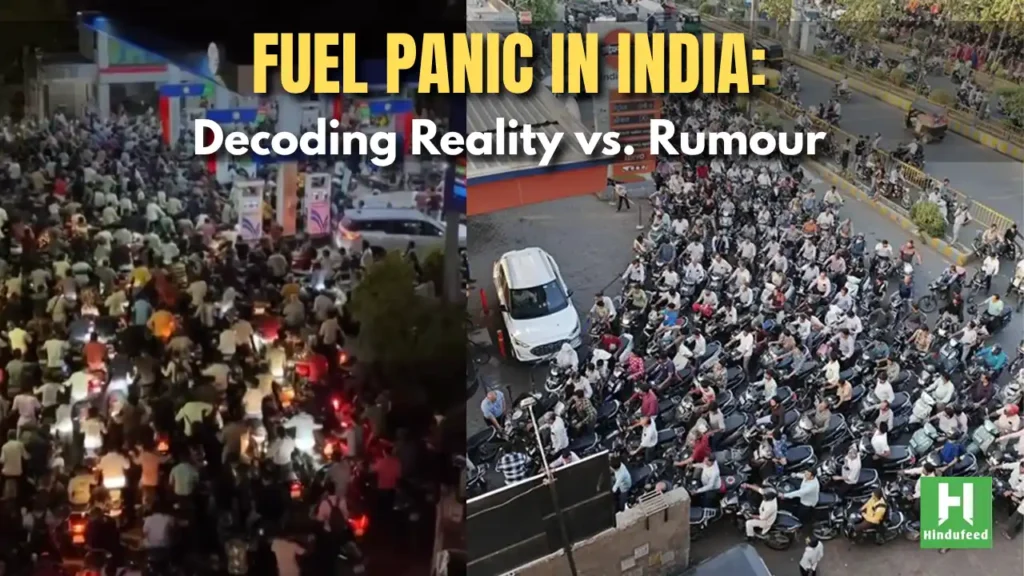
The scene at a Bharat Petroleum station in South Delhi at 11:00 PM last night looked more like a border evacuation than a routine refill. Hundreds of cars and thousands of motorcycles snaked around the block, their headlights cutting through the smog in a desperate bid to reach the nozzle. Similar scenes are playing out across India’s Tier-1 and Tier-2 cities.
What started as a ripple of concern on social media has transformed into full-blown “Panic Buying.” Driven by fears of a total maritime blockade in the Red Sea and the recent drone strikes on Saudi Arabia’s Yanbu refinery, Indian consumers are bracing for a scenario where “dry pumps” become the new normal.
I. The Trigger: Why is India Panicking?
The current hysteria is fueled by a “Perfect Storm” of geopolitical events. India imports nearly 85% of its crude oil, with a significant portion transiting through the Bab el-Mandeb strait and the Strait of Hormuz—both of which are currently “Active Combat Zones” in the 2026 Middle East conflict.
The Catalyst Events:
- The Yanbu Strike: The successful drone assault on Saudi Arabia’s western refinery has signaled that even “safe” energy hubs are now targets.
- Insurance Spikes: Global shipping insurance for tankers entering the Arabian Sea has surged by 400%, leading some private carriers to temporarily suspend voyages to the subcontinent.
- Social Media Viral Effect: Unverified videos showing “Out of Stock” boards at a few highway pumps in Rajasthan and Punjab went viral on WhatsApp, triggering a nationwide rush.
II. The Psychology of the Queue: A Self-Fulfilling Prophecy
Economics experts at IIT-Delhi warn that the current shortage is not a supply problem, but a logistics problem caused by the panic itself.
“India’s fuel delivery system is a fine-tuned machine designed for steady, predictable demand,” says Dr. Vikram Mehra, a supply chain analyst. “When the entire population decides to fill their tanks to capacity on the same Tuesday, the localized fuel depots simply cannot dispatch trucks fast enough to keep up. The pump goes dry not because the country is out of oil, but because the tanker is stuck in traffic created by the people waiting for fuel.”
In Bengaluru, the “Panic Buying” has led to secondary chaos, with food delivery services and ride-hailing apps reporting a 30% drop in active drivers as workers spend their shifts standing in fuel lines rather than fulfilling orders.
III. The Strategic Reality: How Deep is India’s Reserve?
While the visual of a long queue is terrifying, the data from the Ministry of Petroleum & Natural Gas suggests a more resilient picture. India has spent the last decade building a “Safety Net” known as the Strategic Petroleum Reserves (SPR).
The SPR Breakdown:
India’s “Underground Insurance” is stored in massive salt caverns and unlined rock bunkers across three primary locations:
- Visakhapatnam (Andhra Pradesh): 1.33 Million Metric Tonnes (MMT).
- Mangaluru (Karnataka): 1.50 MMT.
- Padur (Karnataka): 2.50 MMT.
The Math of Survival: Currently, India’s SPR holds enough crude to power the entire nation for roughly 9.5 days. When combined with the storage held by oil marketing companies (IOCL, BPCL, HPCL) in their refineries and depots, India has a total “cushion” of approximately 65 to 70 days.
This means even if every tanker in the ocean stopped moving today, the lights in India would stay on for over two months.
IV. Government Response: “There is No Scarcity”
Minister of Petroleum, Hardeep Singh Puri, issued a stern warning against hoarding and clarified the government’s stance.
“We are monitoring the Red Sea situation hourly. Our diversified sourcing—including increased intake from Russia and Latin America—means we are not solely dependent on the Persian Gulf. I urge citizens to stop panic buying; you are creating a crisis where none exists.”
Emergency Measures Taken:
- 24/7 Depot Operations: Fuel depots have been ordered to operate through the night to ensure tankers are refilled and dispatched to pumps.
- Anti-Hoarding Patrols: State police in Punjab and Haryana have been authorized to inspect “bulk buyers” who are reportedly filling large barrels and drums at retail outlets to sell at a premium later.
V. The Economic Impact: The “Oil Sandwich” Effect
While the supply is stable for now, the price is the real enemy. With Brent Crude hitting $135 per barrel, the Indian Rupee has touched an all-time low against the Dollar.
| Indicator | Pre-War (Jan 2026) | Current (March 25, 2026) | Trend |
| Petrol (Delhi) | ₹96.72 | ₹114.50 | Rising |
| Diesel (Mumbai) | ₹89.62 | ₹108.20 | Rising |
| LPG (14.2kg) | ₹903 | ₹1,250 | Critical |
| Crude Oil (Brent) | $82/bbl | $135/bbl | Volatile |
The “Oil Sandwich” refers to the double pressure of high import costs and the weakening Rupee, which creates a massive Fiscal Deficit. If the war persists, the government may be forced to choose between a massive price hike for consumers or a crushing subsidy burden on the national exchequer.
VI. Frequently Asked Questions (FAQ)
1. Is India going to run out of petrol in the next few days?
No. The shortage at individual pumps is a temporary logistical delay caused by the sudden spike in demand. The national reserves are healthy.
2. Should I fill my tank to the brim today?
Only if you genuinely need it. Topping off a half-full tank adds to the queue and prevents someone with an empty tank (like an ambulance or a delivery driver) from getting fuel.
3. Will prices go up on April 1st?
While the new financial year often brings tax adjustments, the government is likely to use “Excise Duty” buffers to prevent a massive price shock, though a marginal increase of ₹2-3 per liter is expected given the global situation.
Final Verdict
The “Fuel Panic” of 2026 is a test of India’s collective nerves. While the geopolitical situation in the Middle East is undeniably grave, the internal panic is an avoidable wound. India’s strategic reserves and diversified sourcing provide a 70-day window of safety—a window that the government is using to navigate the US-Israel-Iran war.
For the People of India, the best course of action is Vigilance, not Volatility. Trust the reserves, ignore the WhatsApp rumors, and remember that every panic-filled tank is a gallon taken away from the nation’s essential services.
Are you seeing long queues in your city? Have you noticed any ‘Out of Stock’ signs at local pumps? Share your ground-level reports in the comments below!
