



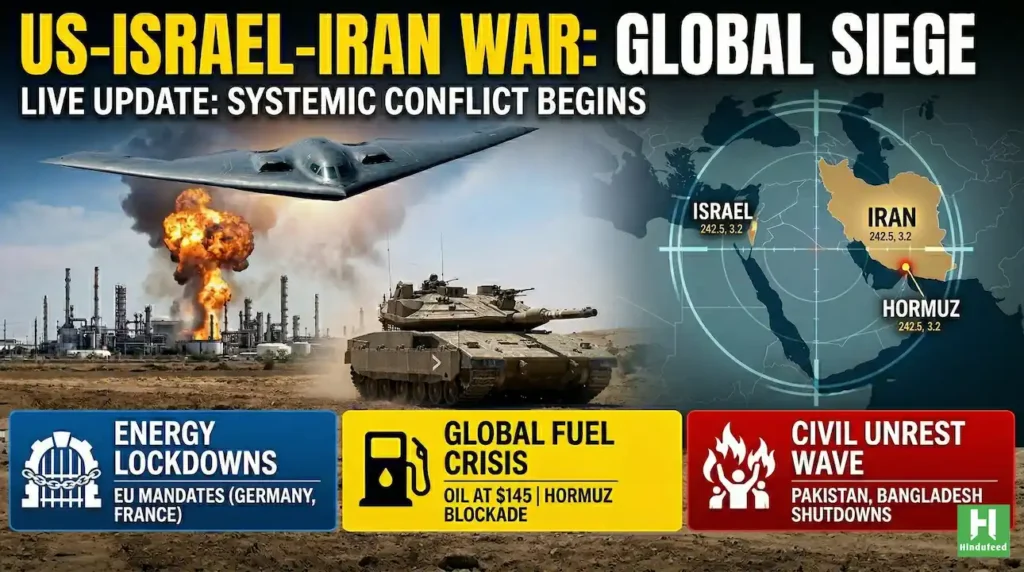
The last twelve hours have seen the most significant military and economic escalations since the onset of the conflict. What began with precision strikes has evolved into a war of attrition targeting the very infrastructure of modern civilization.
I. The War Room: Military Situation Report
The Lebanon Front: “Operation Northern Sword”
Israeli ground forces have reportedly breached the Litani River line, pushing further into central Lebanon than at any point in the 21st century. Hezbollah, bolstered by “volunteer” brigades from the Iranian IRGC, has shifted to a scorched-earth defensive strategy.
- The Incident: A massive ballistic missile volley from Western Iran targeted the Port of Haifa and the Dimona vicinity this morning. While the ‘Iron Beam’ laser defense intercepted 80% of the projectiles, three direct hits on Haifa’s chemical storage zone have triggered a localized ecological disaster.
The US Intervention: “Sentinel’s Wrath”
The US Pentagon has confirmed that a B-2 Spirit stealth bomber wing conducted “proportional” strikes on Iranian drone manufacturing hubs in Isfahan and Shiraz. This marks the first time the US has directly struck the Iranian mainland in this conflict, effectively ending the era of proxy-only warfare.
II. The Energy Chokehold: Oil at $145/Barrel
The “Energy War” establishing in our previous reports (Yanbu and Valero) has reached a tipping point.
The Hormuz Blockade
The Iranian Navy has officially declared the Strait of Hormuz a “Zone of Hostility.” Any vessel linked to the US or its allies is being intercepted or targeted.
- Global Impact: Roughly 17 million barrels of oil per day are now stranded.
- The Valero Factor: With the Port Arthur refinery in Texas still offline after Monday’s explosion, the US domestic gasoline supply is at its lowest level since the 1970s.
| Market Indicator | Current Price (March 26) | 24-Hour Change |
| Brent Crude | $145.60 | +14.2% |
| Natural Gas (EU) | €210/MWh | +22.0% |
| Gold (Spot) | $2,850/oz | +9.5% |
| Bitcoin | $31,200 | -18.0% |
III. Domestic Frontiers: “Energy Lockdowns” and Civil Unrest
As the fuel crisis deepens, several countries have invoked “Emergency Powers” to prevent total grid failure. These are not medical lockdowns, but Infrastructure Lockdowns.
1. Europe: The “Dark Nights” Protocol
- Germany & France: Governments have mandated a 4-day work week and a “Total Blackout” of non-essential public lighting after 9:00 PM. Schools in Berlin have shifted to remote learning to save on heating oil.
- United Kingdom: Already reeling from the Canterbury Meningitis Outbreak, the UK has now restricted private car travel to “Essential Services Only” in the London metro area to preserve dwindling diesel reserves.
2. South Asia: The Fuel Riot Wave
- Pakistan: Following the assassination of the LeT commander in Muridke, internal instability has reached a fever pitch. Combined with a total lack of fuel, riots have broken out in Lahore and Karachi.
- Sri Lanka & Bangladesh: Both nations have declared a “National Energy Holiday,” shutting down government offices for 72 hours as they await emergency credit lines for oil shipments.
IV. India’s Position: The G20 Emergency Summit
India has taken a central role in attempting to de-escalate the “Oil War.” Prime Minister Modi has called for an emergency G20 Virtual Summit tonight to discuss a “Humanitarian Energy Corridor.”
The “Safe Passage” Proposal
India is leveraging its “Neutrality” to propose that Indian-flagged tankers, protected by the Indian Navy’s Mission-Based Deployments, be allowed to ferry oil from the Gulf to “Neutral Hubs” in Southeast Asia. This would effectively bypass the US-Iran blockade.
“India’s priority is the stability of the global South,” said a spokesperson for the MEA. “We cannot allow a regional war to become a global famine.”
V. Live Situational Timeline (Last 12 Hours)
- 06:00 IST: Iran launches “Wave 4” of drone swarms toward US bases in Iraq and Jordan.
- 09:30 IST: Global stock markets open with a “Circuit Breaker” halt as oil crosses $140.
- 11:15 IST: Reports of a “Cyber-Blackout” in Northern Israel; power grids in Tel Aviv partially compromised.
- 14:00 IST: Turkey closes the Bosphorus Strait to all military vessels from any nation.
- 16:45 IST: Crude oil hits $145.60—the highest inflation-adjusted price in history.
VI. Expert Analysis: The “Total Retaliation” Trap
Strategic analysts suggest we are entering the “Horizontal Escalation” phase. Iran knows it cannot win a traditional naval battle against the US. Instead, it is using “Systemic Sabotage”—hitting refineries, blocking straits, and triggering cyber-attacks on western financial hubs.
The goal isn’t to take territory; it’s to make the cost of supporting Israel so high that Western domestic populations demand a ceasefire. The “Energy Lockdowns” in Europe are exactly what Tehran intended to achieve.
VII. Frequently Asked Questions (FAQ)
1. Is this the start of World War III?
In the traditional sense of trenches and vast fronts, no. But in the modern sense of a “Total War” affecting every global supply chain, many analysts believe we are already in a Global Systemic Conflict.
2. Should I withdraw cash from the bank?
While there is no immediate threat to Indian banks, the “Cyber-War” aspect of the conflict means digital payment systems could face temporary glitches. Having a small amount of emergency cash is a standard “Disaster Response” protocol.
3. Will flights be canceled?
Yes. Major airlines like Emirates, Qatar, and Air India have already re-routed flights to avoid the Middle East. Expect significant delays and a “War Surcharge” on all international tickets.
Final Verdict
The events of March 26, 2026, mark the end of the “Post-Cold War” era of cheap energy and safe shipping. As the US and Iran trade direct blows, the world is being forced to adapt to a new reality of scarcity and high-stakes diplomacy. For India, the challenge is twofold: protecting our energy security while acting as the “Global Mediator” to prevent a total economic meltdown.
Do you believe India should lead the ‘Humanitarian Energy Corridor’? Are the energy lockdowns in Europe a sign of what’s to come for the rest of us? Let us know your thoughts in the comments below.
