



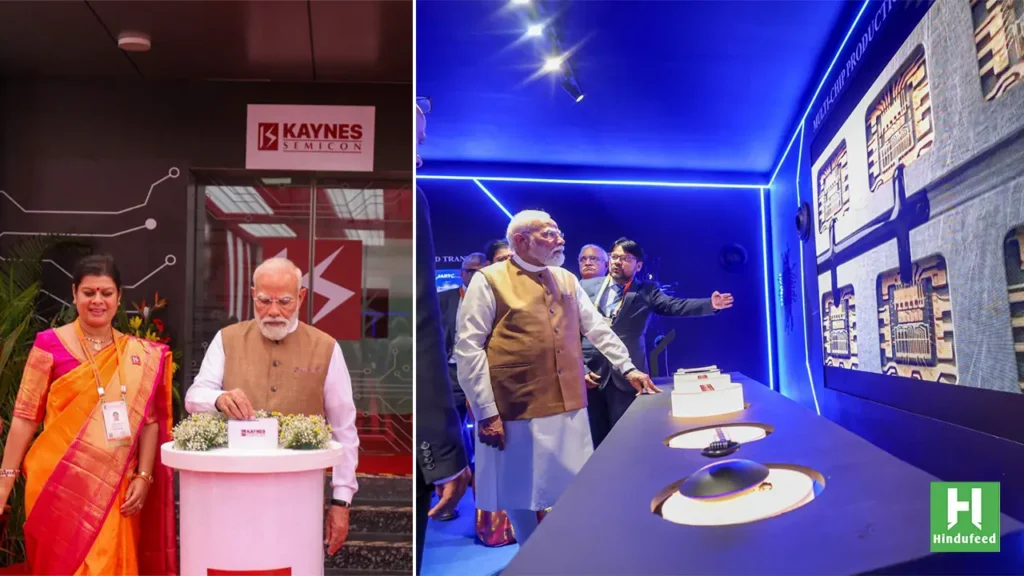
Yesterday, the skyline of Sanand, Gujarat—long known as India’s “Detroit” for its automobile dominance—officially evolved. As Prime Minister Narendra Modi pressed the haptic sensor to start the first assembly line at the Kaynes Semicon facility, he signaled the end of India’s total dependence on foreign chip packaging.
The inauguration comes exactly one month after the Micron plant began commercial production in the same region, proving that the “900-day miracle” of India’s semiconductor policy is no fluke. With a daily capacity of 6.3 million (63 lakh) chips, this ₹3,300 crore venture by Kaynes Technology is designed to power the world’s most critical sectors, from electric vehicles (EVs) to the most advanced AI servers.
I. The “Sanand to Silicon Valley” Bridge
During his address, the Prime Minister introduced a new mantra: “Digital is our Present; Semiconductors are our Future.” He noted that a significant portion of the Intelligent Power Modules (IPMs) produced at this plant is already booked for export to major tech hubs in California.
“The chips designed in Bengaluru, tested in Sanand, and used in Silicon Valley represent the new ‘Circular Tech Economy’ of India,” PM Modi remarked. “We are no longer just making in India; we are Making for the World.”
What is an OSAT Facility?
For the uninitiated, an OSAT (Outsourced Semiconductor Assembly and Test) plant is where the “brains” of electronics are perfected. It involves taking the raw silicon wafers and performing the delicate tasks of:
- Assembly: Cutting wafers and mounting them onto circuit boards.
- Packaging: Enclosing the chip in a protective casing.
- Testing: Ensuring the chip can withstand extreme temperatures and voltages.
II. The Data Snapshot: ₹3,300 Crore of High-Tech Power
| Feature | Details (Verified: March 31, 2026) |
| Total Investment | ₹3,300 Crore (approx. $351 Million) |
| Location | Sanand GIDC, Ahmedabad, Gujarat |
| Production Capacity | 6.3 Million Units per Day (at full scale) |
| Primary Products | Intelligent Power Modules (IPMs), Multi-Chip Modules |
| Jobs Created | 5,000+ Direct and Indirect Employment |
| Policy Framework | India Semiconductor Mission (ISM) 2.0 |
III. Tactical Analysis: Why This Plant Changes Everything
The global semiconductor market has been historically concentrated in Taiwan’s Hsinchu and South Korea’s Gyeonggi. By establishing a “Chip Cluster” in Sanand, India is following the “Clustering Effect” strategy.
1. Diversifying the Global Supply Chain
Following the pandemic-era chip shortages and the ongoing geopolitical volatility in the Middle East, the world is desperate for a “Resilient Third Pole.” This facility places India as a trusted partner that operates under democratic transparency.
2. Focus on “Power Semiconductors”
Instead of chasing the high-risk “2-nanometer” mobile processors immediately, the Kaynes plant focuses on IPMs. These are the “Muscle Chips” used in:
- Electric Vehicles: Managing battery output to motors.
- Industrial Automation: Powering high-speed robotic arms.
- Green Energy: Inverters for massive solar farms.
By dominating the power management segment first, India is building the foundation for the Net-Zero economy of the 2030s.
IV. The “900-Day Miracle” and Mission 2.0
A recurring theme in the PM’s address was Speed. He highlighted that from the signing of the initial MoU to the commencement of production, the Indian government has cleared approvals in record time—often under 12 months—a feat that usually takes years in the West.
Enter: Semiconductor Mission 2.0
The PM officially unveiled the broad goals of Semiconductor Mission 2.0. While 1.0 was about attracting the giants (Micron, Tata, Kaynes), 2.0 focuses on:
- The Talent Pipeline: Training 85,000 design professionals within the next 24 months.
- The Supply Chain: Incentivizing machine manufacturers and chemical suppliers to move their base to India.
- The “Chips to Startup” Program: Providing 400 universities with access to modern design tools, resulting in 55+ indigenous chips already in the pipeline.
V. Domestic Impact: The Boom of Sanand
Sanand’s transformation from an automobile hub to a silicon hub has led to a local economic surge. Real estate prices in the Sanand-Ahmedabad corridor have seen a 25% appreciation in the last year, and the demand for specialized technical diplomas has skyrocketed.
“Sanand is now India’s first integrated chip packaging cluster,” said a state industry official. “We are seeing a ‘reverse brain drain’ where engineers who went to Taiwan and Japan are returning to lead these plants.”
VI. Frequently Asked Questions (FAQ)
1. Does this mean India will now make its own smartphones entirely?
Almost. While we were already assembling phones, we were importing the “packaged” chips. With plants like Kaynes and Micron operational, the most expensive components are now being finished on Indian soil.
2. Why was Gujarat chosen for this plant?
Gujarat’s Semiconductor Policy 2022-27 was the first of its kind, offering massive subsidies on land, electricity, and water. Additionally, the existing industrial discipline of the Sanand GIDC made it the logical choice for a high-precision facility.
3. Will this lower the price of laptops and EVs in India?
In the long run, yes. By reducing import duties and logistics costs (which add about 15-20% to the cost of components), domestic manufacturing will eventually lead to more competitive pricing for Indian consumers.
Final Verdict
The inauguration of the ₹3,300 crore Kaynes plant is the definitive end of the “Wait and See” era for Indian tech. By building the backend infrastructure first through OSAT plants, India is strategically “climbing the ladder” of semiconductor complexity. As the first batch of Intelligent Power Modules leaves Sanand for California, the message is clear: The Techade is here, and it is made of Indian Silicon.
Do you think India can surpass Taiwan as a semiconductor hub by 2035? Is the ‘Sanand Model’ the right blueprint for other states? Share your thoughts in the comments below!
