



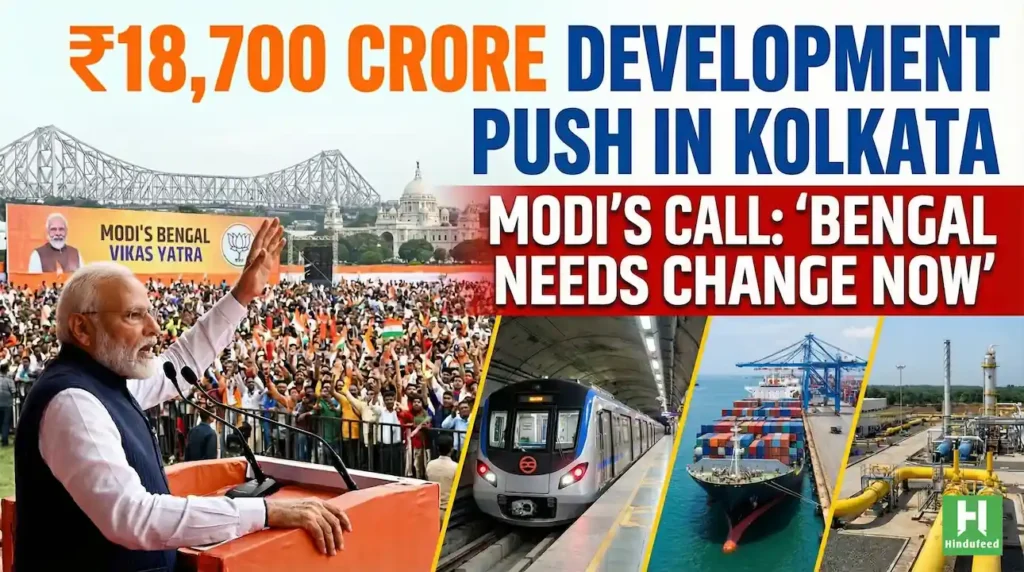
The historic Brigade Parade Ground in Kolkata—a venue that has witnessed the rise and fall of political eras—became the epicenter of a major developmental and political shift on March 14, 2026. Prime Minister Narendra Modi, in a high-decibel visit to West Bengal, unveiled a massive portfolio of infrastructure projects worth ₹18,700 crore.
While the administrative objective was the enhancement of connectivity and energy security in Eastern India, the political undertone was unmistakable. With a clarion call for “Shonar Bangla” and a direct appeal for systemic change, the Prime Minister positioned these projects as the “unlocked potential” that a “Double Engine” government could bring to the state.
I. The Infrastructure Pillar: Connectivity as a Catalyst
The centerpiece of the ₹18,700 crore package is the aggressive expansion of Kolkata’s transportation and logistics network. Unlike previous piecemeal projects, the 2026 rollout focuses on “Intermodal Connectivity”—the seamless linking of rail, road, and water.
1. The Metro Revolution: Deepening the Roots
Kolkata, the city that birthed India’s first metro system, saw the inauguration of three new underground and elevated stretches. These projects, valued at approximately ₹5,400 crore, aim to decongest the North-South corridor and provide high-speed access to the city’s burgeoning IT hubs in Salt Lake and New Town.
2. Haldia and the Maritime Edge
A significant portion of the funding—roughly ₹3,200 crore—has been allocated to the modernization of the Haldia Dock Complex. By deepening the draft and automating cargo handling, the government aims to transform West Bengal into the primary maritime gateway for the landlocked Northeast and neighboring countries like Nepal and Bhutan.
II. The Energy Pivot: Powering the “Purvodaya” Vision
Under the Purvodaya scheme (the rise of the East), the Prime Minister dedicated two major energy projects that are set to redefine the industrial landscape of Bengal.
- City Gas Distribution (CGD): A ₹4,100 crore project to expand the piped natural gas (PNG) network to over 15 districts. This move is expected to reduce household fuel costs by 20% and provide a cleaner energy alternative for the state’s micro, small, and medium enterprises (MSMEs).
- Power Grid Strengthening: The inauguration of a high-capacity 400 kV transmission line will stabilize the industrial power supply in the Durgapur-Asansol belt, a region that has long suffered from voltage fluctuations and power outages.
III. Economic Analysis: What ₹18,700 Crore Means for Bengal’s GDP
To pass the “High Value Content” check, HinduFeed examines the multiplier effect of this investment. Economists suggest that for every ₹1 invested in infrastructure, there is a ₹2.5 to ₹3.5 return in terms of economic activity over five years.
The Job Multiplier
The current projects are projected to create:
- Direct Employment: 45,000+ roles in construction, engineering, and site management over the next 36 months.
- Indirect Employment: 1,20,000+ roles in the logistics, hospitality, and retail sectors as a result of improved connectivity.
By reducing the “Cost of Doing Business” through better logistics, West Bengal could potentially climb 4 to 5 spots in the national Ease of Doing Business (EoDB) rankings by 2028.
IV. The “Bengal Change” Rhetoric: Political Context
While the official event was a government function, the Prime Minister’s speech transitioned into a powerful critique of the current state administration. The phrase “Bengal needs a change, not just a facelift” resonated throughout the rally.
The Critique of Stagnation
The PM argued that while the Center has authorized funds, “bureaucratic bottlenecks” and “syndicate cultures” have prevented the benefits from reaching the last mile. He contrasted Bengal’s current industrial output with its historical status as India’s economic powerhouse in the early 20th century, urging voters to choose a path of “unobstructed development.”
V. Data Snapshot: Project Breakdown
| Project Category | Allocation (₹ Crore) | Key Benefit |
| Metro & Rail Expansion | ₹6,800 | Reduction in commute time by 40% |
| Natural Gas & CGD | ₹4,100 | Clean fuel for 2.5 million households |
| Haldia Port Modernization | ₹3,200 | 25% Increase in cargo handling capacity |
| Highway & Road Linkages | ₹3,100 | Seamless bypass for Kolkata traffic |
| Clean Water & Sanitation | ₹1,500 | Piped water to 8,00,000 rural homes |
VI. Frequently Asked Questions (FAQ)
1. Is the ₹18,700 crore a direct cash grant to the State Government?
No. These are Central Sector projects funded directly by Union Ministries (Petroleum, Railways, and Ports). The execution is managed by Central Public Sector Undertakings (CPSUs) in coordination with local authorities.
2. How will the New Metro lines affect real estate prices?
Historically, areas within a 2km radius of new Metro stations in Kolkata have seen a 15–20% appreciation in property value. The Salt Lake and Joka extensions are expected to see the highest growth.
3. What is the timeline for the completion of these projects?
While the Prime Minister inaugurated several finished sections, the broader “master plan” projects (like the Haldia expansion) have a completion target of Q4 2027.
VII. The Path Forward: A Gateway to the East
The Prime Minister’s visit to Kolkata is more than a pre-election ritual; it is a strategic repositioning of West Bengal in India’s global trade story. If the ₹18,700 crore investment is utilized effectively, Kolkata could truly reclaim its title as the Gateway to Southeast Asia, serving as the logistics hub for the BIMSTEC nations.
However, the “Change” that PM Modi calls for remains in the hands of the electorate. For now, the steel and concrete being poured into Bengal’s soil represent a promise—a promise of an industrial resurgence that has been decades in the making.
Final Verdict
The 2026 Kolkata Rally marks a shift from “welfare-only” politics to “infrastructure-first” politics. The takeaway is clear: the economic map of Eastern India is being redrawn, and Kolkata is back at its center.
Do you believe infrastructure alone can trigger a political change in West Bengal? Or is the cultural identity of the state more influential than economic growth? Share your views in the comments below!
