



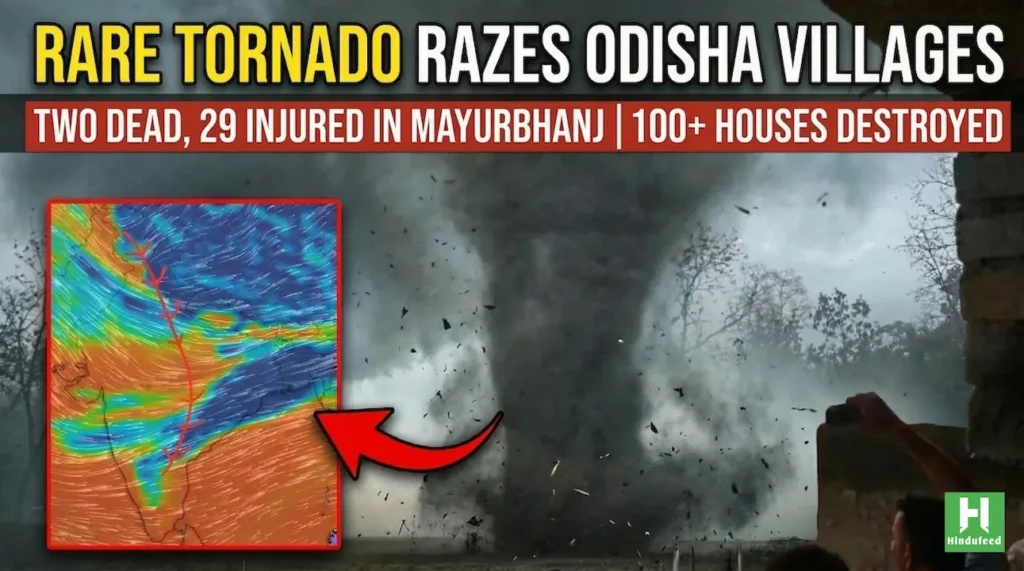
The quiet Sunday afternoon of March 15, 2026, was meant to be a period of rest for the villagers of Mayurbhanj district. Instead, it became a fight for survival. At approximately 4:00 PM, the sky over the Karanjia block turned an unnatural shade of bruised purple—a classic precursor to the “Nor’wester” storms (locally known as Kal Baisakhi) that often strike Eastern India. However, this was no ordinary storm. Within minutes, a violent, funnel-shaped whirlwind descended upon the villages along National Highway 220, leaving two dead, 29 injured, and hundreds of families homeless in its wake.
While Odisha is accustomed to cyclones, the manifestation of a land-based tornado of this magnitude is a rare and terrifying phenomenon. For 30 minutes, nature unleashed a level of fury that even the most seasoned local residents had never witnessed.
I. Ground Zero: The Descent into Chaos
The tornado’s path of destruction was concentrated across four primary villages: Kia, Kankada, Paniposi, and Dumuria. According to eyewitnesses and local administrative reports, the vortex reached estimated wind speeds of nearly 170 km/h, effectively acting as a giant vacuum that stripped the land of everything not bolted to the Earth.
The “Flying” Autorickshaw Incident
One of the most harrowing accounts came from Kankada village. Villagers watched in disbelief as an autorickshaw and a scooter were lifted off the ground by the vacuum pressure and hurled into a nearby pond. “It didn’t just push things; it picked them up,” said Dhruba Biswal, a resident of Kankada. “Motorcycles were being tossed around like toys. We hid under our beds, hearing the sound of a freight train passing through our roof.”
II. The Human Cost: Lives Cut Short
The tragedy claimed two lives, both individuals who were caught in the open and unable to find sturdy shelter as the vortex crossed the highway.
- Police Naik (45): A resident of Keonjhar district, Naik was reportedly on the road near Tato when the storm struck. His inability to find a pakka (concrete) structure in time led to his fatal encounter with the debris-laden winds.
- Malati Mohanta (50): A resident of Tato village, Malati was caught in the whirlwind’s direct path. Her death has cast a pall of gloom over the Karanjia block, as she was a well-known figure in her local community.
The Medical Crisis
Of the 29 injured, the condition of six remains “critical.” These individuals have been shifted to the Dharanidhar Medical College and Hospital in Keonjhar for specialized trauma care. The remaining 23 victims are undergoing treatment at the Karanjia Sub-Divisional Hospital, suffering from deep lacerations, fractures, and blunt force trauma caused by flying asbestos and roof tiles.
III. Infrastructure and Economic Ruin
The tornado specifically targeted the “Kutcha” (mud and thatch) houses that form the backbone of rural Odisha’s housing.
- Housing: Initial assessments suggest over 100 houses were completely decimated, while another 100 sustained partial damage to walls and roofs. In Kia village, some houses were reported to have been “completely blown away,” leaving nothing but the plinth behind.
- Power & Water: The uprooting of dozens of electric poles has plunged the Karanjia block into total darkness. Restoration teams are currently working to clear fallen trees from the NH-220 to allow for the transport of repair equipment.
- Agriculture: The timing of the storm is a massive blow to local farmers. Hectares of standing crops and local orchards, which were nearing harvest, have been flattened, threatening the livelihoods of thousands of families for the coming season.
IV. Government Response: Relief and Recovery
The Odisha state government has moved swiftly to address the immediate fallout. Chief Minister Mohan Charan Majhi announced an emergency compensation package within hours of the disaster.
| Feature | Details |
| Ex-Gratia Payment | ₹4 Lakh to the next of kin of each deceased |
| Medical Care | Free treatment for all injured in government facilities |
| Immediate Relief | Cooked food and polythene sheets for homeless families |
| Recovery Survey | Door-to-door structural assessment by Revenue authorities |
Mayurbhanj Collector Hemakanta Say and Sub-Collector Kasturi Panda are currently stationed in Karanjia, overseeing the distribution of aid. “Our priority is to ensure no family goes hungry tonight. We are setting up community kitchens and temporary shelters,” the Collector confirmed.
V. The Science: Why a Tornado in Odisha?
It is important to understand the technical “nuisance” of this storm. While cyclones are massive systems that cover hundreds of kilometers, tornadoes are micro-scale events—highly localized and incredibly intense.
The Nor’wester Connection
The India Meteorological Department (IMD) explained that a trough line stretching across the region, combined with high temperatures in the Eastern Ghats over the previous week, created extreme atmospheric instability. This “convective energy” resulted in a Supercell, which eventually spawned the tornado.
Scientific Note: While tornadoes are rare in India, the eastern belt (Odisha, West Bengal, and Bangladesh) is one of the few places in Asia where the geography allows for these violent vortices during the pre-monsoon season.
VI. Frequently Asked Questions (FAQ)
1. Is it safe to travel to Mayurbhanj right now?
The main arterial road, NH-220, is being cleared of debris. However, travelers are advised to exercise caution as the IMD has issued an Orange Warning for Mayurbhanj and surrounding districts for the next 24 hours, citing the possibility of more thunderstorms and lightning.
2. How can I help the affected villagers?
Local NGOs and the District Red Cross are coordinating relief materials. The most immediate needs are dry rations, clean drinking water, and tarpaulin sheets.
3. Why didn’t the early warning system detect a tornado?
Current radar technology is excellent at detecting large cyclones but often struggles to predict the exact “touchdown” point of a localized tornado until minutes before it happens. This tragedy highlights the need for last-mile Doppler radar integration in rural India.
Final Verdict
The Mayurbhanj tornado is a sobering reminder of the volatility of our changing climate. As the people of Kia and Kankada begin the slow process of picking up the pieces of their lives, the focus must shift from “recovery” to “resilience.” Building cyclone-resistant (and now tornado-resistant) housing is no longer a luxury for the people of Odisha—it is a necessity for survival.
Our thoughts are with the families of Police Naik and Malati Mohanta. May the community find the strength to rebuild.
