












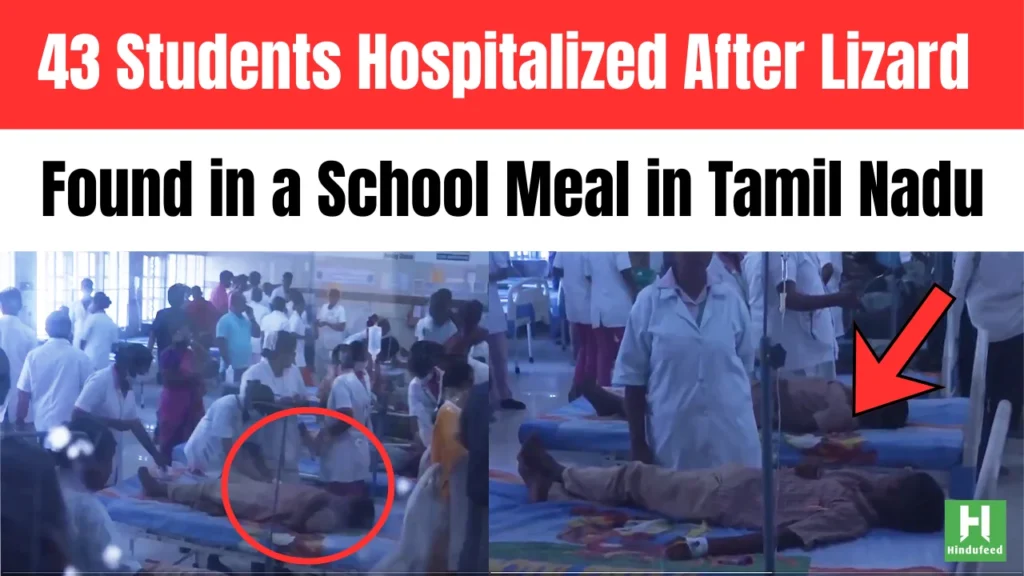
A major health scare gripped the Kavundampalayam area of Coimbatore on Tuesday, March 10, 2026, after 43 students of the Coimbatore Corporation Middle School fell ill following their midday meal. The incident, triggered by the discovery of a dead lizard in the food, has once again put a spotlight on the hygiene standards of the state-run noon meal scheme in Tamil Nadu.
While all affected students are reported to be in stable condition, the event has sparked protests from parents and prompted a high-level inquiry by the Coimbatore City Municipal Corporation (CCMC).
I. The Incident: A Discovery That Sparked Panic
The incident occurred during the standard lunch hour at the Kavundampalayam Corporation Middle School, which serves over 380 students daily under the government’s nutrition program.
- The Discovery: While eating, a student noticed a dead lizard in the sambar served on their plate. The alarm was raised immediately, and the school staff halted the meal service for the remaining students.
- Immediate Symptoms: Shortly after consumption, several students began complaining of nausea, dizziness, and vomiting.
- The Response: School authorities and the CCMC acted swiftly, deploying ambulances to transport the children to the Coimbatore Medical College Hospital (CMCH).
Medical Status of the Students
According to CCMC Commissioner M. Sivaguru Prabhakaran, a total of 43 students—30 boys and 13 girls—were admitted for observation. A dedicated team of five doctors and a nursing unit were assigned to monitor the children. As of 9:00 PM on Tuesday, hospital authorities confirmed that all students were stable and out of danger, though they remained under observation to rule out late-onset food poisoning symptoms.
II. Investigation and Administrative Action
The local administration has taken a stern view of the negligence. Commissioner Prabhakaran has ordered a comprehensive probe into the school’s catering unit and kitchen hygiene.
- Kitchen Inspection: A team from the Food Safety Department has collected samples of the contaminated meal and the raw materials stored in the school kitchen for laboratory analysis.
- Safety Circulars: In response to the scare, the CCMC announced that a new mandatory Food Safety Circular will be issued to all corporation schools in Coimbatore, reinforcing strict protocols for cleaning grains and covering cooked food.
- Accountability: Preliminary reports suggest a lapse in the “covering” protocol during the cooling period of the meal. Officials have indicated that strict action will be taken against the staff responsible for the meal preparation.
III. Is a Lizard in Food Truly Poisonous?
The Scientific Perspective
According to toxicologists, the common Indian house lizard is not inherently venomous. Unlike snakes, their skin and flesh do not contain toxins that are fatal to humans upon ingestion. However, they pose a significant biological hazard:
- Salmonella Risk: Lizards often carry Salmonella bacteria on their skin and in their digestive tracts. If a lizard is cooked in food, these bacteria can cause severe gastrointestinal distress, leading to vomiting and diarrhea.
- Psychological Reaction: In many cases, the “illness” observed in large groups is a psychological “nocebo” effect. The sheer shock and disgust of seeing a reptile in food can trigger real physical symptoms like fainting and nausea in children.
IV. A Pattern of Negligence? Regional Context
This is not an isolated event in the region. In early 2026 alone, several similar cases have been reported near Coimbatore:
- Sultanpet Incident (January 2026): Over 30 students fell ill at a government school in Odakkalpalayam after a suspected case of poorly cooked rice.
- Pollachi Scare (February 2026): A similar incident involving a lizard in the meal was reported in the Dasanayakanpalayam area.
These repeated occurrences have led political leaders and child rights activists to demand a centralized, tech-enabled monitoring system for school kitchens to ensure real-time hygiene checks.
V. Frequently Asked Questions (FAQ)
1. What should a school do if a lizard is found in a meal? The service must be stopped immediately. Any student who has already consumed the food should be moved to a medical facility for observation, even if they show no immediate symptoms. The food samples must be sealed for FSSAI testing.
2. Are the Coimbatore students out of danger? Yes. As per the latest update from the Coimbatore City Municipal Corporation, all 43 students are stable and responding well to treatment.
3. What are the FSSAI guidelines for school kitchens? FSSAI mandates that all school kitchens must have Food Safety Display Boards (FSDBs), maintain a “Clean-in-Place” (CIP) log, and ensure that all windows and vents are fitted with insect meshes to prevent reptiles and pests from entering.
Final Verdict for Readers
While the physical health of the 43 students is no longer a concern, the “trust deficit” in the noon meal scheme is growing. For parents, the priority remains the safety of their children. The Coimbatore administration’s move to audit all school kitchens is a necessary first step, but consistent oversight—not just a reaction to a crisis—is what is required to protect India’s future generation.
Does your child go to a school with a noon-meal program? What hygiene standards do you check for? Share your thoughts in the comments below.


