











For years, many of us viewed UPI-based cardless cash withdrawals as a “cheat code”—a way to get cash without exhausting our limited debit card swipes. As of this April, that loophole is closing. Here is the breakdown of the new reality.
I. The UPI-ATM Merger
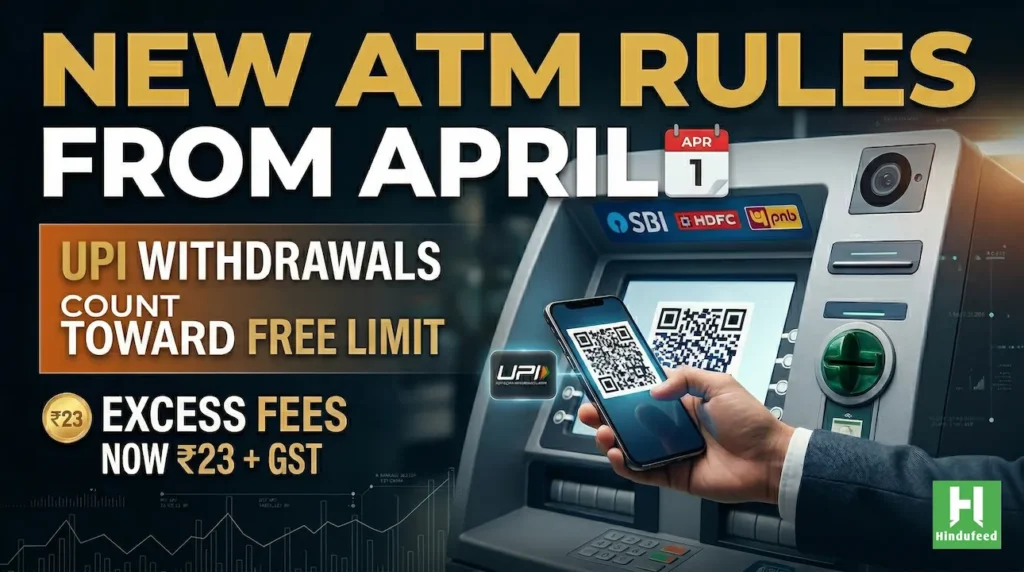
The biggest shift starting April 1 is the standardization of UPI cardless withdrawals. Major private lenders, led by HDFC Bank, have officially announced that every time you use a QR code to withdraw cash from an ATM, it will be counted as a regular ATM transaction.
Previously, many banks treated UPI withdrawals as a separate digital service or simply didn’t count them against your monthly quota. Now, they are being unified under a single fee structure. Whether you dip your chip or scan a code, the counter for your “5 free monthly transactions” will tick forward all the same.
Note: This move is designed to help banks recover the rising operational costs of maintaining physical ATM infrastructure while ensuring that digital and physical withdrawal methods are treated with parity.
II. The New Fee Structure: Breaking Down the ₹23 Rule
If you exceed your monthly free limit, the cost of convenience is going up. Following the RBI’s adjusted cap on interchange fees, most banks have now standardized their “excess” charges.
The Math of a Withdrawal
Beyond your free limit, every financial transaction (cash withdrawal) will now cost you ₹23 + GST. For a standard 18% GST rate, the total cost per withdrawal looks like this:
Total Fee = 23 + (23 x 0.18) = 27.14
Rounding to the nearest rupee, you are looking at nearly ₹27 for every extra visit to the machine.
The Metro vs. Non-Metro Divide
The RBI has maintained a strict distinction based on where you live. Your “Other Bank” limits depend on your geography:
| Location Category | Own Bank ATMs | Other Bank ATMs |
| Metro Cities* | 5 Free / Month | 3 Free / Month |
| Non-Metro Cities | 5 Free / Month | 5 Free / Month |
*Metro cities include Mumbai, New Delhi, Chennai, Kolkata, Bengaluru, and Hyderabad.
III. The Silent Killers: Non-Financial Transactions
A common mistake users make is assuming “transactions” only means “withdrawing cash.” Under the new 2026 rules, the following actions all count toward your free monthly limit:
- Checking your Balance Enquiry.
- Requesting a Mini Statement.
- Changing your ATM PIN.
If you check your balance three times at another bank’s ATM in New Delhi, you have exhausted your “Other Bank” free limit for the month without ever touching a single ₹500 note. After that, even a balance check could attract a non-financial fee (typically around ₹10–₹12 + GST).
IV. RBI’s Security Mandate: The 2FA Revolution
Security is the other half of the April 1 update. The RBI has mandated Two-Factor Authentication (2FA) for all digital payments and ATM interactions.
Starting this month, expect more “Dynamic” checks. This means your static PIN might not be enough for high-value withdrawals. Banks are now integrating biometric verification (fingerprint or face ID on your banking app) or SMS-linked dynamic tokens that must be entered at the ATM screen to finalize the transaction. This is a direct response to the rise in sophisticated “skimming” and “SIM-swap” frauds.
V. Digital Wallets: The New Cash Points
In a move toward absolute interoperability, the RBI has finally leveled the playing field for Prepaid Payment Instruments (PPIs). If you hold a full-KYC digital wallet (like those from major fintech players), you can now withdraw cash directly from ATMs using your wallet balance.
This effectively turns every ATM into a “Digital Wallet Outpost.” However, the same April 1 rules apply: these withdrawals will carry fees similar to bank accounts once you cross the interoperable limits.
VI. Sector-Wise Impact: PSU vs. Private Banks
- PSU Banks (SBI, PNB, BoB): Public sector banks are focusing on “Risk Recalibration.” PNB, for instance, is reportedly reducing daily withdrawal limits for certain Classic and Gold card categories to mitigate fraud risks.
- Private Banks (HDFC, ICICI, Axis): Private players are moving toward “High-Value Digitalization.” They are incentivizing users to stay within the digital ecosystem by making physical cash more expensive, while offering higher limits for “Premium” or “Salary” account holders.
Expert Tips: How to Avoid the “April Tax”
- The “One-Big-Withdrawal” Rule: Instead of withdrawing ₹2,000 five times a month, withdraw ₹10,000 once. It counts as one transaction rather than five.
- App-Based Balance Checks: Never check your balance at an ATM. Use your bank’s official app or a UPI app. It’s always free and won’t kill your ATM quota.
- Prioritize “Own Bank”: Always walk the extra 200 meters to find your own bank’s ATM. You get 5 free swipes there regardless of whether you’re in a metro or a village.
- Cashback at POS: Many grocery chains now allow “Cash at POS.” If you’re buying milk, ask if you can withdraw ₹1,000 at the counter. These often have different (and sometimes lower) fee structures than ATMs.
Frequently Asked Questions (FAQ)
1. Does the UPI withdrawal limit include my regular shop payments?
No. Scanning a QR code to pay a merchant is a “P2M” transaction and does not count toward your ATM limits. Only “UPI-ATM” (withdrawing physical cash at a machine) counts.
2. What if the ATM transaction fails due to a technical error?
RBI rules are clear: Failed transactions due to technical reasons (machine out of cash, link failure) cannot be counted as a free transaction or charged a fee.
3. Are senior citizens exempt from these charges?
While the RBI does not mandate a blanket exemption, many banks offer “Senior Citizen Accounts” which typically provide 10–15 free transactions per month as a loyalty benefit. Check your specific account terms.
Final Verdict
The April 2026 rules represent a strategic push by the RBI to make India a truly “Less-Cash” society. By increasing the cost of physical withdrawals and integrating UPI into the ATM counter, the regulator is nudging the population toward a digital-first lifestyle. For the consumer, the message is simple: Digital is free; Physical is a premium.


