



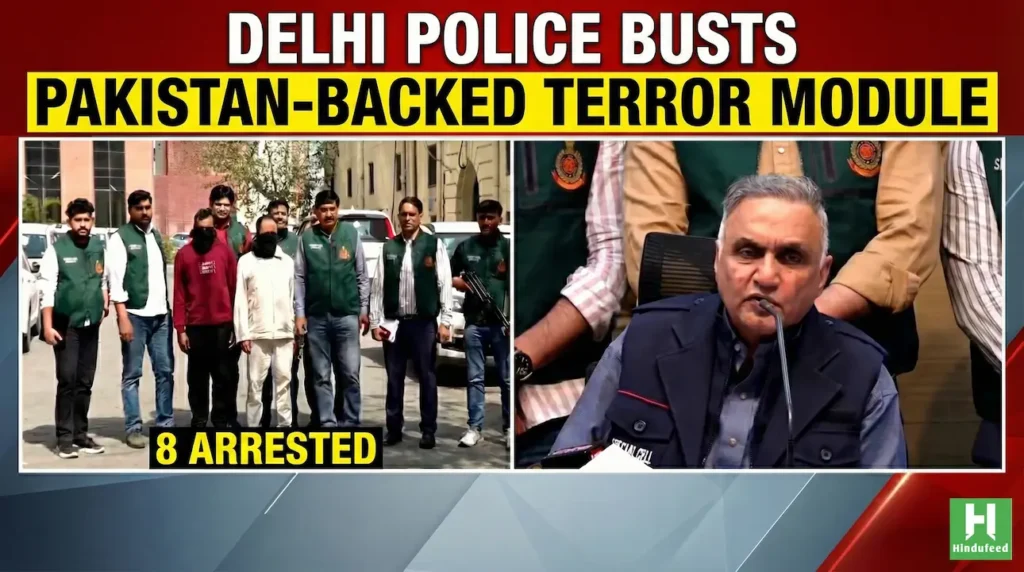
The Delhi Police Special Cell has dismantled a terror module that was planning to carry out a series of high-intensity attacks throughout India. The arrested group was Pakistan- backed and officials confirmed the arrest of 8 individual, including 7 Bangladeshi nationals and 1 Indian, that resulted from a coordinated multi-state operation was busted by Delhi Police Special Cell.
According to the module, Pakistan’s Inter-Services Intelligence (ISI) and Lashkar-e-Taiba (LeT) were the main supporters of the group, which was believed to be in the final stages of planning IED (Improvised Explosive Device) attacks.
The inputs from the intelligence indicated that the group had carried out reconnaissance of several places with a lot of foot traffic and sensitive locations. Their main targets were the Red Fort and surrounding heritage sites in Delhi and a well-known temple in the Chandni Chowk area.
Suspects’ Arrest
The investigation was sparked on February 7, 2026, when provocative “Free Kashmir” and anti-India posters appeared at the Kashmiri Gate Metro station and other locations in Delhi during a high-profile AI Summit.
A special cell followed a digital and physical trail that took them to Tiruppur, Tamil Nadu, and Kolkata, West Bengal.
- Tamil Nadu Raid: Six suspects — Mizanur Rahman, Mohammad Shabat, Umar, Mohammad Litan, Mohammad Shahid, and Mohammad Ujjalwere arrested in garment factories.
- West Bengal Arrests: Two other suspects, including Umar Farooq and Robil Ul Islam, were arrested in Kolkata.
Investigators uncovered that the suspects had been using fake Aadhaar cards to live under false names and blend with the local workers.
The Mastermind: Shabbir Ahmed Lone
The unit was said to be led by Shabbir Ahmed Lone, a native of Kashmir who is currently operating from Bangladesh.
Lone is a seasoned militant; back in 2007 he was caught with AK-47 rifles and grenades when he was about to carry out a fidayeen (suicide) attack. After being released from prison in 2019, he escaped to Bangladesh where, according to the police, he reconnected with LeT leaders to recruit and train new operatives for strikes across India.
| Item | Quantity | Significance |
| Mobile Phones | 8+ | Used for encrypted communication with foreign handlers. |
| SIM Cards | 16+ | Procured using fake documents to avoid detection. |
| Digital Evidence | Multiple Videos | Reconnaissance footage of various Indian cities. |
Security Implications
The bust highlights how cross-border terrorism remains a serious threat, and it also reveals the continued evolution of terrorist handlers’ strategies by exploiting third countries, like Bangladesh for recruitment. The fact that illegal immigrants with forged documents were used similarly indicates a major loophole in the verification which the Special Cell is now focusing on.
Delhi Police have brought all eight accused from other states to the national capital for further questioning so that they can thoroughly investigate the terror network and also Identification of any remaining “sleeper cells” in different states is another aspect.
