












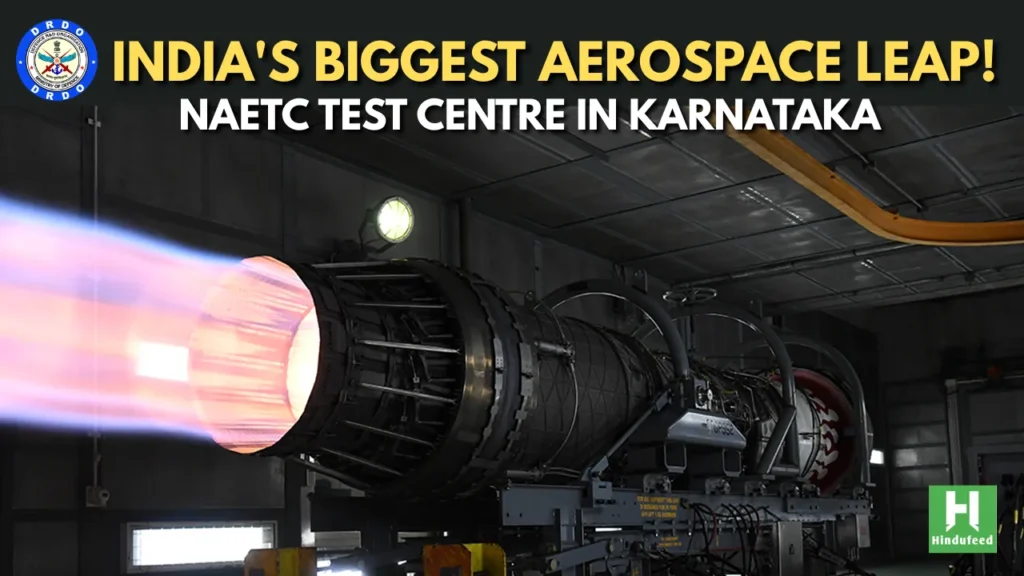
For decades, Indian aerospace engineers have faced a humiliating reality: every time a home-grown engine like the Kaveri or the Manik reached a critical stage of development, it had to be crated up and shipped to the Gromov Flight Research Institute in Russia or facilities in France for high-altitude testing. This dependency didn’t just cost millions in foreign exchange; it cost time.
The wait times for testing slots in foreign labs often spanned years, dragging India’s fighter jet programs into decades of delay. Today, that era of dependency begins its sunset. The DRDO’s Gas Turbine Research Establishment (GTRE) has issued a Request for Information (RFI) to establish the National Aerospace Engine Test Centre (NAETC)—a massive state-of-the-art complex dedicated to simulating the harshest flight conditions on earth, right here in India.
I. What is the NAETC? (The Science of Simulation)
You cannot simply bolt a jet engine to the ground, turn it on, and call it a success. An engine that works perfectly at sea level in the humid air of Tamil Nadu might flame out in the thin, freezing air at 50,000 feet over the Himalayas.
The NAETC will be an Altitude Test Facility (ATF). Its primary job is to create “synthetic sky.” By using massive compressors and refrigeration units, the facility can simulate:
- Air Pressure: Mimicking altitudes from sea level to 60,000 feet.
- Temperature: Simulating the -50°C temperatures of the stratosphere.
- Mach Speeds: Testing how the engine breathes when the aircraft is moving at supersonic speeds.
II. The Karnataka Hub: Why Chitradurga?
The RFI specifies that this facility will likely be housed in the Chitradurga Aeronautical Test Range (ATR) in Karnataka. Karnataka is already the undisputed aerospace capital of India, housing HAL, GTRE, and ADA.
Chitradurga offers the vast, open land required for a project of this scale. Testing jet engines is incredibly energy-intensive and noisy. A dedicated “Science City” in Chitradurga allows the DRDO to build massive power sub-stations and cooling towers without the logistical nightmares of a congested city like Bengaluru.
III. The Kaveri Lesson: Why We Need the NAETC
The ghost of the Kaveri Engine project haunts every Indian defense discussion. Critics often call it a failure, but technically, the Kaveri achieved 90% of its goals. Its downfall was the final 10%—the fine-tuning required after high-altitude testing.
Because India lacked an ATF, every minor adjustment required a trip to Russia. If a sensor failed during a test in Moscow, the engine had to be shipped back to Bengaluru, fixed, and then sent back again. This cycle added 15 years to the project. The NAETC ensures that the engines for the AMCA (Advanced Medium Combat Aircraft) and the Tejas Mk2 do not suffer the same fate.
IV. Data Snapshot: The Global “Engine Club”
Only a handful of nations possess the infrastructure to fully test and certify a clean-sheet jet engine design.
| Country | Key Testing Entity | Status |
| USA | Arnold Engineering Development Complex (AEDC) | Global Gold Standard |
| Russia | CIAM / Gromov Institute | Primary testing site for India (current) |
| France | DGA Essais de Propulseurs | High-end European hub |
| UK | Rolls-Royce (Derby/Bristol) | Private-Public Excellence |
| China | SBWRI (Shenyang) | Rapidly expanding capacity |
| India | NAETC (Proposed) | Joining the Elite Tier |
V. Technical Specs of the RFI
The DRDO is not looking for a small lab; they are looking for an industrial-scale complex. The RFI invites private Indian players and global aerospace giants to provide solutions for:
- Massive Air Intake Systems: Capable of sucking in hundreds of kilograms of air per second.
- Exhaust Treatment: Systems to cool down 1,500°C exhaust gases instantly to protect the facility.
- Real-time Telemetry: Thousands of sensors capturing data at millisecond intervals.
- PPP Model: The RFI hints at a Public-Private Partnership, encouraging firms like Tata Aerospace, L&T, and Godrej to invest and manage the facility alongside the DRDO.
VI. Geopolitical Impact: The End of “Technical Veto”
When India depends on another country for testing, that country holds a “technical veto” over India’s defense progress. If relations sour, or if a foreign power wants to slow down India’s stealth jet (AMCA), they can simply delay the testing slots.
With the NAETC, India achieves Aerospace Sovereignty. We will be able to test not just military engines, but also:
- Civilian Turbofans: For India’s future regional transport aircraft (RTA).
- Marine Gas Turbines: For the Indian Navy’s future destroyers.
- UAV Engines: For high-altitude long-endurance (HALE) drones.
VII. Frequently Asked Questions (FAQ)
1. How long will it take to build the NAETC?
Given the RFI status, we are looking at a 2-year design phase followed by 4-5 years of construction. We can expect the first “test fire” at the facility by 2030-2031.
2. Will this help in the co-development of the GE-F414 engine?
Yes. While the GE engine is an American design, having an indigenous testing center allows Indian engineers to perform their own maintenance and “tropicalization” tests without sending the engines back to the US.
3. Is this related to the AMCA stealth fighter?
Absolutely. The AMCA requires a 110kN thrust engine. Designing such a powerhouse is impossible without a local high-altitude test bed. The NAETC is the foundation upon which the AMCA will fly.
Final Verdict
The issuance of the RFI for the NAETC is the moment India stopped being a “buyer” and started the serious journey of becoming a “builder.” You cannot build a house without a foundation, and you cannot build a jet engine without a test center.
By grounding this project in the technological soil of Karnataka, the DRDO is ensuring that the “heart” of our future fighter jets will finally be truly Indian. It is a leap that doesn’t just promise independence—it guarantees it.
Is this the missing piece of the puzzle for the Indian Air Force? Should India have built this 20 years ago? Let us know your thoughts in the comments!


