












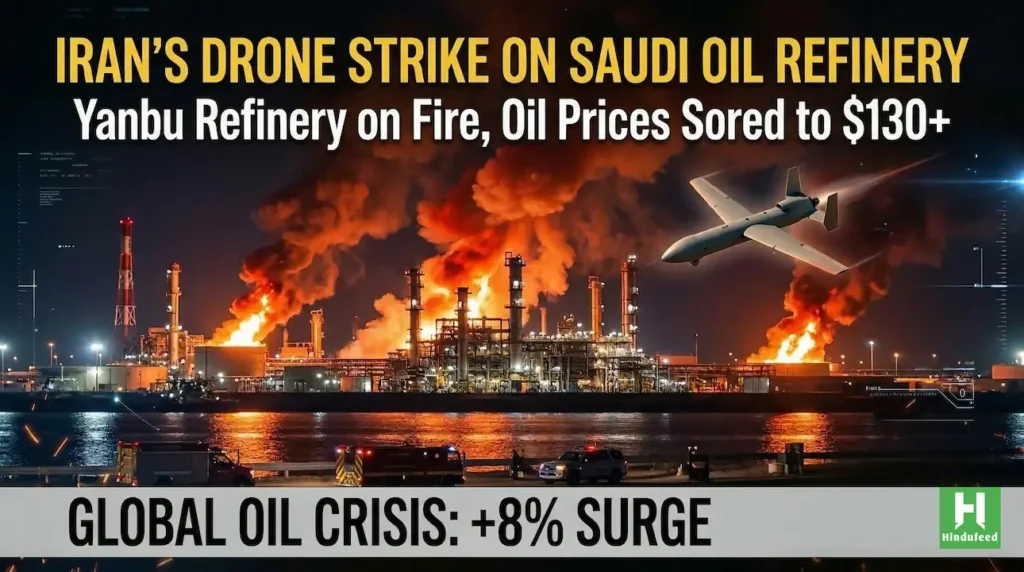
At approximately 02:15 AM local time, the night sky over the industrial port of Yanbu was illuminated by a series of high-intensity detonations. According to the Saudi Ministry of Energy at least five “suicide drones” believed to be advanced long-range variants of the Shahed-series targeted the refinery’s primary distillation units and storage tanks.
While Saudi Aramco’s rapid-response teams managed to contain the fires within four hours, the psychological and economic damage was immediate. The strike marks a definitive shift in Iran’s strategy: following the assassination of their security chief and the strike on the Bushehr plant, Tehran has officially moved to a “Total Retaliation” phase targeting any regional infrastructure that supports the Western-aligned energy block.
I. The Incident Breakdown: Saturation and Penetration
Military analysts believe the success of the Yanbu strike was due to a “Saturation Tactic.” The drones did not fly in a single cluster; they were launched from multiple directions, including the Red Sea, likely from “mother ships” disguised as commercial vessels.
The Damage Report:
- Direct Hits: Two drones struck the Atmospheric Distillation Unit, which is critical for separating crude oil into various components like gasoline and diesel.
- Storage Fires: A secondary drone hit a fuel-oil storage tank, resulting in a black smoke plume visible from satellite imagery across the Hijaz region.
- Production Halt: As a “precautionary measure,” Saudi Aramco has temporarily suspended operations at the Yanbu site, which processes roughly 400,000 barrels per day (bpd).
II. The “Epic Fury” Context: Why Now?
The Yanbu strike did not happen in a vacuum. It is part of the third wave of Iranian retaliation following the death of Supreme Leader Ali Khamenei in February 2026 and the subsequent Israeli ground invasion of Lebanon.
The Timeline of the Retaliation Wave:
- March 16: Israel launches ground operations in South Lebanon.
- March 17: Iranian Security Chief Ali Larijani is killed in a precision strike.
- March 18: Projectile strikes near the Bushehr Nuclear Plant; Iran vows a “crushing response.”
- March 19: RT journalists are wounded in Khiyam; Russia warns Israel of “unintended consequences.”
- March 20 (Today): The Yanbu Refinery is hit, signaling that the “Resistance Axis” is widening the battlefield to include the Red Sea corridor.
III. Official Statements: The War of Words
The Saudi Ministry of Energy:
“This act of sabotage does not only target the Kingdom but the security of global energy supplies. We call upon the international community to take a firm stand against these cowardly attacks that threaten the global economy.”
The IRGC (Islamic Revolutionary Guard Corps):
In a brief statement on their official Telegram channel, the IRGC hinted at responsibility without a formal admission:
“The era of ‘hit and run’ is over. Those who provide their soil and skies for the Zionists to strike the heart of the Resistance must understand that their glass houses are no longer safe.”
The White House (United States):
Presidential spokesperson confirmed that the U.S. is “consulting with regional partners” and has moved a Carrier Strike Group closer to the Bab el-Mandeb strait to secure maritime trade routes.
IV. Global Economic Impact: $135 Per Barrel?
The most immediate effect of the Yanbu strike was felt in the markets. Crude oil prices, already volatile due to the Lebanon invasion, surged by 8% within an hour of the news reaching the trading floors.
| Market Indicator | Pre-Strike (March 19) | Post-Strike (March 20) | Change |
| Brent Crude | $112.50 | $126.80 | +12.7% |
| WTI (U.S. Oil) | $108.00 | $121.40 | +12.4% |
| Gold (Spot) | $2,450/oz | $2,610/oz | +6.5% |
| Shipping Insurance | Standard | War-Risk Premium (+300%) | Critical |
The “India Factor”
For India, which imports over 80% of its oil, the Yanbu strike is a direct threat to domestic inflation. If the Red Sea remains a high-risk zone, the diverted shipping costs around the Cape of Good Hope will add an estimated ₹5-7 per liter to petrol and diesel prices in the coming weeks.
V. The Tech: The Rise of the “Red Sea Drone”
The drones used in the Yanbu strike represent a technological leap. Experts at Janes Defense suggest these units were equipped with Electronic Warfare (EW) resistant GPS, allowing them to bypass the jamming systems usually protected Saudi refineries.
Technical Note: The drones likely used “Terrain Contour Matching” (TERCOM) during their final approach, flying as low as 20 meters above the sea to stay beneath the radar horizon of the Patriot missile batteries.
VI. Frequently Asked Questions (FAQ)
1. Will this lead to a direct war between Saudi Arabia and Iran?
While both nations have avoided direct “state-on-state” war for decades, the 2026 conflict is different. With the Supreme Leader’s death, the internal power structure in Iran is increasingly dominated by hardline IRGC generals who view an “Energy War” as their only leverage against Western sanctions.
2. Is the Yanbu Refinery completely destroyed?
No. Initial reports suggest the damage is localized to two units. However, the interconnected nature of a refinery means that a hit on one unit can halt the entire flow for weeks to ensure safety and repairs.
3. How does this affect the 2026 Lebanon War?
The strike on Yanbu is designed to distract the West. By forcing the U.S. and its allies to focus on protecting oil assets in the Gulf and Red Sea, Iran hopes to reduce the military pressure on Hezbollah in Southern Lebanon.
Final Verdict
The strike on the Yanbu Refinery is the opening bell of a new, darker chapter in the Middle East. We are moving beyond a battle for “influence” and into a battle for “survival.” As the “Epic Fury” war spreads its wings, the world must prepare for a prolonged period of energy instability and high-stakes brinkmanship.
For the people of India and the world, the cost of the war in Lebanon is no longer a distant news headline—it is reflected in the price of the energy that powers our lives.


