










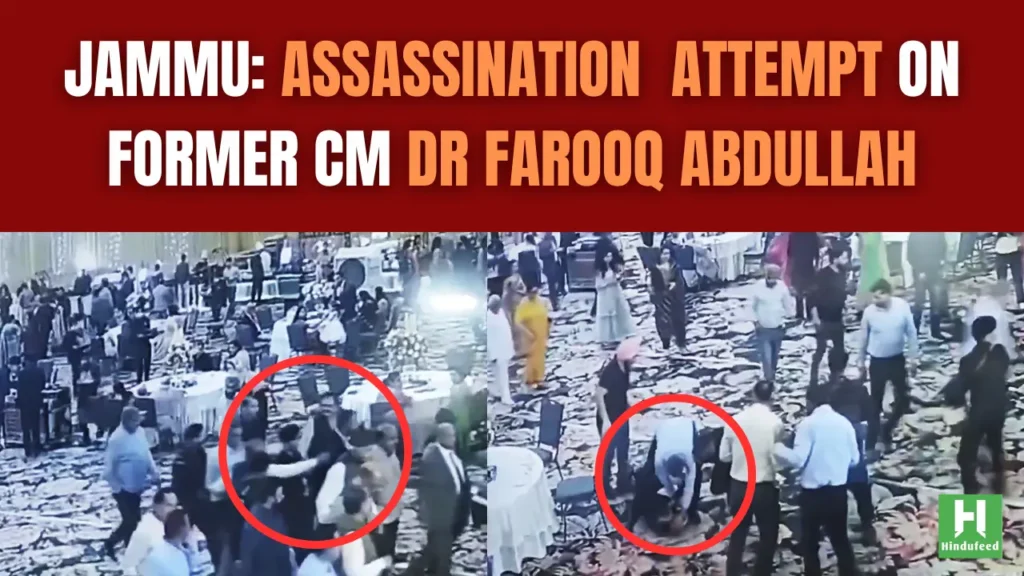
The political situation in Jammu and Kashmir was almost changed forever on the evening of March 11 2026. Something scary happened when Dr. Farooq Abdullah, the leader of the National Conference and a three-time Chief Minister survived an attempt on his life during a big wedding in the outskirts of Jammu.
As the 88-year-old leader was greeting guests, a lone gunman managed to get past the security team firing two shots at range. While the whole nation is waiting to see what happens next this incident has raised some questions about how the security team failed and the changing patterns of militancy in the region.
I. What Happened: A Wedding Turned Into a Crime Scene
The attack happened at 8:45 PM at a fancy banquet hall in the Sunjuwan area of Jammu. Dr. Abdullah was attending the wedding of a party colleague’s son an event attended by many high-ranking politicians and bureaucrats.
Some people who were there describe a man, who looked like he was in his mid-20s and was dressed in traditional formal clothes to blend in with the guests approaching Dr. Abdullah to take a picture.
As he drew within three feet, the assailant pulled a semi-automatic pistol. A Personal Security Officer from the Special Security Group spotted the gun a fraction of a second before it was fired. The officer’s quick move deflected the shooters aim. Two shots were fired; one grazed Dr. Abdullah’s shoulder while the other hit a security official. The gunman was immediately stopped by the return fire from the security team.
Dr. Abdullah was taken to the Government Medical College Hospital in Jammu, where doctors said he is stable and out of danger.
II. Security Analysis: The “Jammu Shift” and Intelligence Gaps
For a time the security focus in Jammu and Kashmir has been on the Kashmir Valley. However this incident confirms a trend that intelligence agencies have been talking about since the start of 2026: The shift of activity to the Jammu Division.
The Security Team Failed:
A Z+ security cover is the level of protection in India involving a 55-member team, including NSG commandos and local police. The fact that an armed person was able to get so close to Dr. Abdullah suggests critical failures:
- The security team did not properly check the people working at the event.
- The metal detectors at the entrance did not work properly. Were bypassed because of the large number of important guests arriving at the same time.
- Militants are now targeting social gatherings where security is often not as tight as it is at official public rallies.
III. What This Means for Politics: A Leader Who Defines an Era
Farooq Abdullah is not a politician; he is a bridge between the old guard of Indian federalism and the complex realities of Jammu and Kashmir’s modern status.
The Stability of the National Conference:
If Dr. Abdullah had been killed it would have created a power vacuum. With the region in a delicate state of administrative transition the loss of a unifying figure like Dr. Abdullah could have sparked widespread civil unrest. His survival has for now prevented a ” earthquake” in the Union Territory.
The Reaction from New Delhi:
Within hours of the attack the Union Home Ministry ordered a high-level investigation by the National Investigation Agency. Prime Minister Modi and the Home Minister both spoke to Omar Abdullah to express their relief and ensure that the people who did this would face justice quickly.
IV. The History of Threats Against the Abdullahs:
To understand how serious this event is we need to look at the context. The Abdullah family has been on the hit list of terror groups from outside the country since the 1980s.
- In 1989-1990 there were attempts on Dr. Abdullahs life during the peak of the insurgency, which forced him to leave the country for a while.
- The National Conference has lost workers and senior leaders to targeted killings over the last three decades.
- Despite the threats Farooq Abdullah has remained an advocate for the process, which has made him a primary target for those seeking to destabilize the region.
V. The Human Cost: Security Officials in the Line of Fire:
While everyone is talking about Dr. Abdullah we must also think about the heroism of the security personnel. The officer who deflected the gun, Head Constable Rajesh Kumar is currently in condition at the same hospital. His quick action saved the life of a Chief Minister highlighting the dangers of “close protection” duties in high-risk areas.
VI. Frequently Asked Questions (FAQ)
1. What is the current health status of Dr. Farooq Abdullah?
As per the medical bulletin released at 10:00 AM on March 12, Dr. Abdullah is “conscious and stable.” The shoulder injury was a superficial graze, and he is expected to be discharged within 48 hours.
2. Who was the attacker?
The NIA has identified the shooter as a 24-year-old individual from the Rajouri district. Investigations are ongoing to determine if he was a “lone wolf” or part of an organized sleeper cell.
3. Will this affect upcoming political events in Jammu and Kashmir?
While political rallies may face stricter regulations in the short term, the National Conference has stated that their democratic outreach will continue unabied. However, security protocols for all “Z” and “Z+” protectees are currently being overhauled across the UT.
VII. What Happens Next: Tightening Security
The Sunjuwan shooting is a wake-up call. It shows that even though there are big terror incidents the threat of targeted high-profile attacks is still real.
For the government the challenge is to keep things while making sure that social gatherings do not become targets for attacks. For the people of Jammu this incident is a reminder that the peace they enjoy’s fragile and needs constant attention.
Final Verdict:
Dr. Farooq Abdullah’s survival is a “miracle” for the stability of Jammu and Kashmir. However the breach that allowed a gun to get so close to him is a failure that the Indian security team must answer for.
Do you think security protocols for politicians in Jammu and Kashmir need to be more strict or will that make them more distant from the people? Let us know what you think in the comments.


