













The traditional notion of a “family” is being redefined worldwide. Marriage and having children used to be perceived as two sides of the same coin however according to the OECD Family Database this connection is dissolving in a number of areas around the globe. In fact, in quite a few countries, more children are being born to unmarried parents than to married couples.
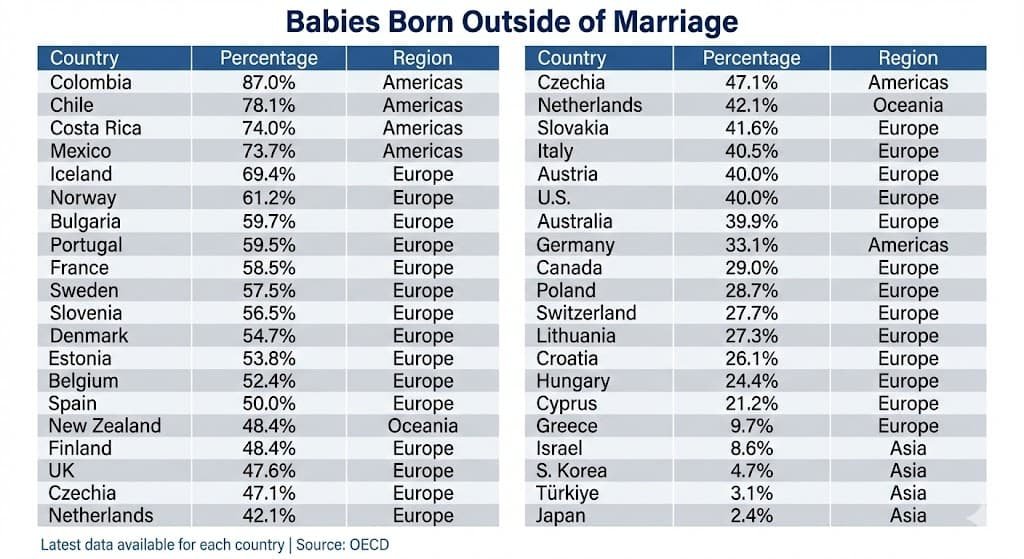
According to OECD Family Database, a clear disparity is revealed in the family structures across the world, with non, marital birth rates spanning dramatically from 87% to merely 2%.

Latin America: The Global Leader
Currently, Latin America is greatly affected by this demographic evolution. Colombia occupies first place in the world, with a very high 87.0% of children born to parents who are not formally married. This is a trend that is also seen in other countries of the region such as Chile 78.1%, Costa Rica 74.0%, and Mexico 73.7%.
In such societies, the high percentage is not necessarily indicative of a decline in the value of the family but is simply a sign that the people prefer “consensual unions” or cohabitation. Such relationships are often long, term and socially accepted but lack the legal or religious documents that a traditional marriage would have.
Here is the data from the chart presented in a table format:
| Country by Rank | Percentage | Region |
| 1. Colombia | 87.0% | Americas |
| 2. Chile | 78.1% | Americas |
| 3. Costa Rica | 74.0% | Americas |
| 4. Mexico | 73.7% | Americas |
| 5. Iceland | 69.4% | Europe |
| 6. Norway | 61.2% | Europe |
| 7. Bulgaria | 59.7% | Europe |
| 8. Portugal | 59.5% | Europe |
| 9. France | 58.5% | Europe |
| 10. Sweden | 57.5% | Europe |
| 11. Slovenia | 56.5% | Europe |
| 12. Denmark | 54.7% | Europe |
| 13. Estonia | 53.8% | Europe |
| 14. Belgium | 52.4% | Europe |
| 15. Spain | 50.0% | Europe |
| 16. New Zealand | 48.4% | Oceania |
| 17. Finland | 48.4% | Europe |
| 18. UK | 47.6% | Europe |
| 19. Czechia | 47.1% | Europe |
| 20. Netherlands | 42.1% | Europe |
| 21. Slovakia | 41.6% | Europe |
| 22. Italy | 40.5% | Europe |
| 23. Austria | 40.0% | Europe |
| 24. U.S. | 40.0% | Americas |
| 25. Australia | 39.9% | Oceania |
| 26. Luxembourg | 39.0% | Europe |
| 27. Ireland | 38.4% | Europe |
| 28. Latvia | 37.3% | Europe |
| 29. Romania | 33.9% | Europe |
| 30. Germany | 33.1% | Europe |
| 31. Canada | 29.0% | Americas |
| 32. Poland | 28.7% | Europe |
| 33. Switzerland | 27.7% | Europe |
| 34. Lithuania | 27.3% | Europe |
| 35. Croatia | 26.1% | Europe |
| 36. Hungary | 24.4% | Europe |
| 37. Cyprus | 21.2% | Europe |
| 38. Greece | 9.7% | Europe |
| 39. Israel | 8.6% | Asia |
| 40. S. Korea | 4.7% | Asia |
| 41. Türkiye | 3.1% | Asia |
| 42. Japan | 2.4% | Asia |
Nordic’s Approach
As far as Northern Europe is concerned, a high proportion of non marital births here are largely accounted for by social security and gender equality. In fact, Iceland is at the forefront with 69.4%, while Norway and Sweden are at 61.2% and 57.5% respectively.
Strong welfare countries such as these have in place laws and provide funds to ensure the rights of any child, regardless of whether or not the child’s parents are married to each other. Since couples living together without marrying are often given the same rights as those who have gotten married, getting married now is more of a personal, symbolic decision than a legal one.
The Traditionalists: Where Marriage Remains the Gatekeeper
At the other end of the scale, certain areas still tightly associate marriage with having children.
This can be clearly seen in East Asia where there is almost no concept of having children outside marriage:
- Japan: 2.4%
- South Korea: 4.7%
Likewise, in the Eastern Mediterranean, Turkey (3.1%) and Israel (8.6%) continue to demonstrate impressive adherence to tradition.
In such societies, the notion of shame, religious customs, and the absence of a state support system for single, parent families staunchly uphold marriage as the only legitimate way of having a family.
The Global Middle Ground
The Western world along with most parts of the Anglosphere are not top performers but rather stagnate right around the dataset average of 42.3%. Take for example:
- United Kingdom: 47.6%
- United States: 40.0%
- Canada: 29.0%
In these countries, the pattern is mostly depicted as “sliding into” parenthood by way of living together, where multiple couples decide to get married long after their children have been born.
Where Does India Stands
India is not in the list as the major part of the data in the chart is based on the OECD Family Database which mainly tracks marital/non, marital births of only the OECD member countries and their partners. India has not been a member of the group tracked for non, marital births.
Nevertheless, demographic statistics on a different aspect of births and marriage in India have been very recently made public, and they describe the situation in the following way:
Births Outside Marriage in India:
Researches have revealed that marriage is still the norm in India and having children outside marriage is very uncommon. Most such estimates indicate the level to be around 0.1% or even lower. This agrees with the “Low Rates” category referred to in the article for other Asian countries such as Japan and South Korea.


