











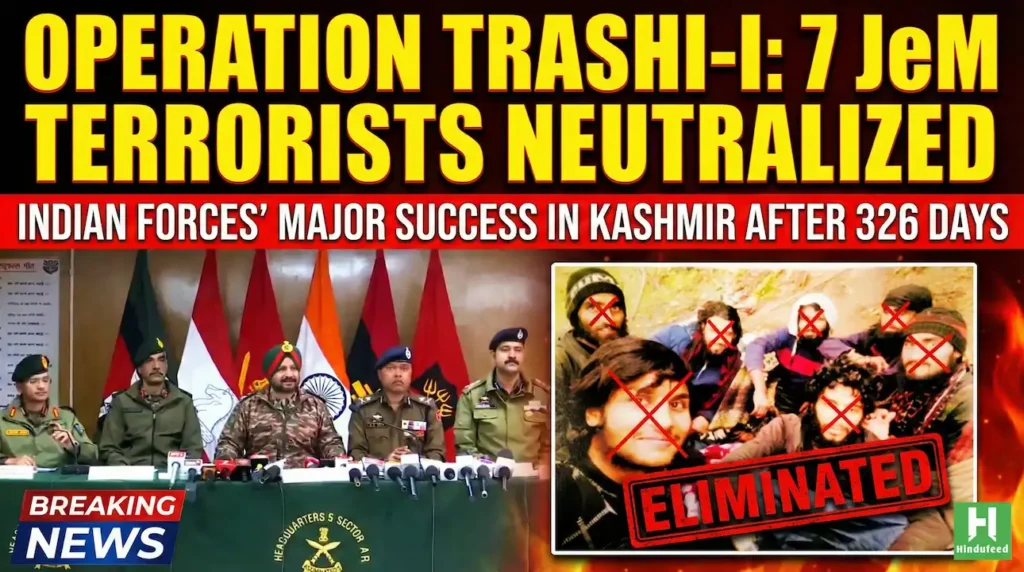
On February 22, Indian security forces successfully wrapped up Operation Trashi-I with a significant counter-terrorism victory in the Chenab Valley. They managed to neutralise the entire seven-member of Jaish-e-Mohammad (JeM) terrorist squad that had been operating in the rugged high-altitude terrain of the Kishtwar district. The 326-day-long military operation, underlining the Indian Army’s competence in intelligence-based counter-insurgency especially in harsh geographical conditions, has become a landmark in the history of Indian military.
The Operation: 326 Days in the Mountains
Throughout 326 days, joint high-altitude operations were carried out in Kishtwar. Security personnel were able to locate the militants during harsh, cold, wet weather combined with challenging terrain resulting in several battles.
Operation Trashi-I, initiated in January counted as the primary mission to expel terrorists from the secluded mountainous regions in the Kishtwar district such as Chatroo, Sonnar, Dolgam, and Dichhar belts. This came after several cordon-and-search operations had been carried out in the area over the last few weeks.
About 11:00 AM on February 22, the last stage of the operation took place in the Passerkut area of the Chatroo belt where the security forces had another round of a fierce gun battle with some surviving terrorists.
The Final Encounter: Saifullah Eliminated
Security forces shot and killed Jaish-e-Mohammed commander Saifullah during a violent gunfight in Kishtwar. Saifullah, a Pakistani terrorist was responsible for the major attacks in the Doda-Kishtwar regions and was known to have escaped on a few occasions.
For almost four years, Saifullah had been active and continuously managed to slip out of the security forces clutches by taking advantage of the rugged terrain and the locals’ support. It was reported through intelligence sources that he had crossed into Indian territory with the plan to restart terrorism in the Chenab Valley which includes the districts of Doda, Kishtwar, and Ramban.
The battle continued even after the initial skirmishes. The Indian Army’s White Knight Corps announced that the third terrorist on February 22 was neutralised in the difficult terrain of Kishtwar district and security forces have recovered the remains and weapon of the militant. When the day shortened and the last phase of operations was over, all seven militants had been accounted for.
A Joint Forces Achievement
The soldiers of the White Knight Corps, Jammu and Kashmir Police, and CRPF followed the guidance of the intelligence grid which was flawlessly set by the civil and military agencies working in close coordination and culminated in the killing of seven terrorists in Chatroo, Kishtwar.
The operation was conducted jointly by the Indian Army and Jammu and Kashmir Police, with support from the Intelligence Bureau and other security agencies. Recovering weapons and ammunition from the site were several AK-47 rifles.
Technology at the Centre of the Strategy
An outstanding element of Operation Trashi-I was the use of sophisticated military technology in a military operation which was primarily an endurance test of infantry across a difficult mountain terrain. The use of technology such as FPV drones, satellite images, RPAs/UAVs, and advanced communication systems were constantly used to support the operations.
The raid also became a talking point because of a unusual hero: a military dog named Tyson. Major General APS Bal praised the brave dog Tyson, who was the one that first started the action during a very critical phase of the operation.
Military Leadership Reflects on the Victory
At a press conference held on February 23, Major General APS Bal, General Officer Commanding of the Counter-Insurgency Force Delta, described Operation Trashi-I as a showcase of determination, having a clear objective, meticulous planning, and the Indian troops relentless efforts along with all the security agencies which were involved in countering terrorism.
Major General Bal stressed that Operation Trashi, I was a perfect example of resisting the enemy, coherence in thinking, correct planning, and smooth coordination at all levels. Besides, he acknowledged that a local support system which allowed the militants to live as long as they did was there, thus, he stated that civil, military cooperation should still continue in the region.
Broader Context: A Month of Sustained Pressure
Operation Trashi-I was not the only one. In February, forces killed six Jaish-e-Mohammed terrorists in the wider region, including one in the Udhampur area and another in Kishtwar.
Over the past 20 days, six terrorists were killed in Jammu region counter-terror operations, thus Jammu and Kashmir’s terror infrastructure had been dealt a significant blow. Two terrorists were killed on February 4 in a gunfight in the Jophar Forest, Basantgarh, as part of Operation KIYA, and another was killed in the Dichhar area of Kishtwar as part of Operation Trashi-I on the same day.
Significance and What Comes Next
Ending Operation Trashi-I has removed one of the most entrenched JeM networks in the Chenab Valley. Pakistan-based terror outfits over the years have tried the Chenab Valley as a corridor leading to the revival of militancy in the Kashmir region. Killing a commander like Saifullah with such an extensive operational background is akin to delivering a crippling structural blow rather than a mere numeric one.
The White Knight Corps communicated that the unyielding effort and determination of the forces, resulting in the killing of Saifullah and his associates, is evidence that the determination, courage, and valour of men in uniform and the intelligence agencies can overcome any obstacle.
Major General Bal remarked that the operations against terrorism will be persistent and that the forces will continue to neutralise terrorists in their area of responsibility.


