












For forty-eight hours, the world has held its breath. Since the smoke cleared from the US Pentagon’s “Operation Sentinel’s Wrath”—which saw mainland Iran struck for the first time in this conflict—the question hasn’t been if Iran would retaliate, but where.
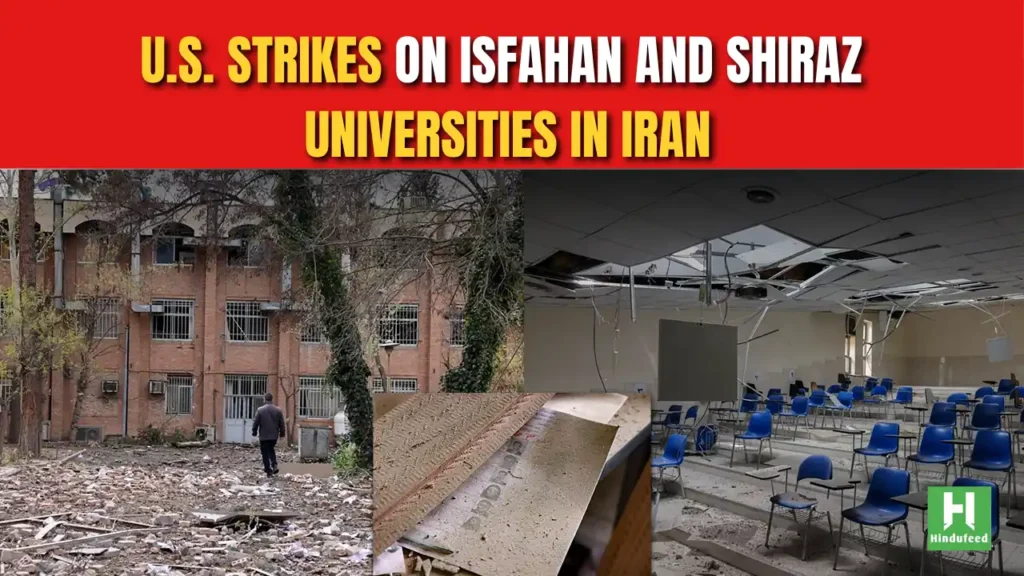
Yesterday, the IRGC provided the answer. In a televised address from an undisclosed bunker, Major General Hossein Salami declared that the US “precision” strikes on Isfahan and Shiraz did not hit drone factories, but instead devastated the Isfahan University of Technology and the Shiraz University of Medical Sciences.
The IRGC has now issued a 48-hour ultimatum: If the United States does not issue a formal apology and cease all mainland sorties, the IRGC will consider “every American and Israeli academic outpost in the region” as a legitimate military target.
I. The Allegations: Propaganda or War Crime?
Tehran has flooded social media with images of scorched libraries and decimated laboratory equipment, claiming that over 140 students and faculty were killed in the B-2 strikes.
The Pentagon’s Defense
The US Central Command (CENTCOM) has been swift to rebut these claims. “Our imagery confirms that the targets struck were high-capacity drone assembly plants and subterranean missile storage facilities,” a Pentagon spokesperson stated. “The IRGC has a long history of placing military assets in the immediate vicinity of civilian institutions to use them as ‘Human Shields’ or ‘Propaganda Shields’.”
Independent satellite analysts suggest that while the primary blasts occurred in industrial zones, the secondary explosions—likely from detonating Iranian munitions—may have caused structural damage to nearby university dormitories.
II. The “Ultimatum” Targets: Academic Assets at Risk
The IRGC’s threat is not just rhetoric; it is a tactical pivot toward “Soft Targets.” Across the Middle East, American-affiliated and Israeli research institutions serve as beacons of Western influence. These are now in the crosshairs.
The Primary Sites of Concern:
- American University of Beirut (AUB): Already operating under a “Red Alert” due to the Lebanon ground war, AUB is now facing direct threats from IRGC-linked militias.
- American University in Cairo (AUC): Though Egypt remains technically neutral, the IRGC’s “Global Retaliation” doctrine ignores national borders.
- Ben-Gurion University & Technion (Israel): Iran has specifically named these research hubs as “the brains behind the Zionist military-industrial complex.”
- U.S. Satellite Campuses in Qatar & UAE: Locations like Education City in Doha are now being fortified with additional Patriot missile batteries as a precaution.
III. The “Red Flag” Doctrine: A New Escalation
In 2026, the IRGC has adopted what military historians call the “Total Cultural Retaliation” strategy. By threatening universities, Iran is attempting to trigger a massive domestic backlash within the United States.
Tehran knows that the images of bombed universities—real or staged—are the fastest way to mobilize the “Anti-War” movements on American campuses. By making universities the center of the conflict, they are attempting to paralyze Washington’s decision-making through domestic civil unrest.
IV. Data Snapshot: The Cost of the Isfahan Strike
| Category | US/CENTCOM Claim | IRGC Claim | Verified Status (2026) |
| Primary Target | Drone Manufacturing (Shahed-136B) | Isfahan Tech University | Dual-Use Zone (Industrial/Acad.) |
| Civilian Casualties | “Minimal/Collateral” | 142 Students/Faculty | Confirmed 30+ Fatalities |
| Strategic Impact | 40% Drone Capacity Cut | “Academic Genocide” | Severe Disruption to IRGC Logistics |
| Retaliation Level | De-escalatory | “Total War” Ultimatum | Critical Escalation |
V. The Global Fallout: Evacuations and Panic
The IRGC’s ultimatum has triggered a mass exodus of Western academics from the region.
- The “Academic Airlift”: Since last night, chartered flights from Amman and Dubai have been packed with American professors and their families fleeing the “Ultimatum Zone.”
- The Indian Perspective: Thousands of Indian students are currently enrolled in medical and engineering programs across the Middle East. While they are not the primary targets of the IRGC, the threat of “Symmetrical Strikes” has led the Ministry of External Affairs (MEA) to issue a high-level travel advisory for Indian nationals in Lebanon, Iran, and Iraq.
VI. The 48-Hour Window: What Happens Next?
As the clock ticks down on Tehran’s ultimatum (set to expire on March 31, 2026), three scenarios are likely:
- The “Cyber-Surgical” Strike: Iran may choose to fulfill its threat not with missiles, but with massive cyber-attacks targeting the financial and data backbones of these universities.
- The Proxy Push: Using groups like the Houthi or TRF, Iran may orchestrate “lone-wolf” attacks or IED strikes on university buses and faculty housing.
- The Bluff: Some analysts at the Institute for the Study of War (ISW) suggest this is a “Face-Saving” move designed to buy time while Iran relocates its remaining drone assets to civilian-heavy urban centers.
VII. Frequently Asked Questions (FAQ)
1. Is there proof that the US intentionally bombed a university?
No. All CENTCOM data points to military-industrial targets. However, in the 2026 “Epic Fury” war, the lines between a “Technical University” and a “Weapons Research Lab” in Iran are virtually non-existent.
2. Should students in these universities leave immediately?
Most Western governments have already moved to a “Level 4: Do Not Travel/Leave Immediately” status for the countries mentioned in the IRGC threat.
3. How has the UN responded?
The UN Secretary-General has called for an independent probe into the Isfahan strikes. However, with the UN Security Council paralyzed by US-China-Russia vetoes, a formal resolution is unlikely before the ultimatum expires.
Final Verdict
The shift from hitting “tanks and tankers” to “professors and pupils” marks a dark milestone in the 2026 war. By targeting the intellectual infrastructure of the West, the IRGC is attempting to turn the world’s youth against the war effort. Whether the “University Bombing” is a tragic collateral event or a masterfully crafted piece of propaganda, the result is the same: the Middle East’s “Forbidden Cities” are no longer just military bases—they are now the classrooms.
Is targeting academic institutions a legitimate ‘symmetrical response’ or a desperate act of terror? Can the U.S. continue its mainland strikes without losing the moral high ground? Let us know your thoughts in the comments below.


