












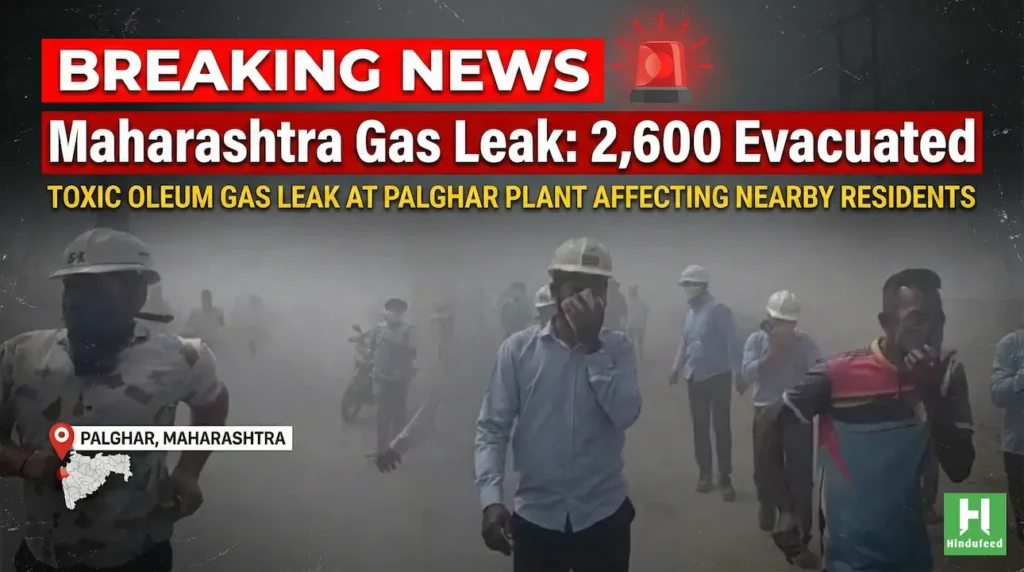
A thick cloud of poisonous gas spread through Boisar industrial belt on March 2, 2026 after tanks ruptured at a factory in Palghar, Maharashtra. Fumes formed from leaking Oleum, also known as fuming sulfuric acid and began drifting across the industrial zone which led to a mass evacuation of over 2,000 people, including hundreds of school students as well as nearby residents of the villages. The sky turned hazy white as emergency crews sealed off roads and set up medical checkpoints. People coughed, eyes burned, some stumbled while walking out under smoky air. Hours passed before winds finally began to clear the vapours hanging low over factories.
The Incident
Around two in the afternoon fumes began escaping from a plant run by Bhageria Industries Ltd, once known as Zenith Chemicals located in the industrial zone of Tarapur MIDC (Maharashtra Industrial Development Corporation) area.
A leak began from a storage unit holding 2,500 litres of oleum. Because winds were strong that day the gas moved fast, which appears as a dense-suffocating white cloud spread rapidly affecting a radius of nearly 5 kilometers.
What is Oleum?
Sulfur trioxide mixed with sulfuric acid creates Oleum. When it leaks into the air, it reacts with atmospheric moisture to form a fine mist of sulfuric acid. These appear as thick-white smoke. Breathing it harms the lungs; contact hurts eyes and skin just as badly. Exposure can cause severe coughing, difficulty breathing, and chemical burns.
Massive Evacuation
Fumes crept into neighborhoods and schools nearby. When they did, officials set their emergency response in motion without delay
1,600 students were successfully evacuated from the nearby school as the cloud approached near Tarapur Vidyamandir School
Over 1,000 employees at Bhageria Industries along with staff from nearby plants were ordered to leave their posts immediately.
People living close by including Salwad and Pasthal Village got warnings through posts online and loudspeakers telling them to remain inside or move in the opposite direction of the wind.
Emergency Response and Containment
The response involved a multi-agency effort though the sheer density of the smoke initially made it difficult for teams to reach the source
Starting off National Disaster Response Force (NDRF) and Bhabha Atomic Research Centre (BARC) took charge when disaster struck. Firefighters arrived soon after, meanwhile officers from the local police kept things steady on the ground.
Responders wore Self-Contained Breathing Apparatus (SCBA) to enter the “hot zone.” They utilized sandbags to surround the leaking tank and suppress the fumes, as pouring water directly on oleum can trigger violent chemical reactions.
By early evening, Palghar Superintendent of Police (SP) Yatish Deshmukh confirmed that 90–95% of the spillage had been covered and the leak was effectively stopped.
Health Risks and Safety Guidance
Despite the scale of the panic, the rapid evacuation prevented a mass-casualty event. Few people ended up in hospital with minor eye irritation and trouble breathing. Their state stayed steady afterward. Some needed care but nothing worsened over time.
District Collector Dr. Indu Rani Jakhar suggested holding a damp cloth over your mouth. Rinse eyes straight away using fresh water and keep at it for about 15-20 minutes if exposed.
A Recurring Fear in Tarapur
Something similar happened before just months back in August 2025, 4 people died when nitrogen leaked at another plant in Tarapur. Now, eyes turn again to how safe factories really are in Palghar. People living nearby along with community groups want closer checks on old equipment across MIDC areas so small dangers don’t grow. Because close calls keep showing up where machines wear thin.
As of the night of March 2, the area remains under monitoring, and a technical investigation into the cause of the tank failure is underway.


