



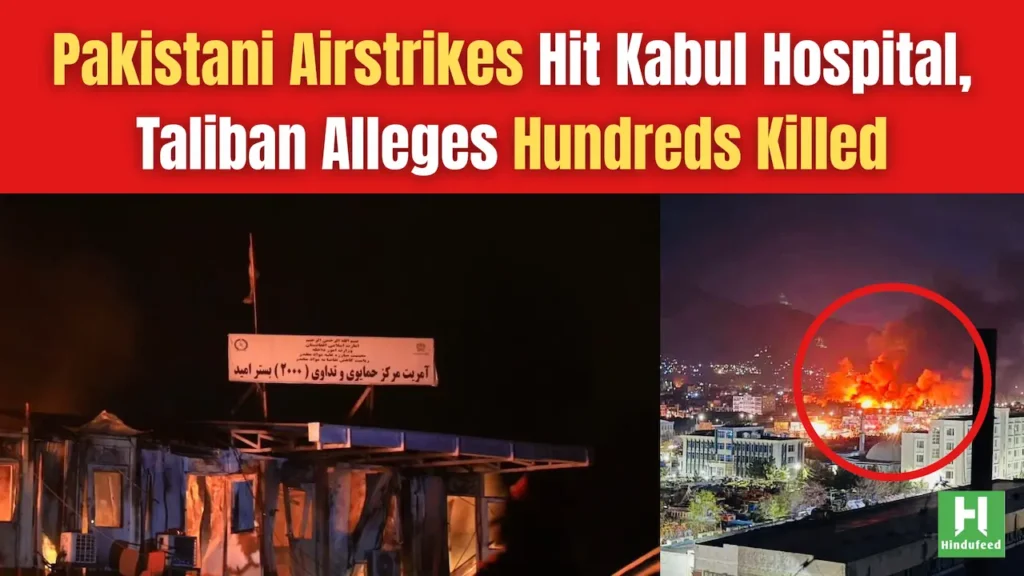
The holy month of Ramadan is meant to be a time of peace, reflection, and community. But on the 28th night, the 3,000 patients and staff at Kabul’s Omid Addiction Treatment Hospital found themselves in a real-life doomsday.
It was around 9:00 PM local time on Monday, March 16, 2026. Families across the Afghan capital had just broken their daily fast. At the Omid hospital, patients were gathering in their wards and dormitories. Then, the anti-aircraft guns began to fire. Moments later, the sky tore open. Multiple powerful explosions reduced the vast 2,000-bed facility to a sprawled field of burning debris.
The Afghan Taliban government claims that at least 400 people were killed in a targeted Pakistani airstrike. Nearly 250 others were injured. The hospital, formerly a U.S. military base known as Camp Phoenix, was a place where young men, rounded up from across Kabul, were given a rare chance at rehabilitation. After that night, it was a tomb.
Doomsday in a Dormitory
For those inside, there was no warning. Ahmad, a 50-year-old security guard who was also a patient, had gathered with his 25 roommates in their dormitory after prayers. He described the moment of impact to Reuters: “The whole place caught fire. It was like doomsday.”
Ahmad was the only one in his room to survive.
Yousaf Rahim, a patient who managed to escape, recalled the horrifying scene to The Guardian. “We were inside the wards when the explosion happened. It was a horrific scene. Patients fell from their beds, screaming and running as fire and smoke filled the wards.”
Outside, mothers waited at the gates, their cries of despair cutting through the night as they called out the names of their sons. Rescue crews and volunteers spent the night and the following morning digging through the rubble, sometimes using cranes to move entire sections of collapsed concrete. In the early hours, only blackened walls and piles of brick, metal, and wood remained—a grim monument to a sudden, catastrophic act of violence.
The Conflict of Claims
The tragedy at the Omid hospital is a turning point in a modern conflict between two neighbours, a conflict that has been intensifying for three weeks and is now described by Pakistan’s defence minister as an “open war.” The two Islamic nations are engaged in a battle of claims.
Afghan officials are unequivocal. Zabihullah Mujahid, a Taliban spokesperson, condemned the attack as a “crime against humanity.” He accused Pakistan of deliberately targeting a civilian medical facility and violating Afghanistan’s airspace. Sharafat Zaman, the spokesperson for the Taliban’s health ministry, insists there were no military facilities near the hospital.
Deputy government spokesperson Hamdullah Fitrat took to social media to share his grief, posting a photo of a charred hand and calling the facility the “slaughterhouse of dreams.”
Pakistan has flatly denied the allegations. A spokesperson for Prime Minister Shehbaz Sharif called the claims “baseless.” The Information Ministry labeled the reports of a hospital target as “false and misleading,” a deliberate attempt to stir public sentiment.
Islamabad maintains that its military conducted “precision airstrikes” under the code name Operation Ghazab lil-Haq. Their targets, they say, were military installations and terrorist support infrastructure, specifically a drone assembly workshop and an ammunition depot belonging to the Afghan Taliban regime and a linked group, Fitna al-Khawarij. In a detailed post on X, the ministry went as far as to suggest that the fire at the rehabilitation centre was caused by the secondary detonation of the Taliban’s own ammunition depot, a claim the Taliban reject.
War Without a Path to Peace
This is the deadliest incident between Pakistan and Afghanistan in years, the peak of an escalation that began in late February. The roots of the conflict run deep, built on a porous 2,600-km border and a decade of shared and shifting problems.
Pakistan has long accused Afghanistan of providing a safe haven to militant groups, particularly the Tehrik-i-Taliban Pakistan (TTP), a terrorist organization designated by the U.S., as well as other outlawed separatist and militant networks. Islamabad believes these groups carry out cross-border attacks that target Pakistani security forces and civilians. The Taliban administration in Kabul has consistently denied these charges.
The latest fighting broke a Qatar-brokered ceasefire from October 2025. It began after Afghanistan launched cross-border attacks in response to earlier Pakistani airstrikes that Kabul said killed civilians. The cycle of retaliation spun out of control, fueled by reports of drones, cross-border firing, and mounting casualties. The U.N. Security Council had unanimously called on the Taliban to step up efforts to combat terrorism just hours before the hospital strike.
The Human Nuance of a National Crisis
The loss of the Omid hospital is more than a statistic; it is a profound blow to Afghanistan’s internal health. Drug addiction is a powerful and growing problem in the country, and resources for treatment are scarce. The facility was a central pillar in the government’s plan to combat this crisis, offering one of the few places for rehabilitation in the entire nation. Its destruction represents the extinguishing of hope for thousands.
A Sickening Act
The international community’s response has been slow, but individual voices have been sharp. Indian External Affairs Ministry condemned the strike, calling it a “cowardly and unconscionable act of violence.”
Afghan cricketer Naveen-ul-Haq used a post on Facebook to express his fury, comparing the Pakistani regime to Israel and stating, “Hard to find any difference between Israel and Pakistani regime period.” His teammate Rashid Khan called it a war crime, emphasizing that attacks on civilian infrastructure cannot be justified and calling the sheer disregard for human lives, “sickening and deeply concerning.”
For now, the calls for a ceasefire remain unheeded. The United Nations is continuing to monitor the situation, but neither side seems to be listening. The region, already a base for al-Qaeda and the Islamic State groups, is becoming more volatile by the day.
As rescue crews in Kabul pull the final bodies from the ruins of the Omid hospital, a final, painful truth remains: the bodies are overwhelmingly those of patients. This is a tragedy defined not by the nuances of international law or the strategic value of an ammunition depot, but by the suffering of the sick and the wounded who were caught in a war without a path to peace.
