



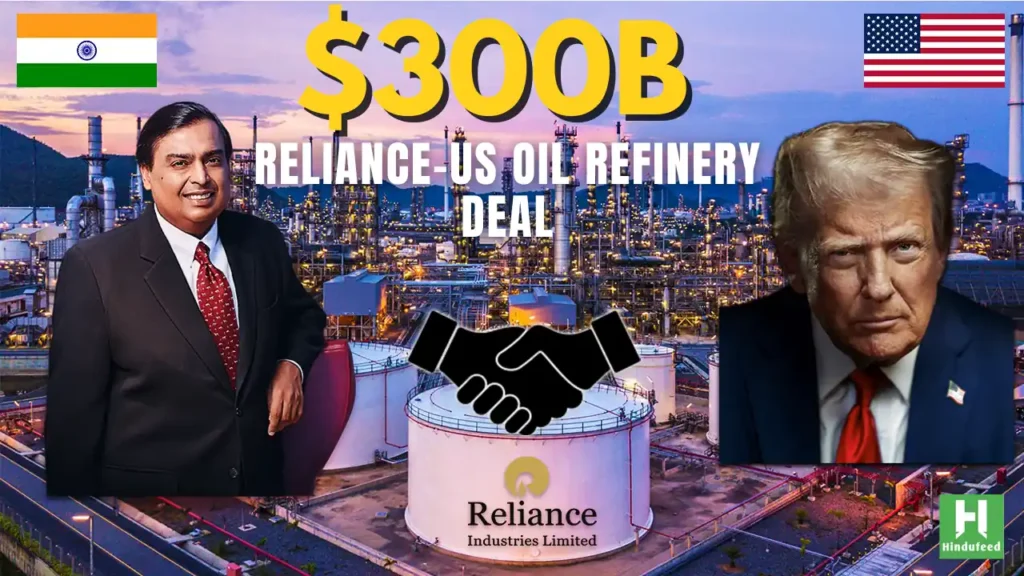
In a move that has sent shockwaves through global energy markets, Reliance Industries Limited (RIL), led by billionaire Mukesh Ambani, has emerged as the anchor partner for the first major new oil refinery to be built in the United States in half a century. Announced by US President Donald Trump on March 10, 2026, the project at the Port of Brownsville, Texas is being described as a “historic $300 billion deal”—the largest of its kind in American history.
While the headline figure is staggering, the true value of this deal lies in its intricate financial structure, its role as a geopolitical hedge, and its potential to redefine the India-US strategic energy partnership.
I. Beyond the Headlines: The $300 Billion “Offtake” Nuance
When President Trump characterized this as a $300 billion investment, many interpreted it as the construction cost of the refinery. However, the financial reality is more nuanced. As per America First Refining (AFR), the project developer, the $300 billion figure represents the total commercial value of a binding 20-year commitment.
The Math of the Deal
- The Crude Purchase: Reliance has committed to purchasing 1.2 billion barrels of American light shale oil over two decades. At current market projections, this crude is valued at approximately $125 billion.
- The Refined Output: The agreement also covers the processing and distribution of nearly 50 billion gallons of refined products—including gasoline, ultra-low sulfur diesel, and jet fuel—valued at roughly $175 billion.
- The Equity Component: While RIL has not yet issued an official filing, analysts report a “nine-figure” ($XXX million) equity investment from the Indian giant, placing the project’s total valuation in the “ten-figure” ($Billion) range.
II. Operational Deep-Dive: A Refinery Designed for the Shale Era
For fifty years, the US refining sector has stagnated, largely because existing facilities were built to process heavy, high-sulfur crudes from Venezuela or the Middle East. The Brownsville facility is different: it is the first “Greenfield” refinery designed specifically for the American Shale Revolution.
Feedstock and Capacity
The refinery will have a capacity of 168,000 barrels per day (bpd)—roughly 60 million barrels per year. Unlike the aging refineries in the US Gulf Coast that struggle with light shale, this facility is engineered to process 100% American light shale oil (47° API grade) sourced directly from the Permian and Bakken basins.
The “Cleanest” Claim
Originally proposed by Element Fuels (now led by AFR’s John Calce), the facility aims to be the “cleanest refinery in the world.” It plans to incorporate hydrogen-powered heat sources and carbon-capture technologies to minimize its environmental footprint—a critical factor in securing permits in the current regulatory climate.
III. Geopolitical Nuances: The Strategic Hedge
Why is an Indian conglomerate, which owns the world’s largest refinery in Jamnagar, investing in a mid-sized facility in Texas? The answer lies in the current global chaos of 2026.
1. The “Middle East” Insurance Policy
With Operation Epic Fury and the ongoing conflict involving Iran and Israel, the Strait of Hormuz has become a high-risk zone for global shipping. By locking in a 20-year supply of Texas crude, Reliance is effectively creating a geographical hedge. If Middle Eastern supplies are choked, the Texas refinery ensures that Reliance remains a dominant player in the global fuel trade.
2. Diversification from Russia
In 2024 and 2025, Reliance was under intense scrutiny for its heavy procurement of discounted Russian oil. By committing billions to American energy, Mukesh Ambani is sending a clear diplomatic signal to Washington. This deal “smooths” bilateral ties, positioning Reliance as a partner in American Energy Dominance rather than just a customer of sanctioned regimes.
3. Reducing the Trade Imbalance
A recurring point of friction in India-US relations has been the trade surplus in India’s favor. This $300 billion agreement is projected to significantly improve the US trade balance, providing the Trump administration with a “political win” while securing India’s energy future.
IV. Risks and Regulatory Realities
Despite the high-profile backing, the Brownsville project faces significant hurdles.
- The 2027 Timeline: AFR aims for Phase 1 (55,000 bpd capacity) to be operational by 2027. For a greenfield project in the US, where environmental approvals and community litigation can take a decade, this is an incredibly aggressive target.
- Permitting Risks: While the Trump administration has promised to “streamline permits,” the Port of Brownsville is an ecologically sensitive area. Resistance from local environmental groups remains a wild card that could delay the groundbreaking scheduled for Q2 2026.
V. Key Statistics at a Glance
| Feature | Details |
| Location | Port of Brownsville, Texas, USA |
| Partners | Reliance Industries (Anchor Investor) & America First Refining (AFR) |
| Total Deal Value | $300 Billion (20-Year Offtake Agreement) |
| Refining Capacity | 168,000 Barrels Per Day (BPD) |
| Feedstock | 100% American Light Shale Oil (47° API) |
| Economic Impact | 2,000+ Construction Jobs; 300+ Permanent Roles |
| Groundbreaking | Scheduled for Q2 2026 |
VI. Frequently Asked Questions (FAQ)
1. Is Reliance buying a US company or building a new one?
Reliance is an anchor investor and a primary offtake partner in a project developed by America First Refining (AFR). It is a partnership model where Reliance provides capital and technical expertise in exchange for long-term supply and potential equity.
2. Why hasn’t Reliance officially confirmed the $300 billion figure?
The $300 billion refers to the cumulative value of oil and products over 20 years. Companies often wait for definitive agreements and regulatory filings before announcing multi-decade offtake values, whereas political announcements (like those from President Trump) tend to focus on the total aggregate impact.
3. Will this affect petrol/diesel prices in India?
Indirectly, yes. By diversifying its supply chain, Reliance reduces its vulnerability to Middle East price shocks. A more stable global supply for Reliance’s O2C (Oil-to-Chemicals) business generally leads to more stable refined product pricing.
Final Verdict
The Reliance-Texas deal is more than just a refinery; it is a geopolitical anchor. For India, it secures a 20-year lifeline of shale oil. For the US, it revitalizes a dormant industry with foreign capital. And for Mukesh Ambani, it is a masterclass in alignment—ensuring that his business interests are perfectly synchronized with the diplomatic priorities of two of the world’s most powerful nations.
Do you think this move marks the beginning of Indian companies taking over global energy infrastructure? Share your views in the comments below!
