



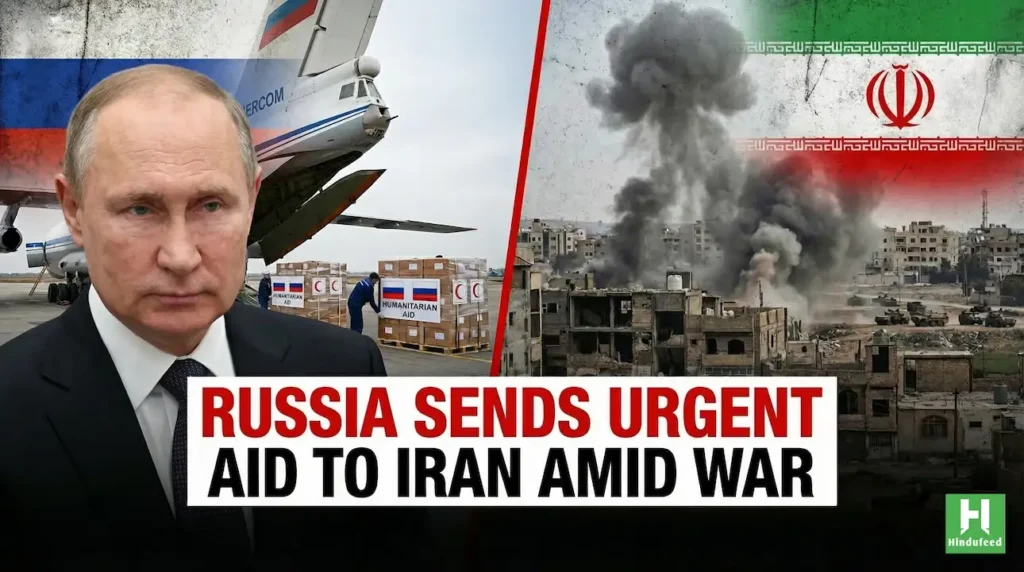
As the conflict between the United States-Israeli coalition and the Islamic Republic of Iran enters its third volatile week, a significant diplomatic and humanitarian shift has occurred. On March 12, 2026 Russia officially broke its “neutral” logistical stance by dispatching its first major shipment of humanitarian aid to Tehran.
Coordinated by the Russian Ministry of Emergency Situations (EMERCOM) under the direct instructions of President Vladimir Putin, the 13-ton shipment marks the first time a global power has successfully bypassed the regional blockade to provide medical relief to the Iranian population. Delivered via a special flight to Azerbaijan for subsequent ground transfer, the aid arrives as Iran’s healthcare system teeters on the brink of total collapse.
I. The “Flight of Mercy”: Logistics and Contents
The delivery was executed using a Russian Il-76 transport aircraft, which landed at Heydar Aliyev International Airport in Baku, Azerbaijan.
What was in the 13 Tons?
According to Russian Foreign Ministry spokesperson Maria Zakharova, the “special-purpose” cargo was tailored to address the specific trauma needs of the Iranian Ministry of Health:
- Advanced Trauma Kits: Specialized surgical equipment designed for shrapnel removal and burn treatment.
- Pharmaceutical Reserves: Critical antibiotics and blood-clotting agents, which have been in short supply since the March 1 blockade of the Strait of Hormuz.
- Mobile Ambulance Modules: Equipment to set up temporary stabilization points in urban centers like Tehran and Tabriz, where traditional hospitals have been targeted.
II. The Humanitarian Toll: Why Iran Asked for Help
The request for aid was not a mere formality; it was an admission of a spiraling crisis. Since the launch of Operation Epic Fury on February 28—which resulted in the assassination of Supreme Leader Ali Khamenei—the scale of civilian suffering has reached unprecedented levels.
1. Destruction of the Medical “Backbone”
The World Health Organization (WHO) has verified at least 18 targeted strikes on healthcare facilities within Iran since the conflict began. High-precision strikes aimed at underground military command centers have often caused catastrophic “collateral” damage to adjacent civilian hospitals.
2. The Minab School Tragedy
Public sentiment in the region was further inflamed by the recent strike on a girls’ school in Minab, near Bandar Abbas. The accidental hit resulted in the deaths of over 170 people, mostly children. Russia’s humanitarian shipment specifically included pediatric medical supplies and psychological trauma kits in direct response to this incident.
3. Displacement and Disease
With over 100,000 people internally displaced in Iran and another 700,000 in Lebanon, the risk of waterborne diseases and respiratory infections from damaged petroleum infrastructure is rising. Moscow’s aid includes water purification units to mitigate the threat of a secondary cholera outbreak.
III. Russia’s Strategic Balancing Act
For an authoritative news outlet like HinduFeed, it is crucial to analyze the “why” behind this shipment. Russia’s move is a masterclass in “Grey Zone” diplomacy.
Aid vs. Arms
While Russia has been accused by U.S. intelligence of providing “targeting data” and satellite imagery to help Iran track American warships, Moscow has refrained from sending advanced S-400 missiles or fighter jets during the active hostilities. By sending medicines instead of missiles, Russia achieves three goals:
- Maintaining Moral High Ground: It portrays itself as a stabilizer in the eyes of the Global South and “friendly states.”
- Bypassing Sanctions: Humanitarian aid is traditionally exempt from the most stringent international sanctions, allowing Russia to maintain its footprint in Iran without triggering a direct military confrontation with the Trump administration.
- Strengthening the 20-Year Treaty: The aid fulfills the “Humanitarian Cooperation” clause of the Comprehensive Strategic Partnership Treaty signed between Moscow and Tehran earlier this year.
IV. The “Baku Corridor”: Azerbaijan’s Delicate Role
The choice of Baku as the transit point is equally significant. Azerbaijan, which has historically maintained close security ties with Israel and energy ties with Europe, is now acting as a “humanitarian bridge.”
This corridor allows Russia to bypass the contested Persian Gulf waters where the U.S. Navy has established a strict “No-Fly/No-Sail” zone. It also signals that regional neighbors are increasingly wary of a total Iranian collapse, which could trigger a refugee crisis across the Caucasus.
V. Data Snapshot: The Cost of Conflict (As of March 14, 2026)
| Metric | Estimated Impact (Iran) | Source |
| Confirmed Fatalities | 3,019 (1,298+ Civilians) | HRANA / Hengaw |
| Injuries | 9,000+ | WHO / Red Crescent |
| Internally Displaced | 100,000+ | UN OCHA |
| Hospitals Destroyed | 18+ | Ministry of Health (Iran) |
| Oil Export Capacity | Down 95% | IEA Reports |
VI. Frequently Asked Questions (FAQ)
1. Will Russia send military troops to Iran?
Currently, no. Russia’s involvement is limited to intelligence sharing, satellite support, and humanitarian aid. Moscow is heavily committed to its own front in Ukraine and seeks to avoid a direct kinetic war with the U.S. and Israel.
2. Why did Iran need Russia’s medical supplies specifically?
Iran’s domestic pharmaceutical industry, while robust, relied on imported precursors that have been blocked since the closure of the Strait of Hormuz. Russia is one of the few nations with the logistical capacity to airlift large quantities of “dual-use” medical tech through non-traditional routes.
3. Has the U.S. responded to the Russian aid shipment?
The U.S. State Department has noted the shipment but has not moved to block it, as doing so would violate international humanitarian law and potentially alienate neutral regional partners like Azerbaijan and Turkey.
Final Verdict
The arrival of the EMERCOM Il-76 in Baku is more than a delivery of bandages and syringes; it is a sign that the “Axis of Resilience” is evolving. Russia is betting that a surviving, indebted Iranian regime will be a far more useful long-term ally than a defeated one.
For the people of Iran, however, the 13 tons of aid are a drop in the ocean of their current needs. As the conflict intensifies, the world watches to see if this “Mercy Flight” is the beginning of a sustained relief effort or merely a symbolic gesture in a war that shows no signs of cooling.
Do you believe Russia’s aid is purely humanitarian, or is it a calculated move to secure its energy interests in the Middle East? Share your analysis in the comments below.
