


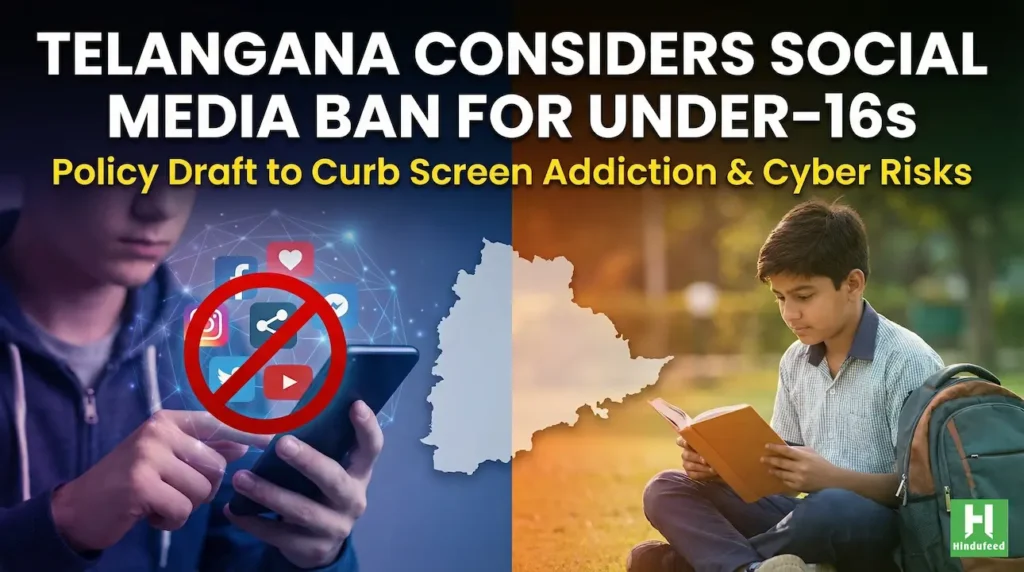
In early March 2026, the digital environment of India was changed significantly when social media bans for children under 16 years and under 13 years of age were respectively announced by the neighbouring states Karnataka and Andhra Pradesh.
Telangana has not yet officially signed a blanket ban into law as of March 7, 2026 but the state is now the centre of a heated national debate. According to recent high-level talks in Hyderabad, Telangana may soon be treading the path of its neighbors as the child rights activists and the Telangana Cyber Security Bureau are the major groups driving the momentum.
The Current Status in Telangana
While Karnataka took the ban route by including it in the State Budget 2026-27, Telangana is only planning the act through consultation and advocacy.
- Shield 2.0 Conference: The Shield 2.0 conference organized by the Telangana Cyber Security Bureau in Hyderabad in February 2026 saw child rights founders among key speakers who stressed that a total ban for those under 16 is the “only way” to deal with the increasing cases of online exploitation and “digital grooming”.
- Government Stance: Although the government has already demonstrated its worry about “mobile addiction”, at present they are exploring the legal possibility of a state-level ban as versus a national framework.
Why the Push for a Ban?
The officials in Hyderabad as well as in other parts of South India have been using pretty much the same points to argue their case. They are mainly focusing on 3 areas:
- Mental Health & Addiction: Officials quoting from the “Economic Survey 2025-26” talk about digital addiction being a “global epidemic”. They list as hazards the short attention spans, sleep deprivation, and the “comparison trap” that results in anxiety and depression.
- Cyber Safety: The Telangana Cyber Security Bureau recently drew attention to certain cases where anonymous predators using fake identities have managed to approach minors. Some people supporting stricter measures believe that the way age-gating is done now (usually 13+) is very easy to get around.
- Academic Performance: A number of people are advocating to revert to “analog” learning, and the state is also considering different options to emphasize education, only tablets as a replacement for highly engaging, algorithm, controlled platforms such as Instagram, TikTok, and Snapchat.
Telangana’s policy is being heavily influenced by the swift actions of its neighbors:
| State | Proposed Age Limit | Implementation Timeline |
| Karnataka | Under 16 | Announced in March 2026 Budget |
| Andhra Pradesh | Under 13 (studying 13-16) | Within 90 days (by June 2026) |
| Telangana | Under Discussion | Awaiting Cabinet Sub-committee report |
Major Hurdles: Can it actually be enforced?
Critics and tech experts in Hyderabad have raised several “red flags” regarding a potential ban:
- Legal Issues: According to Indian Constitution, the central government through Ministry of Electronic and Information Technology (MeitY) is mainly responsible for regulating internet and digital intermediaries. So, a banning decision by a state level may immediately get challenged in the High Court.
- Age Restriction: How a platform can be sure of a 15-year-old’s age without making an intrusive collection of biometrics or government IDs? Meta and other tech companies have said they will follow orders but have warned that bans may result in kids moving to “darker” unregulated parts of the web.
- The Shared Device Problem: Most Indian families are big enough that children normally get to use their parents’ mobile phones. It is quite a challenge for apps to differentiate between a mother checking her messages and a son scrolling down.
What’s Telangana’s Next Step?
The government in Telangana is likely to keep an eye on the implementation in Bengaluru and Vijayawada before drafting their own legislation. Most people believe that the government will come up with a plan consisting of different measures rather than just a ban:
- Strict Age Verification: Mandating KYC-linked logins for social media.
- School Bans: A total prohibition of smartphones within educational premises (similar to Himachal Pradesh).
- Parental Awareness: State-wide campaigns to educate parents on using “Digital Wellbeing” locks and filters.
