



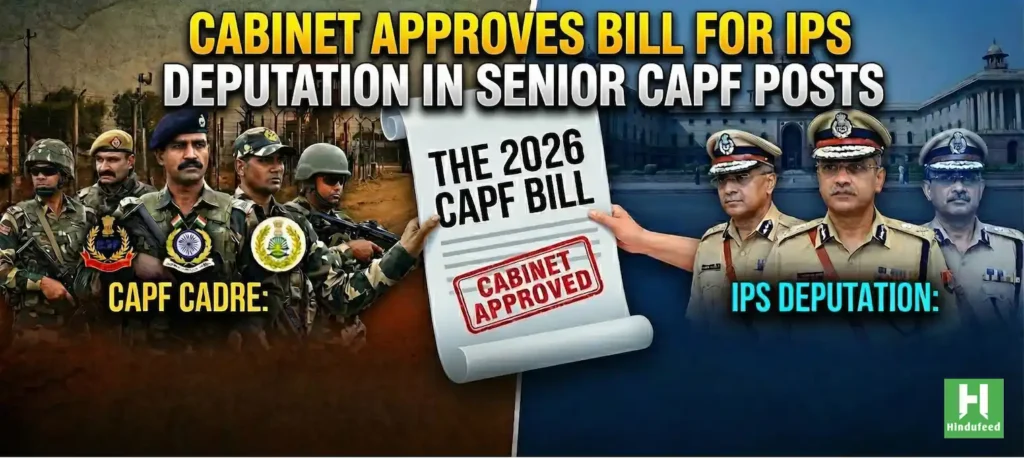
The Union Cabinet chaired by Prime Minister Narendra Modi officially approved the draft of the Central Armed Police Forces (General Administration) Bill, 2026.
The proposed legislation seeks to formalize and codify the long-standing practice of reserving senior leadership positions—specifically at the Inspector General (IG) and Deputy Inspector General (DIG) levels—for officers of the Indian Police Service (IPS) on deputation. While the government frames this as a necessity for “administrative synergy,” it has met with stiff resistance from the cadre officers of the “Big Five” paramilitary forces, who view it as a direct challenge to a recent Supreme Court mandate.
I. The Core Provisions: What the 2026 Bill Proposes
Currently, the leadership structure of the Central Armed Police Forces (CAPFs)—which includes the BSF, CRPF, ITBP, CISF, and SSB—operates largely through executive orders. The 2026 Bill aims to replace these “soft rules” with a statutory framework.
The Statutory Quota
The Bill intends to solidify the following reservation levels for IPS officers:
- DIG Rank: 20% of all sanctioned posts to be filled via IPS deputation.
- IG Rank: 50% of all sanctioned posts to be reserved for IPS officers.
- Top Tier: Provision for nearly all Director General (DG) and Additional Director General (ADG) posts to continue being headed by IPS officers.
By moving these quotas from “Recruitment Rules” to a “Parliamentary Act,” the Ministry of Home Affairs (MHA) is effectively creating a permanent legal shield for IPS presence in paramilitary leadership.
II. The Judicial Backdrop: A Battle of Status and Seniority
To understand the “nuisance” of this deal, one must look at the legal odyssey that preceded it. In May 2025, the Supreme Court delivered a landmark ruling in the Sanjay Prakash vs. Union of India case.
- OGAS Status: The court granted Organised Group A Services (OGAS) status to CAPF cadre officers. This was a massive win, as it placed them on par with other elite civil services (like the IAS or IRS) in terms of financial benefits and promotional avenues.
- The “Progressive Reduction” Mandate: Most crucially, the Apex Court directed the MHA to “progressively reduce” the deputation of IPS officers up to the rank of IG within a two-year window (ending in 2027).
- The Cabinet’s Response: The 2026 Bill is widely perceived by legal experts as a “statutory intervention” to circumvent this judicial directive. By passing an Act of Parliament, the government can theoretically override the “Recruitment Rules” that the Court was interpreting.
III. The Cadre vs. IPS Conflict: Generalists vs. Specialists
The tension between the two cadres is not merely about “ego”; it is about the fundamental philosophy of how India’s borders and internal security are managed.
The IPS Argument (The Generalist View)
The MHA and IPS associations argue that IPS officers bring a “360-degree policing perspective.” Because they serve in various state cadres, they have experience in criminal justice, law and order, and state-level coordination—skills vital for CAPFs that must frequently work alongside state police during elections or communal riots.
The Cadre Argument (The Specialist View)
CAPF cadre officers, who spend decades in specialized terrains—from the -30°C peaks of the LAC (ITBP) to the dense jungles of the Red Corridor (CRPF)—argue that they possess “domain expertise” that an outsider lacks.
- The Stagnation Crisis: Currently, a CAPF officer takes an average of 25 years to reach the rank of Commandant, a position an IPS officer reaches in 12–15 years.
- Morale Impact: Cadre officers argue that having a “temporary” leader (IPS on 3-year deputation) at the IG level prevents long-term institutional building and leaves the permanent cadre feeling “professionally orphaned.”
IV. Institutional Impact: The “Big Five” at a Glance
| Force | Primary Role | Sanctioned Strength | Primary Concern with the Bill |
| CRPF | Internal Security / Anti-Naxal | ~3.13 Lakh | Impact on operational command in LWE zones. |
| BSF | Pakistan & Bangladesh Borders | ~2.65 Lakh | Specialist border management vs. General policing. |
| ITBP | China Border (LAC) | ~90,000 | Technical mountain warfare leadership gaps. |
| CISF | Industrial & Airport Security | ~1.70 Lakh | Commercial security expertise vs. Police mindset. |
| SSB | Nepal & Bhutan Borders | ~95,000 | Intelligence-led border guarding stagnation. |
V. The Financial and Operational “Nuance”
The Bill isn’t just about who sits in the IG’s chair; it has massive Non-Functional Financial Upgradation (NFFU) implications.
Under the OGAS status, if a batch of IAS or IPS officers gets promoted to a higher pay scale, the corresponding batch of CAPF officers must also receive that pay scale, even if a “vacancy” doesn’t exist. By formalizing IPS quotas, the MHA can argue that “promotional blocks” are a statutory requirement, potentially slowing down the rollout of financial benefits to nearly 13,000 Group A cadre officers.
VI. Frequently Asked Questions (FAQ)
1. Does this Bill mean CAPF officers can never become Director General (DG)?
Technically, they can. However, because the senior-most slots are dominated by IPS officers, most cadre officers retire at the IG or ADG rank before they have enough seniority to be considered for the DG post. The Bill formalizes the “top-heavy” IPS presence that makes a cadre DG a rarity.
2. Why is the government pushing this Bill now?
The MHA informed the Supreme Court in February 2026 that it needed “statutory intervention” to handle the “structural implications” of the 2025 ruling. The government believes a hybrid leadership (IPS + Cadre) is essential for national security coordination.
3. Will this lead to more protests?
Retired CAPF associations have already filed contempt petitions in the Supreme Court, alleging that the MHA is failing to implement the 2025 order. The introduction of this Bill in the ongoing Budget Session is likely to lead to a fresh legal challenge.
Final Verdict
The Central Armed Police Forces (General Administration) Bill, 2026, represents a critical junction in Indian administrative history. While it offers the “statutory clarity” that the MHA desires, it risks deepening the rift between the men on the ground and the officers at the top. For the internal security of India, a “House Divided” is the greatest risk.
Should leadership be earned through decades of force-specific service, or is the “diverse experience” of the IPS indispensable for the nation’s security?
Do you think the top leadership of the BSF and CRPF should only come from within their own ranks? Or is the IPS “bridge” between the State and Center necessary? Share your thoughts in the comments.
