



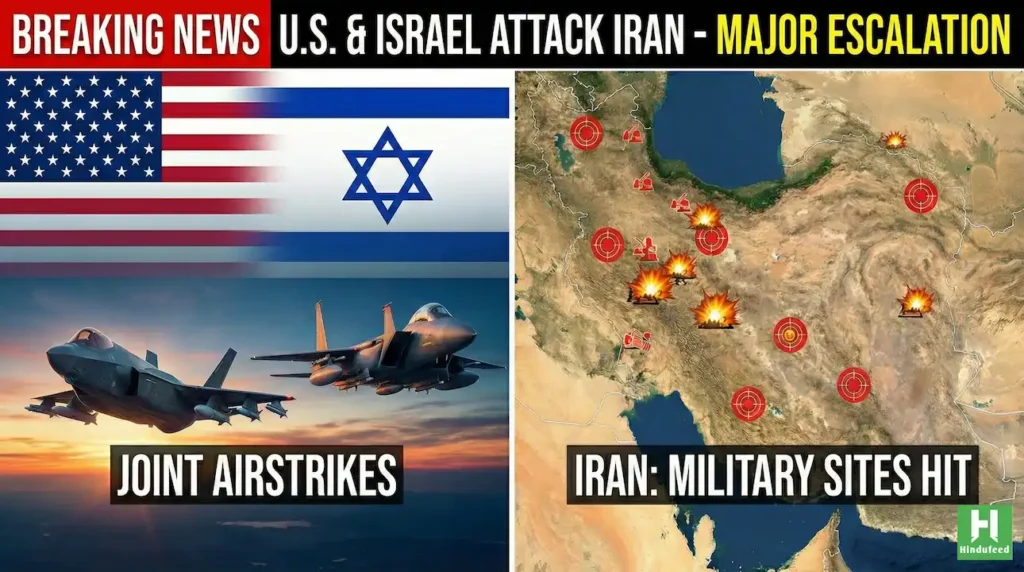
One of the most significant military operations in the 21st century was an extensive and synchronized attack by the United States and Israel targeting Iranian military facilities on Saturday, 28 February in a joint operation named Operation Shield of Judah.
The strikes confirmed by the President Donald Trump and the Israeli Defense Minister Israel Katz have escalated tensions across the Middle East and sent shockwaves through global capitals.
The Strikes on Iranian Military
Explosions rocked multiple Iranian cities in the early hours of Saturday morning. According to the locals, the blasts in Tehran were close to the Pasteur district, which is the location of the Presidential Office and the National Security Council, as well as across the northern Seyed Khandan area of the capital. Furthermore, it has been reported that strikes in Qom, Kermanshah, Isfahan, Tabriz, Karaj, and Khorramabad have been confirmed, resulting in a comprehensive situation of a thoroughly devised plot hitting the military, governmental, and strategic locations at the same time.
Minister of Defense of Israel Katz described the strikes as “preemptive attack meant to eliminate threats to the State of Israel.” One of the most spectacularly targeted sites was the housing complex in the center of Tehran which is usually the residence of the Supreme Leader Ayatollah Ali Khamenei. Subsequently, major international media published satellite photos showing the house was severely damaged, however, Khamenei’s location remained unknown with some reports saying he was taken to a secure undisclosed location before the attack.
U.S. Confirms “Major Combat Operations”
President Trump put out a statement via social media to confirm the American involvement, asserting that the US military had commenced “major combat operations” in Iran. He characterized the strikes as a move to “stop this very evil, radical dictatorship from threatening America and our core national security interests” and he advised the members of Iran’s Islamic Revolutionary Guard Corps (IRGC) that if they did not surrender, they would face “certain death.” U.S. officials have said that the attacks were implemented by strike aircraft launched from several aircraft carriers and air bases in the Middle East region, and the attack was made by the air and the sea. They insisted that it was “not a small strike” as there were reportedly dozens of sorties in the different coordinated waves.
Key Targets and Casualties
Israeli officials believed that IRGC commander General Mohammad Pakpour probably died in the strikes, along with Iran’s Defence Minister and Intelligence Chief however, Iran had not yet officially responded to these assessments. Several top Iranian military and governmental figures were reportedly among the targets of what insiders described as a decapitation strategy aimed at breaking the regime’s command structure. A “significant number” of casualties were also announced at the Revolutionary Guards’ headquarters.
Secretary of State Marco Rubio updated the members of the U.S. Congress’ “Gang of Eight” before the operation, and Israeli Prime Minister Benjamin Netanyahu presented the attacks as a move to get rid of an “existential threat” in the region, showing through his words that he believed the joint action would “lay the groundwork for the courageous Iranian people to take control of their own destiny.”
Iran Strikes Back
Iran did not hesitate to act and hit back hard. Several ballistic missiles were fired at Israeli land and the sirens went off all over the country while Israeli air defence systems, including Arrow, David’s Sling and Iron Dome, were hastily dispatched to shoot down the threatening missile attack.
Besides, Iranian missiles also hit Gulf Arab states where US military bases are located and include Qatar’s Al Udeid Air Base and the U.S. Navy’s 5th Fleet Headquarters in Bahrain. A person was killed in Abu Dhabi when Iranian missiles were intercepted over the UAE. Qatar’s Defence Ministry said that all the missiles that were supposed to be incoming over their territory had been successfully neutralised.
According to a senior Iranian official, speaking to Al Jazeera, “all American and Israeli assets and interests in the Middle East so far have become legitimate targets” also, he warned of a “crushing” retaliation with “no red lines.”
Global Reaction
The international community reacted with alarm. Lebanon’s Prime Minister said that his country was not going to be used as a pawn in any regional conflict. Iran’s exiled Crown Prince Reza Pahlavi called on the Iranian security forces to disobey orders, defect, and back the people. According to reports, Iranian opposition forces and some parts of the Iranian population were celebrating the strikes, considering them a possible lever to change the regime.
Communication services in the whole of Tehran were said to have been cut off after the strikes, and the country’s news flow inside and outside was seriously disrupted. Israel proclaimed a nationwide state of emergency and shut its borders to air traffic while its medical facilities were relocated to underground premises as a precautionary measure.
The attacks are therefore the second big Israeli, American military action against Iran in less than a year after the 12, day IranIsrael war of June 2025 and signify a radically new stage in a confrontation that has lasted for decades. Both parties are getting ready for what could be a long and volatile confrontation, and the world is keeping a close eye on them.
