











The 54-year silence beyond Earth’s orbit has finally been broken. For the first time since the final embers of the Apollo program faded in 1972, humanity has once again aimed its collective gaze—and its physical presence—at the Lunar frontier. As of early 2026, the Artemis II mission has successfully transitioned from a decade of PowerPoint presentations and engineering delays into a thunderous reality.
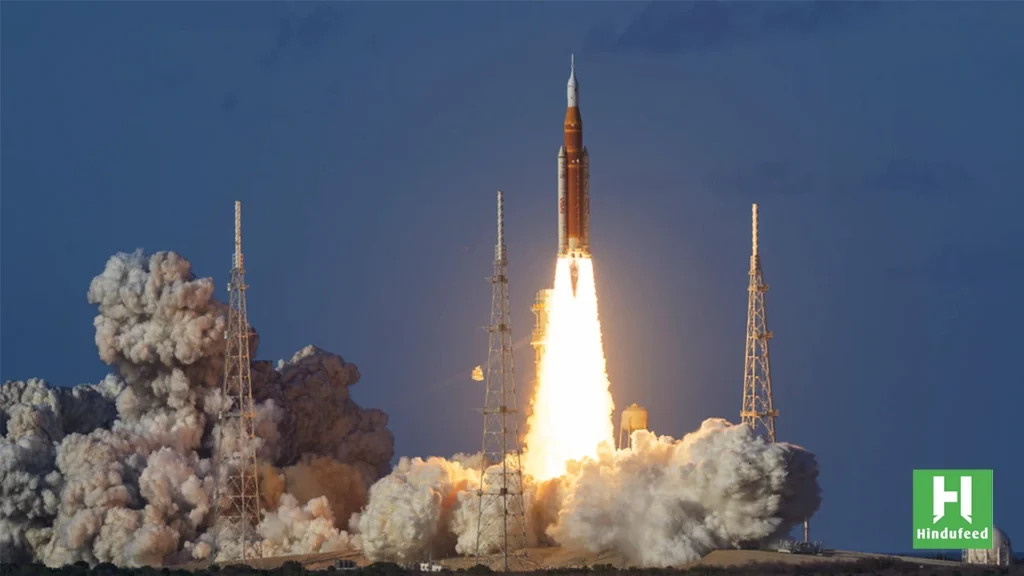
The roar of the Space Launch System (SLS) at Kennedy Space Center’s Pad 39B wasn’t just the sound of 8.8 million pounds of thrust; it was the sound of a half-century of waiting coming to an end. Artemis II has launched. Four astronauts are currently hurtling through the vacuum of space, strapped into the Orion spacecraft, on a trajectory that will take them further from Earth than any human has traveled in history.
This isn’t Apollo 17.5. This is a radically different beast. While Apollo was a sprint driven by Cold War prestige, Artemis is a marathon designed for sustainability, international cooperation, and eventually, a stepping stone to Mars.
I. Meet the Crew of Artemis II
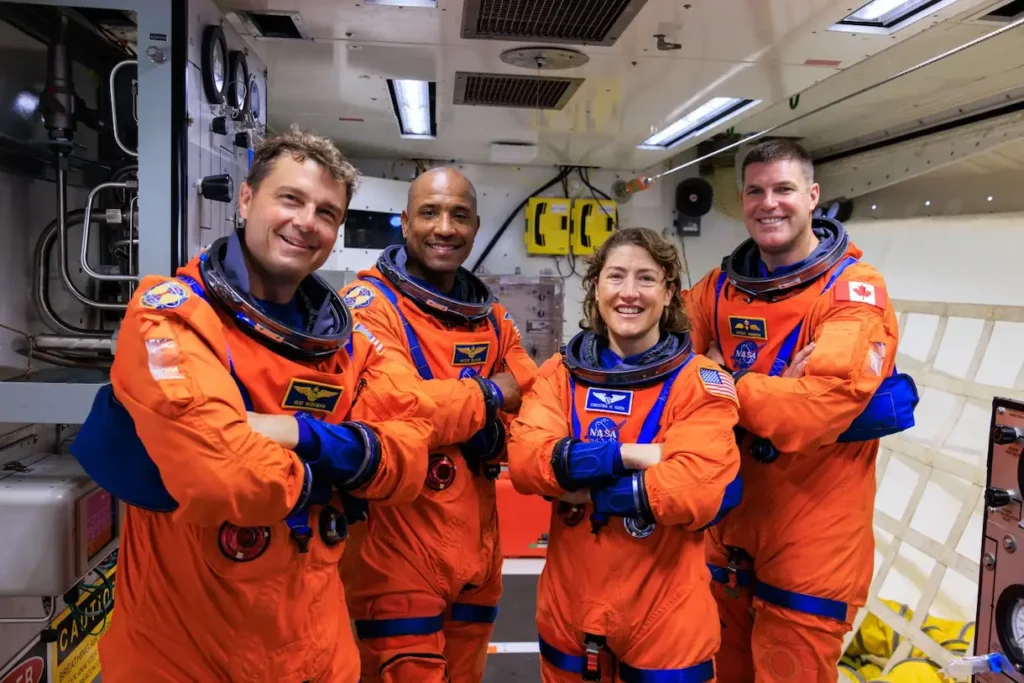
The four individuals currently occupying the few cubic meters of the Orion capsule represent more than just NASA’s elite; they represent the diversity of the modern world. Unlike the all-white, all-male crews of the 1960s, the Artemis II crew reflects the “Artemis Generation.”
1. Reid Wiseman (Commander)
A veteran of the International Space Station (ISS), Wiseman brings the steady hand of a naval aviator to the mission. As the Commander, he is responsible for the overall success of the flight and the safety of his crew during the high-stakes manual proximity operations.
2. Victor Glover (Pilot)
Glover made history as the Pilot of the first crewed SpaceX Dragon flight to the ISS. Now, he becomes the first person of color to leave Earth’s orbit. His role is critical during the initial “proximity operations” where Orion will test its manual handling capabilities near the discarded ICPS stage.
3. Christina Koch (Mission Specialist)
Holding the record for the longest single spaceflight by a woman, Koch is a powerhouse of endurance and engineering. She is now the first woman to ever venture into deep space, serving as a Mission Specialist focused on the spacecraft’s life support and technical systems.
4. Jeremy Hansen (Mission Specialist – CSA)
Hansen represents the “International” in international cooperation. As a Canadian Space Agency (CSA) astronaut, he is the first non-American to leave Low Earth Orbit (LEO). His inclusion is the result of a landmark agreement between the US and Canada, signaling that the Moon belongs to all of humanity.

II. The Mission Path: A 10-Day Odyssey
Artemis II is not a landing mission; it is a “test flight with humans.” The path is a sophisticated “Hybrid Free Return Trajectory” designed to maximize safety while pushing the hardware to its absolute limits.
- Day 1: Launch and High Earth Orbit (HEO): After the SLS clears the tower, Orion enters a very high, elliptical Earth orbit. This 24-hour phase is crucial. The crew will remain in Earth’s vicinity to ensure the life support systems—many of which have never hosted humans in a vacuum before—are functioning perfectly.
- Day 2: The TLI Burn: Once the “all-clear” is given, the European Service Module (ESM) will ignite its main engine for the Trans-Lunar Injection (TLI). This is the moment they leave Earth’s “backyard.”
- Day 4-5: The Lunar Flyby: Orion will swing around the far side of the Moon, passing roughly 10,300 kilometers above the lunar surface. Here, the crew will be the first humans to see Earth-rise with their own eyes since 1972.
- Day 6-10: The Long Fall Home: Using the Moon’s gravity as a slingshot, Orion will begin its four-day trek back to Earth, culminating in a high-velocity re-entry at 40,000 km/h—the fastest any human-rated craft has ever traveled.
III. Core Objectives: Why are we doing this?
If we aren’t landing, what’s the point? Artemis II is the “stress test” that Artemis III (the landing mission) cannot happen without.
1. Testing the “Lifeboat” (Orion)
Orion has flown twice before (EFT-1 and Artemis I), but always empty. Adding four humans changes the physics of the spacecraft. Their breath adds humidity; their bodies add heat; their waste must be processed. Artemis II will prove that Orion is a habitable environment for deep space.
2. Communication and Navigation
Once beyond the Moon, the crew will rely on the Deep Space Network (DSN). Artemis II is testing high-bandwidth laser communications, allowing the astronauts to send 4K video back to Earth—a massive leap from the grainy black-and-white feeds of the 1960s.
3. Radiation Shielding
Beyond Earth’s Van Allen belts, radiation is a silent killer. Artemis II will measure exactly how much dosage the crew receives, validating the shielding designs that will protect future crews on the 6-month journey to Mars.
IV. Data Snapshot: The Artemis II Specs
| Feature | Details (Verified: 2026) |
| Launch Vehicle | SLS Block 1 (Space Launch System) |
| Spacecraft | Orion (Crew Module + Service Module) |
| Total Crew | 4 (3 NASA, 1 CSA) |
| Mission Duration | ~10 Days, 6 Hours |
| Maximum Distance | ~400,000 km from Earth |
| Splashdown Location | Pacific Ocean (near San Diego) |
V. The Path to Artemis III: The Next Giant Leap
Artemis II is the bridge. As soon as the Orion capsule splashes down and the crew is recovered, NASA and its partners will begin the final preparations for Artemis III, scheduled for 2027/2028. That mission will see the first woman and next man step onto the Lunar South Pole—an area rich in water ice.
The data gathered by Wiseman, Glover, Koch, and Hansen over these ten days will dictate the landing zones, the suit designs, and the orbital mechanics of the first moon landing of the 21st century.
VI. Frequently Asked Questions (FAQ)
1. Why didn’t they land on this mission?
Risk management. Landing on the Moon requires a completely separate vehicle (the Starship HLS). Artemis II is designed to ensure the “delivery truck” (Orion) can get the crew there and back safely before we try the “elevator” (the Lander).
2. Is it true they will experience “Earth-Set”?
Yes. As they pass behind the Moon, they will lose all radio contact with Earth for approximately 34 minutes. In that time, they will be the most isolated humans in the history of our species, seeing the stars in a clarity no telescope on Earth can provide.
3. How is India involved in the Artemis program?
While Artemis II is a NASA/CSA led crew, India is a signatory of the Artemis Accords. ISRO and NASA are currently collaborating on the Lunar Gateway (an orbital station), and an Indian astronaut is expected to visit the ISS/Gateway in the very near future as part of this broader partnership.
Final Verdict
Artemis II isn’t just a mission; it’s a validation of human ambition. In an era often defined by internal division and global crises, the sight of four humans leaving our planet behind reminds us that we are still a species of explorers. The “Artemis Generation” has officially begun. We aren’t just going back to the Moon; this time, we are going to stay.
Where were you when the SLS roared into the Florida sky? Do you think we should focus more on the Moon or skip straight to Mars? Share your thoughts in the comments below!


