












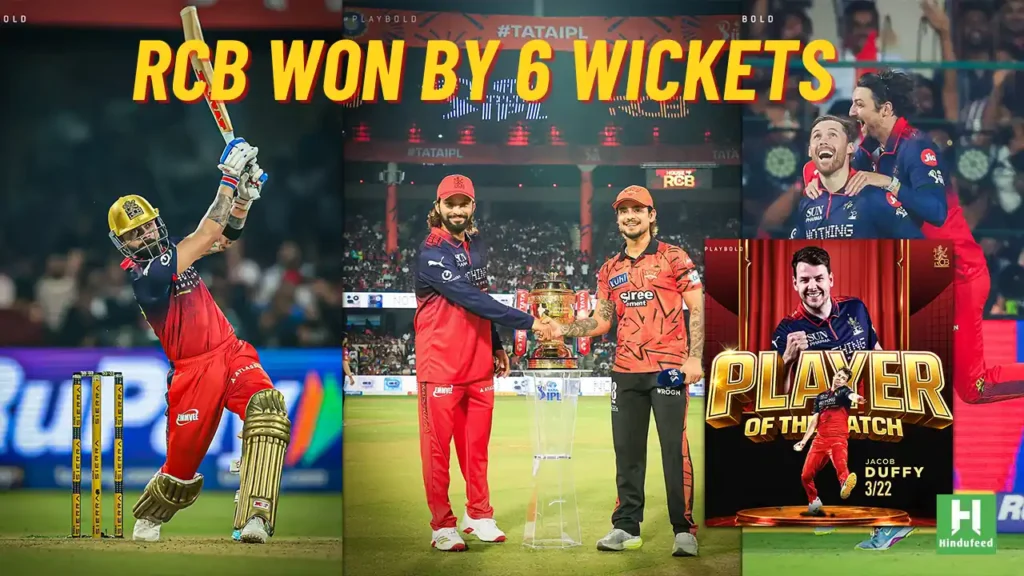
The M. Chinnaswamy Stadium has seen many “Virat Kohli nights,” but the opening fixture of the 19th Indian Premier League (IPL) on March 28, 2026, was something different. It wasn’t just a win; it was a clinical, high-speed execution of a tactical plan that left Sunrisers Hyderabad (SRH) searching for answers.
Chasing a daunting target of 202, the defending champions, Royal Challengers Bengaluru, didn’t just cross the finish line—they sprinted through it, completing the chase in just 15.4 overs with 6 wickets in hand. This victory marks the fastest 200+ chase in the history of the league, sending a clear message to the rest of the field: the trophy isn’t leaving Bengaluru easily.
I. The Jacob Duffy Debut: A Dream Start
The match was effectively won in the first six overs of the evening. Winning the toss, RCB’s new captain Rajat Patidar elected to bowl first, a decision that initially raised eyebrows given the Chinnaswamy’s reputation as a “bat-first” fortress.
However, debutant Jacob Duffy made sure the decision was vindicated. The New Zealand pacer produced what many are calling the “Spell of the Season” on Day 1. Utilizing a heavy ball and a probing short-of-length channel, Duffy dismantled the SRH top order.
- The Victims: Abhishek Sharma (7), Travis Head (11), and Nitish Kumar Reddy (1).
- The Damage: SRH was reeling at 29/3 in the 5th over.
Duffy finished with spectacular figures of 3/22 in his four overs, earning him the Player of the Match award on debut—a feat that has immediately endeared him to the “Bold Army” fans.
II. The SRH Fightback: Kishan and Klaasen’s Counter-Attack
With Pat Cummins ruled out due to a late injury, Ishan Kishan took the captaincy reins and led from the front. Alongside Heinrich Klaasen, Kishan orchestrated a recovery that was nothing short of heroic.
The 97-Run Stand
The duo shifted the momentum in the middle overs, targeting RCB’s spinners and the slightly expensive Romario Shepherd. Kishan, in particular, was in vintage form, smashing 80 off just 38 balls (8 fours, 5 sixes). Klaasen chipped in with a brisk 31 before a “Catch of the Season” contender from Phil Salt at the boundary ended his stay.
Aniket Verma: The Finishing Kick
Just when RCB thought they had reeled them in, young Aniket Verma unleashed a flurry of boundaries. His explosive 43 off 18 balls pushed the SRH total past the psychological 200-mark. SRH finished at 201/9, a total that theoretically should have been enough to challenge any side.
III. The Chase: Padikkal’s Fury & Kohli’s Composure
Chasing 10.1 runs per over is never “comfortable,” but RCB’s openers made it look like a training session.
Devdutt Padikkal’s Homecoming
Returning to his original home, Devdutt Padikkal was the primary aggressor. While Phil Salt departed early, Padikkal took the SRH attack to the cleaners, scoring 61 off 26 balls. His ability to loft the ball straight over the bowler’s head forced Ishan Kishan to shuffle his bowlers constantly, but no one—neither Unadkat nor Malinga—could stem the flow.
The Kohli Masterclass (69 off 38)*
At the other end, Virat Kohli played the role of the “Grand Architect.” After surviving an early drop on 28, Kohli switched gears. He didn’t just hit boundaries; he manipulated the field. His unbeaten 69 featured five signature sixes that sent the Bengaluru crowd into a frenzy.
By the time Rajat Patidar (31 off 12) added his “Captain’s Cameo,” the result was a foregone conclusion. RCB reached 203/4 in 15.4 overs, winning by 6 wickets with a staggering 26 balls to spare.
IV. Data Snapshot: The Scorecard of History
| Statistic | Sunrisers Hyderabad (SRH) | Royal Challengers Bengaluru (RCB) |
| Total Score | 201/9 (20.0 Overs) | 203/4 (15.4 Overs) |
| Top Batter | Ishan Kishan (80 off 38) | Virat Kohli (69 off 38)* |
| Best Bowler | David Payne (2/35) | Jacob Duffy (3/22) |
| Run Rate | 10.05 | 12.89 |
| Outcome | Loss | Win by 6 Wickets |
V. Tactical Analysis: Why RCB Won
- Hard Lengths: Unlike previous years where RCB bowlers traveled for runs by over-pitching, Duffy and Bhuvneshwar Kumar hit the “hard length” zone, making it difficult for Head and Sharma to play their natural game.
- Middle-Order Intent: Even after losing Padikkal and Patidar, RCB didn’t slow down. The intent to finish the game early was evident, likely with an eye on the Net Run Rate (NRR).
- The Phil Salt Factor: While he failed with the bat, his two world-class catches to dismiss Kishan and Klaasen saved at least 30 runs for the side.
VI. Frequently Asked Questions (FAQ)
1. Who is the captain of RCB in IPL 2026?
Rajat Patidar is the official captain for the 2026 season, taking over the leadership role to lead the franchise’s title defense.
2. Why didn’t Pat Cummins play for SRH?
Cummins was ruled out of the opener due to a minor injury sustained during practice. Ishan Kishan led the side in his absence.
3. What is RCB’s next match?
RCB will remain at home to host their arch-rivals, Chennai Super Kings (CSK), on April 5, 2026.
Final Verdict
The IPL 2026 opener has established a new “Gold Standard” for run chases. RCB’s 6-wicket win isn’t just a victory on the points table; it’s a psychological blow to the rest of the league. If the defending champions can combine this level of bowling discipline with such explosive batting, a back-to-back title might be more than just a dream for the fans in Raipur and Bengaluru.
Was Jacob Duffy’s debut the best by an RCB pacer? Can Ishan Kishan lead SRH to a comeback in their next game against KKR? Let us know your analysis in the comments!


