

Most people assume the people closest to them know them best. Parents remember childhood habits. Friends know favorite foods, fears, and ambitions. Partners often recognize subtle mood changes before a single word is spoken. Yet as artificial intelligence becomes increasingly integrated into everyday life, a growing question is emerging: what happens when machines develop a deeper understanding of our behavior than the people around us?
A decade ago, this idea might have sounded like science fiction. Today, it is becoming a serious topic of discussion among researchers, privacy experts, and technology companies. The concern is not that AI is becoming conscious or emotionally aware. Rather, it is becoming exceptionally good at identifying patterns in human behavior.
Every online search, product purchase, social media interaction, streaming choice, location check-in, and digital conversation contributes to a vast collection of data. Individually, these actions reveal very little. Together, they create a remarkably detailed portrait of a person’s habits, preferences, interests, and routines.
Researchers have long demonstrated that digital footprints can reveal more than many people realize. A widely discussed 2015 study by researchers at Stanford University and the University of Cambridge found that computer models analyzing Facebook activity could predict personality traits with surprising accuracy, often outperforming friends, coworkers, and family members.
But in 2026, that study feels almost like a glimpse into a much simpler era.
Back then, algorithms mainly analyzed likes, clicks, and browsing behavior. Today’s AI systems are capable of processing far richer forms of information. Large language models can analyze written conversations, voice recordings, personal notes, customer support chats, emails, and other forms of text to identify patterns that humans might miss.
The difference is significant. An algorithm no longer needs to know only what someone clicked. It can often identify recurring themes, emotional patterns, and behavioral tendencies across thousands of interactions.
A person may never explicitly state that they are worried about their future. Yet an AI system analyzing months of written communication might detect repeated expressions of uncertainty, stress, or self-doubt. Someone struggling with loneliness may reveal subtle signals through search patterns, language choices, and online activity long before they openly discuss those feelings with friends or relatives.
This growing ability to infer emotional and psychological information has transformed the debate around privacy. The question is no longer simply whether companies collect data. Most people already know that they do.
The more important question is what can be learned from that data. Privacy scholar Shoshana Zuboff, known for her work on surveillance capitalism, has argued that modern digital platforms increasingly convert human experiences into behavioral data that can be analyzed and used to predict future actions. While companies often describe data collection as a way to improve services, critics warn that the same information can also be used to influence decisions, shape consumer behavior, and guide attention in subtle ways.
The effects of this are already visible in everyday life. Recommendation systems predict which movies people will watch. Music platforms anticipate what songs users may enjoy next. Online retailers suggest products before customers actively search for them. Navigation apps often know where someone is heading before a destination is entered.
Most of the time, these tools feel helpful. Occasionally, however, they feel unsettling. Many internet users have experienced the strange sensation of encountering an advertisement, recommendation, or piece of content that seems uncannily relevant to something they had been thinking about. While these experiences are usually the result of sophisticated data analysis rather than devices literally listening to private conversations, they can leave people feeling as though technology knows more about them than it should. That reaction reveals something important.
People are accustomed to being understood by other humans. They are less comfortable when a machine appears to understand them. There is also an important distinction between information and understanding. An AI system may know which websites a person visits, how much time they spend online, what products they buy, and what topics they discuss most frequently. It may even predict future choices with remarkable accuracy.
Yet it does not understand the meaning behind those choices in the way another human being might. A close friend remembers shared experiences. A parent understands family history. A partner recognizes the emotional significance of a particular memory, conversation, or life event.
Human understanding is rooted in relationships, empathy, and context. Artificial intelligence relies on probability, pattern recognition, and statistical prediction.
That difference still matters. At the same time, the gap between human insight and machine prediction continues to narrow. As AI systems become more sophisticated, they are likely to develop increasingly detailed models of individual behavior. The technology may help identify mental health risks, personalize education, improve healthcare, and make digital services more useful. It may also create new challenges involving privacy, consent, and personal autonomy.
Society is entering a period in which machines are learning extraordinary amounts about the people who use them.
The future of AI will not be defined solely by how intelligent these systems become. It will also be shaped by how responsibly that knowledge is collected, stored, and used.
The possibility that artificial intelligence could know certain aspects of us better than our friends or family is no longer a distant hypothetical scenario. In many limited ways, it is already happening.
The real question is not whether AI can understand human behavior with remarkable accuracy.
It is whether individuals will continue to have meaningful control over the information that makes such understanding possible.
Trending
- What Happens When AI Knows More About You Than Your Family Does?
- Supreme Court Says Husband Not Speaking to Wife 13 Day Does Not Amount to Cruelty, Sets Aside Conviction in Wife’s Suicide Case
- Facebook Goes Down Globally, Users Face Issues; Instagram Also Down for Some Users
- Holding Public Office Doesn’t Mean Losing Right to Privacy: Karnataka High Court
- Train Delayed by 6 Hours, But Man Fined ₹520 After Platform Ticket Expires at Kalyan Station
- Woman Awarded Rs 35,000 Compensation After KSRTC Bus Leaves Early, Causing Her to Miss Hospital Appointment
- Air India Ordered to Pay Rs 74,131 After Student Was Wrongly Charged for Extra Baggage
- Pakistan’s Expanding Satellite Surveillance Network Draws Attention Beyond the Space Sector

What Happens When AI Knows More About You Than Your Family Does?
 By Niyati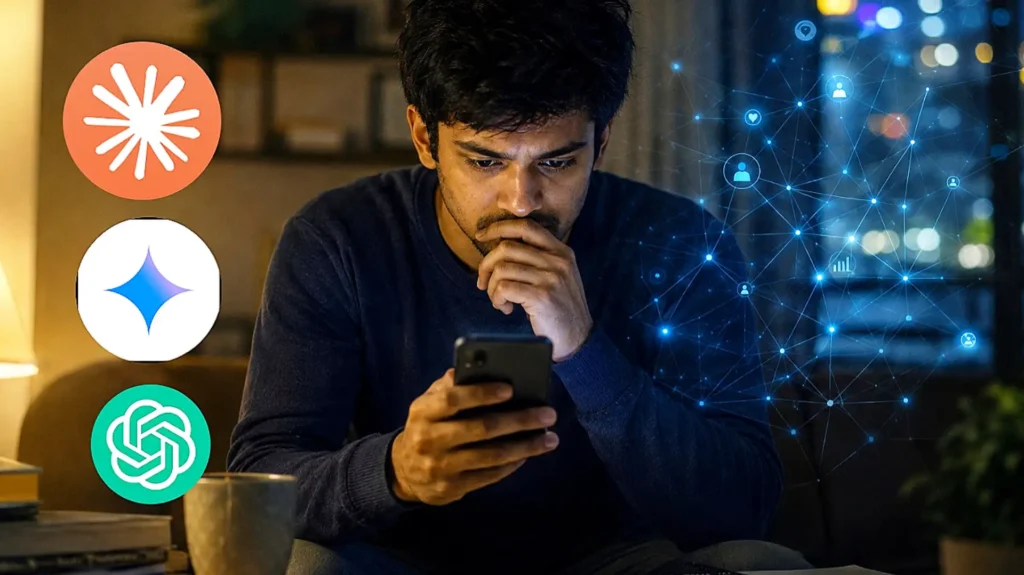

Niyati
Niyati is a digital content writer and current affairs commentator specializing in real-time news and viral internet culture. Known for her ability to transform complex daily headlines into smooth, highly engaging narratives, she focuses on bridging the gap between breaking news and reader-centric storytelling. Her editorial expertise spans human-interest journalism, behavioral psychology, and evolving social trends. Niyati is dedicated to delivering accurate, scannable, and deeply relatable articles that cut through the noise of the modern digital landscape.
Add A Comment