



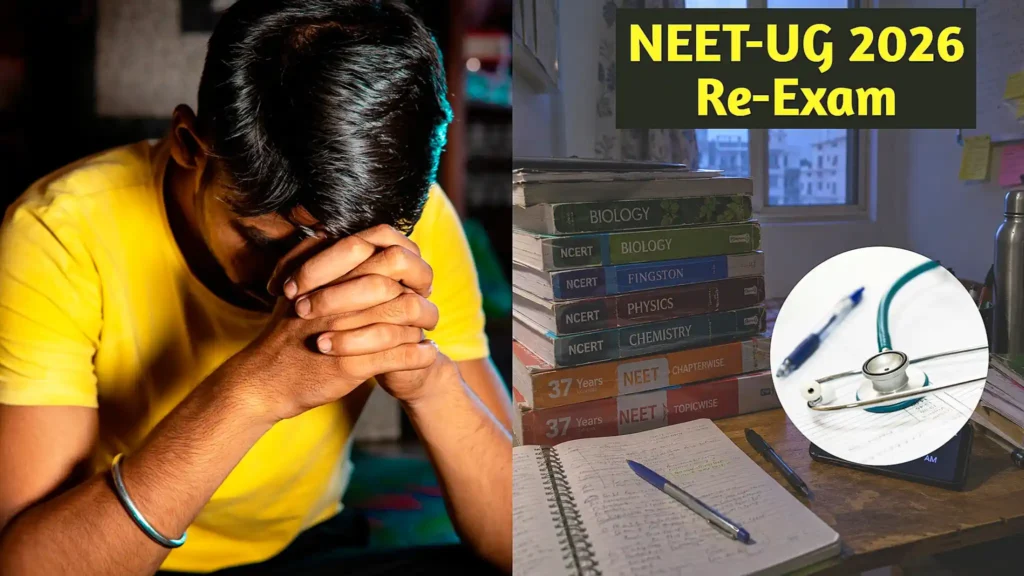
NEET-UG 2026 Re-Exam: The alarm on Priya Deshmukh’s phone was set for 4:47 am.
It had been set to that time since the first week of January — an odd number, she explained once to her roommate, because round numbers feel like they can be negotiated with. 4:47 cannot. You are either awake or you are not.
On the morning of May 13, the alarm went off as usual. Priya, a 19-year-old from Patna preparing for NEET at a hostel in Kota, reached for her phone, silenced it, and lay still for a long moment. The previous evening, NTA had cancelled the examination she had just sat ten days earlier. The last seventeen months of her life — the alarm, the timetable, the 4 am chemistry revisions, the mock series, the sacrificed family functions, the phone calls home that always ended the same way — had been, in administrative terms, voided.
She did not open her textbook that morning. She did not open it the morning after, either.
“I just kept thinking,” she said last week, sitting cross-legged on her hostel bed with a Biology NCERT open but unread beside her. “If I start again, what is the guarantee? How do I trust any of it?”
This is the question that approximately 22 lakh students are carrying right now — not the one that Dharmendra Pradhan and Rahul Gandhi are answering on television, not the one the CBI is pursuing through Latur and Jaipur and Ahmedabad — but the quieter, more personal question about whether it is possible to rebuild motivation from the rubble of a cancelled exam in exactly thirty days.
Nobody in the mainstream conversation is addressing it. Somebody needs to.
The Trauma Has a Name
Dr. Sangeeta Kulkarni is a Pune-based counsellor who has worked with competitive exam aspirants for eleven years. In the three weeks since the NEET cancellation, she has had more consultations than in any equivalent period she can recall.
The presenting issue, across almost every case, is the same. It is not depression in the clinical sense. It is not anxiety about the re-examination syllabus. It is something more specific — a collapse of the psychological contract that keeps a long-preparation student functioning.
“When a student commits to seventeen or eighteen months of sustained preparation,” she explained, “they are not just studying. They are making a deal with themselves. I will give this everything, and the system will evaluate me fairly. When the system breaks that deal — not because of anything the student did wrong, but because adults in positions of authority failed catastrophically — the student’s internal framework breaks with it.”
In clinical terms, this is a form of institutional betrayal trauma. It is not the same as failing. Failure, paradoxically, is easier to metabolise: there is a clear cause, and there is a clear corrective action. A cancelled examination offers neither. The student did not fail. The examination failed. And now they are being asked to sit down, open their books, and prepare again — for the same paper, with the same syllabus, in thirty days — as though that makes complete sense.
For many students, it does not make sense. And pretending that it does — the cheerful “you’ve got this, just revise hard” coaching institute messaging that has been flooding social media since May 13 — is, Dr Kulkarni said carefully, counterproductive.
“Before a student can revise effectively, they need to process what happened. Skipping that step and jumping straight to ‘June 21 strategy’ is like asking someone to run a race with a stress fracture and telling them to focus on their stride.”
Week One Is Not About Biology
This is the first thing most revision roadmaps are getting wrong.
The standard advice being distributed through coaching WhatsApp groups right now runs something like this: immediately resume your full schedule, complete NCERT revision by the end of May, begin full-length mocks in the second week, tighten weak chapters in week three, and keep the final three days light. It is technically correct advice. It is also advice designed for a student who is psychologically ready to execute it, and most students sitting in hostel rooms right now are not.
A counsellor working with aspirants in Kota, who asked not to be identified, described what she calls the “performance trap” that students fall into in the first week after a forced restart.
“They sit at their desk because that is what they are supposed to do. They open the book. They read the same paragraph six times. They write nothing useful on their rough sheet. They close the book two hours later feeling worse than when they opened it — because now they have lost two hours and they have nothing to show for it. And then they conclude: something is wrong with me. I cannot prepare.”
Nothing is wrong with them. The body and mind are processing an abnormal event — the cancellation of an examination they had systematically prepared for, in a context where they subsequently learned that the paper had been compromised by adults operating at the highest levels of the examination administration. Their inability to immediately resume a seventeen-month routine is not a character defect. It is a reasonable physiological and psychological response.
Week one, she said, should be structured differently. Three to four hours of light revision — previous year questions only, no new concepts, nothing that feels like breaking new ground. One full day of deliberate rest. Conversations with family, not about preparation, but about anything else. Physical activity. Sun. Sleep before midnight.
“The goal of week one is not to cover chapters. The goal is to restore the nervous system to a state where focused studying is physically possible.”
NEET-UG 2026 Re-Exam: The Subject Landscape Has Shifted
By week two, most students will be ready to engage with the question that actually matters for June 21: what, precisely, should they be studying?
This is where the granular tactical guidance breaks down in almost every piece of content currently circulating. The broad advice — “focus on NCERT, do mocks, revise weak chapters” — is accurate in the same way that “eat well and exercise” is accurate medical advice: technically true, operationally useless without specifics.
Here is what the specifics look like for June 21.
NTA has confirmed that the question paper for the re-examination will be drawn from an entirely different question bank than the one used on May 3. This is not a minor procedural detail. It has direct implications for how students should distribute their revision time across subjects.
In the May 3 paper, by most credible reconstructions from students who sat it, Physics was heavier on mechanics and modern physics, Chemistry skewed toward physical and inorganic sections, and Biology carried a high proportion of questions from Genetics, Ecology and Human Physiology. A June 21 paper drawn from a different bank is statistically unlikely to reproduce the same distribution. The chapters that felt underrepresented on May 3 — Plant Physiology, Biomolecules and Cell Biology in Biology; Organic reaction mechanisms and coordination chemistry; Waves and Optics in Physics — carry elevated probability for the re-test.
A subject-matter expert from a Delhi coaching institute, who has been tracking NEET paper patterns for nine years and spoke on condition of anonymity, framed it this way: “NTA will not repeat a pattern that is already publicly known. Students who sat May 3 and are now preparing for June 21 have a two-edged advantage: they know what the exam feels like, and they know approximately what it covered. The rational move is to front-load preparation in the areas the first paper did not touch.”
This means Biology’s plant-side chapters — which most students underinvest in relative to their NEET weightage — need specific, deliberate attention in weeks two and three. It means Organic Chemistry, which many students treat as a memorisation exercise when it is more accurately a pattern-recognition exercise, deserves more mock questions and less rereading of mechanisms. It means Physics, where the split between calculation-heavy and concept-heavy questions can shift significantly between papers, should be revised with equal emphasis on both rather than leaning into whichever felt stronger on May 3.
The Week-by-Week Architecture
The thirty days between now and June 21 divide, for practical purposes, into four phases. Each has a different primary objective.
The first week — which has already been discussed — is restoration. The goal is not chapters covered. It is functional readiness to study.
The second week is foundation reinforcement. Not new concepts. Not advanced problems. The full NCERT text for Biology — not summaries, not coaching notes, the actual NCERT chapters — read completely, with particular attention to diagrams, bold terms, and the end-of-chapter points that NTA has historically drawn direct questions from. For Chemistry, this week is about reading the NCERT inorganic section — the blocks, the properties, the reactions — which most students know they should know and have been planning to revise since November. For Physics, this is the week to close any open NCERT chapters rather than adding practice problems.
The third week shifts the emphasis from input to output. Full-length mock examinations, ideally two per week, under examination conditions: phone in another room, no looking up answers mid-paper, three-hour uninterrupted sittings. The purpose of mock tests at this stage is not to identify weak chapters — that window is largely closed — but to rebuild examination temperament. Students who sat May 3 and are now preparing for June 21 have a specific psychological pattern to watch for: mid-paper anxiety spikes triggered by a difficult question, which the May 3 experience has now freighted with extra significance. The only way to retrain the nervous system’s response to a hard question is to encounter hard questions repeatedly in a low-stakes environment.
The fourth week — the final seven days before June 21 — should be the lightest in terms of new material and the most focused in terms of consolidation. This is the week to revisit incorrect answers from the mock tests, to read the one or two NCERT chapters that consistently produced errors, and to do nothing intellectually new. The Saturday before the examination should be spent doing something that has nothing to do with NEET. Walk somewhere. Eat a meal that feels like a meal rather than fuel. Sleep eight hours.
The Comparison Problem
There is one more thing that will damage more preparations between now and June 21 than any syllabus gap, and almost no one is saying it directly.
It is the group comparison that will begin in approximately week two, when students who have stabilised their preparation start to sense how their peers are doing. In hostel corridors, in WhatsApp groups, in the informal conversations at tea stalls near coaching districts, the benchmarking will start. “Rahul finished NCERT Biology already.” “She’s done four mocks this week.” “That Kota batch is already at the integration level.”
Most of this information is either exaggerated or irrelevant. Some of it is fabricated. All of it is damaging if absorbed without a filter.
The counsellor in Kota had a precise description of what happens to a student who enters this comparison cycle in week two of a thirty-day preparation window. “They abandon their own plan — which was calibrated to their specific gaps and strengths — and try to match the most advanced version of everyone around them simultaneously. They end up executing nobody’s plan well. And then, two weeks out, they are exhausted and they have not gone deep on anything.”
This examination has one structural fact working in every student’s favour that tends to get lost in the noise: the pool is fixed. Nobody new is entering. Every student sitting June 21 sat May 3. The relative performance distribution that determined the original scores still exists, approximately, across this group. A student who was genuinely in the top ten percent of this cohort on May 3 is still, roughly, in the top ten percent on the first day of June — unless they spend the intervening weeks in a comparison spiral that erodes their actual preparation.
The cohort’s average preparation level will not surge dramatically in thirty days. The question is only whether each student maintains and refines what they already have.
What the System Owes and What It Has Paid
At some point in the next four weeks, every student preparing for June 21 will have a version of the thought that Priya Deshmukh had at 4:47 on the morning of May 13. It will come at different moments — during a difficult mock, during a conversation with a parent, during a night when sleep does not arrive quickly. The thought is some variation of: I did everything I was supposed to do, and the system failed me, and I am now being asked to do it again.
That thought is accurate. It is not self-pity. It is a correct description of what happened.
The system — NTA, the paper-setting apparatus, the chain of oversight that was supposed to prevent exactly this — did fail. The investigations are ongoing, the arrests are accumulating, and the political arguments about accountability will continue long after June 21 has come and gone. Students preparing right now will not receive an apology that means anything before the re-examination. They will not receive compensation for the months that the cancellation has cost them. They will receive, on June 21, a new question paper and three hours to demonstrate what they know.
That is an inadequate response to what happened. It is also, at this moment, the only response that exists.
The students sitting in those rooms know this. Most of them made peace with it in the first week after the cancellation. Not cheerfully, not without grief, but with the particular pragmatism that a student who has been preparing for seventeen months in a Kota hostel or a Latur library develops: the understanding that the exam will happen regardless of how one feels about the conditions under which it is happening.
4:47 Again
Priya Deshmukh opened her Biology NCERT on the fourth day after the cancellation. Not all the way. She read three pages of Plant Kingdom — a chapter she had covered thoroughly in December but had been meaning to revisit — and then stopped.
She did not set a goal for that morning beyond those three pages. She did not calculate how far behind she was. She did not check how many chapters others had covered.
She set her alarm for 4:47.
By the following week, she was running a full revision schedule again. Not because the betrayal of the cancellation had become acceptable. Not because she had stopped being angry about what adults in positions of authority had done to her examination. But because the exam was on June 21, and she intended to be ready for it.
“I cannot control what happened,” she said. “I can only control the next thirty days.”
In Kota, in Latur, in the hostel rooms of Rajkot and Nagpur and Hyderabad, that is where the real preparation for June 21 is happening — not in the press conferences, not in the parliamentary debates, not in the CBI’s interrogation rooms. In rooms where alarms are set to numbers that cannot be negotiated with, and students are deciding, day by day, to walk back into the work.
The library doors open at six. They keep walking in.
