



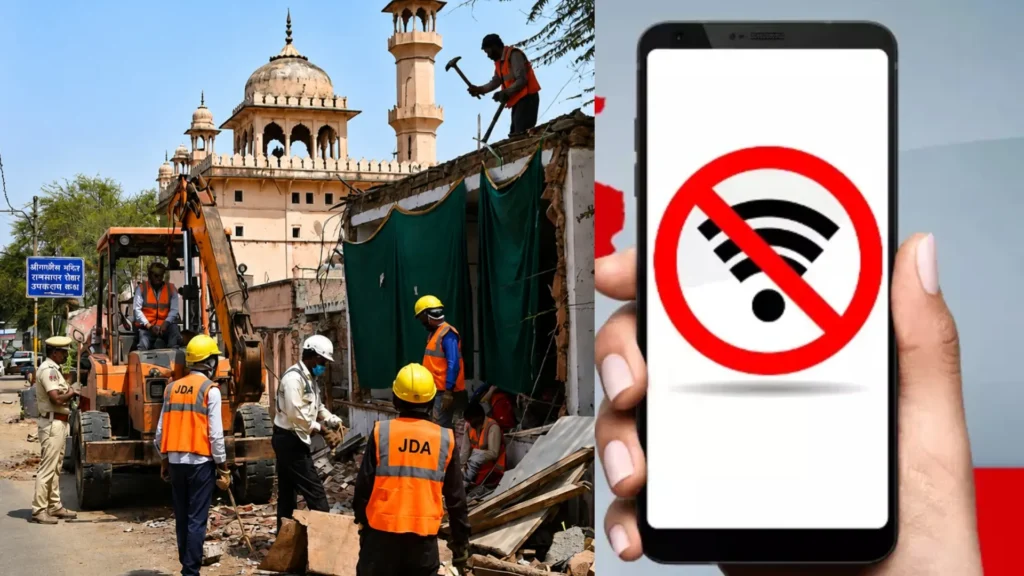
For most people in Jaipur, Monday wasn’t supposed to be a day of big news.
People had work to finish, bills to pay, deliveries to track and messages to reply to. Then mobile internet services were suspended across parts of the city, and suddenly a road-widening project became the biggest topic of discussion.
The Jaipur administration ordered a 24-hour internet shutdown ahead of a demolition and anti-encroachment drive in Jagatpura. The operation was linked to the widening of Nandpuri Road, a project that officials say is needed to improve traffic and make the area easier to navigate. But while bulldozers and police deployments grabbed headlines, many residents spent the day talking about something much simpler. Their phones weren’t working.
A Road That Has Been Causing Problems for Years
Anyone who regularly travels through parts of Jagatpura knows that traffic can be frustrating. The area has grown quickly over the years. New housing societies have come up, more people have moved in and the number of vehicles on the road has increased. What may have worked a decade ago no longer seems enough for the amount of traffic the area sees today.
Officials say Nandpuri Road was originally planned to be much wider. Over time, structures came up along parts of the route, making expansion difficult. That is the reason behind the current demolition drive. On paper, widening the road sounds like a practical decision. Most people want better roads and less congestion. Nobody enjoys sitting in traffic every day.
Yet projects like these rarely stay limited to engineering plans and maps. Once buildings, communities and religious structures become involved, emotions naturally follow.
Why Authorities Took Extra Precautions
The drive became sensitive because some of the structures identified for demolition included religious sites.
Reports said a mosque, a mazar, two temples and a satsang hall were among the structures on the list. Officials feared that rumours or misleading videos shared online could create tension before people knew the full facts. To avoid that possibility, thousands of police personnel were deployed and mobile internet services were temporarily suspended.
From the administration’s point of view, the decision was about preventing problems before they started. Whether people agree with that decision or not, the reasoning behind it is easy to understand. In today’s world, information spreads incredibly fast. Sometimes rumours travel faster than facts.
The Part That Affected Everyone
The demolition drive was taking place in one part of the city. The internet shutdown affected far more people. A shopkeeper accepting online payments suddenly had to ask customers for cash. Students found it harder to access study material. Some people couldn’t contact clients or attend online meetings. Others simply found themselves disconnected from routines they normally don’t think twice about.
What stood out was how quickly people realised how dependent daily life has become on internet access. Not long ago, losing internet for a few hours mostly meant boredom. Now it can interrupt work, education, banking and communication.
That shift is why internet shutdowns create such strong reactions today. People no longer see the internet as a luxury. For many, it is part of everyday life.
More Than Just a Jaipur Story
What happened in Jaipur is not unique. Cities across India are facing similar challenges. Roads need to be expanded. Infrastructure needs to improve. Populations are growing and older systems are struggling to keep up. At the same time, people expect public services to become more reliable, not less. That is where things get complicated.
Governments want development projects to move forward smoothly. Residents want as little disruption as possible. Sometimes those goals work together. Sometimes they don’t. The Jaipur shutdown brought that tension into focus.
The road-widening project may eventually reduce traffic and improve connectivity in the area. Officials hope it will make life easier in the long run. For many residents, however, the immediate experience was different. They spent a day offline.
They dealt with delayed payments, interrupted work and communication problems. And they were reminded of something that often goes unnoticed until it disappears. Just how much modern life depends on staying connected.
Long after internet services return and the demolition drive ends, that will probably be the part many people remember most.
