



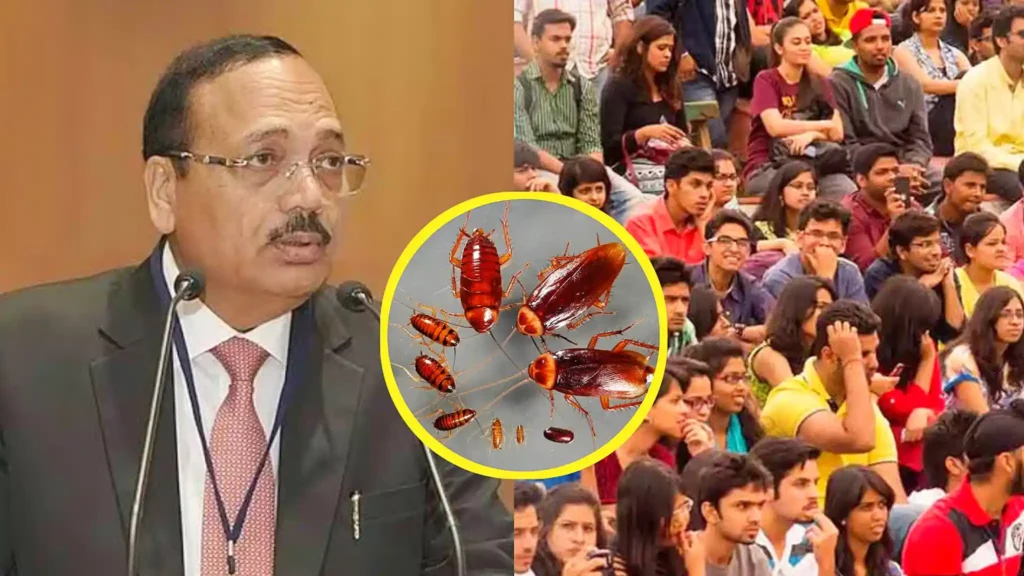
A recent statement by Chief Justice of India Surya Kant has triggered widespread debate across the country after he allegedly compared some unemployed youth to “cockroaches” during a hearing in the Supreme Court. The comments, made in the context of criticism directed at institutions and public figures, have drawn mixed reactions from legal experts, students, activists, and social media users.
The dispute started during a hearing in the Supreme Court regarding the appointment of senior advocates. The petitioner was castigated for repeated petitions, and while doing so, the CJI dwelt on his views on some of the lawyers in Delhi. The chief justice said:
“I am waiting for some matter…I want the CBI to verify the LLB degrees of most of the Delhi people…in Tis Hazari so and so…the kind of Facebook and things they are putting….do they think we are not watching? BCI will not do anything…thousands of them are fraudulent people who are wearing black robes…I have serious doubts on the genuineness of their law degrees. Probably CBI will have to do something. BCI will never do, because they are hands in glove, they are absolutely in collusion.”
He further said:
“There are already parasites of society who attack the system and you want to join hands with them? There are youngsters like cockroaches, who don’t get any employment and don’t have any place in profession. Some of them become media, some of them become social media, some of them become RTI activists, some of them become other activists, and they start attacking everyone…and you people file contempt petitions!”
The apex court also refused to entertain the lawyer’s application for senior designation. The bench said that it was “a status to be conferred and not to be legally pursued”, as reported by Live Law.
The controversy emerged during proceedings related to a lawyer’s repeated petitions and his request for senior advocate designation before the Supreme Court bench headed by CJI Surya Kant. During the hearing, the Chief Justice strongly criticized certain lawyers practicing in Delhi courts and even suggested that the Central Bureau of Investigation (CBI) should verify the authenticity of some law degrees. His remarks about possible CBI involvement became another major point of debate, with critics calling it an unusually strong statement from the head of the judiciary.
These comments instantly became the center of heated discussions both on social networks and in debate forums in the news. In fact, many considered that the use of such harsh language by the Chief Justice was completely inappropriate, especially taking into consideration the current high levels of unemployment in India. Statistics of the latest employment surveys show that a considerable proportion of educated graduates in India fail to get decent work opportunities despite their educational background and qualification. For some young individuals, social networks and independent journalism became one of the ways of expressing themselves and building a career.
The backlash against the remarks was immediate. Soon after reports of the hearing surfaced online, social media platforms like X and Reddit were flooded with criticism from lawyers, students, journalists, and activists. Many users argued that comparing unemployed youth to “cockroaches” and “parasites” was insensitive and disrespectful toward millions of educated young Indians struggling to find jobs.
One of the X user name Tarun Gupta, a prominent voice on the platform with over 30,000 followers, took a sharply sarcastic swipe at the apex court’s remarks.
“Dear unemployed lawyers & law aspirants, Chief Justice of India Surya Kant believes you are “parasites & cockroaches”. It is your fault that you have no support system to survive in this field. We are blessed to have such saviours of Freedom of Expression,” Gupta posted.
Similarly, social-issue content creator Amit Kilhor shared a video response on X focusing on the structural issues within the professional ecosystem, captioning the post:
“When gutters are made, cockroaches will be born; if you want peacocks, plant a garden.”
Several users defended RTI activists and independent journalists, saying they play an important role in exposing corruption and ensuring accountability in a democracy. Some social media users described the comments as “disconnect between the judiciary and ordinary citizens,” while others questioned whether such language was appropriate from the country’s Chief Justice.
At the same time, some people defended Surya Kant, arguing that his remarks targeted only those who misuse social media and activism to spread misinformation or attack institutions without evidence.
Critics argued that comparing unemployed youth to insects was insensitive and could appear dismissive of the struggles faced by millions of students and graduates. Some legal commentators also pointed out that activism and criticism are important parts of a democratic society. RTI activists, journalists, and independent commentators have often played a major role in exposing corruption, raising awareness about public issues, and holding authorities accountable.
Regarding the social media front, quite a number of users were uncertain of whether the comments made by the chief justice were appropriate for him to make as an individual at the top of the country’s judicial sector. A number of students were disappointed and said that being out of job was not an indication of one’s incompetence but something to do with difficult economic circumstances, stiff competition, and lack of chances.
Supporters said the judiciary has increasingly become the target of online abuse, trolling, and baseless accusations, which can weaken public trust in democratic institutions
The incident has once again highlighted the growing tension between institutions and online public discourse in India. In recent years, social media has given ordinary citizens a much larger platform to express opinions. While this has strengthened free expression in many ways, it has also led to the rapid spread of misinformation, online harassment, and extreme political polarization. Public figures, including judges, politicians, journalists, and celebrities, frequently face intense criticism online.
At the same time, the dispute has a wider context of unemployment and frustration on the part of young Indians. It should be noted that one of the youngest countries in the world is India, where there are millions of young people who enter the workforce each year. There is a lot of competition for state jobs, for jobs in the private sector, and for admission tests.
In such conditions, young people tend to look for other ways to build their career, including freelancing, creating content, working on YouTube channels, being influencers on social media platforms, and even independently engaging in activism. Some young people are able to establish themselves using the aforementioned tools, while others use this tool only to vent their frustration.
The issue concerning the CJI’s comments also brings to the forefront questions concerning the equilibrium that exists between the protection of the institutions and criticism within a democracy. Democracies operate on the principles of debate, dissent, and accountability. Although the issues of misinformation and character assassination do exist, many scholars believe that criticism in general is not necessarily a negative thing.
As the controversy persists, the matter has now evolved beyond a single commentary. This case has provided a platform for a wider national dialogue on topics such as unemployment, free speech, activism, and the dynamics between youth and institutions in contemporary India.
