



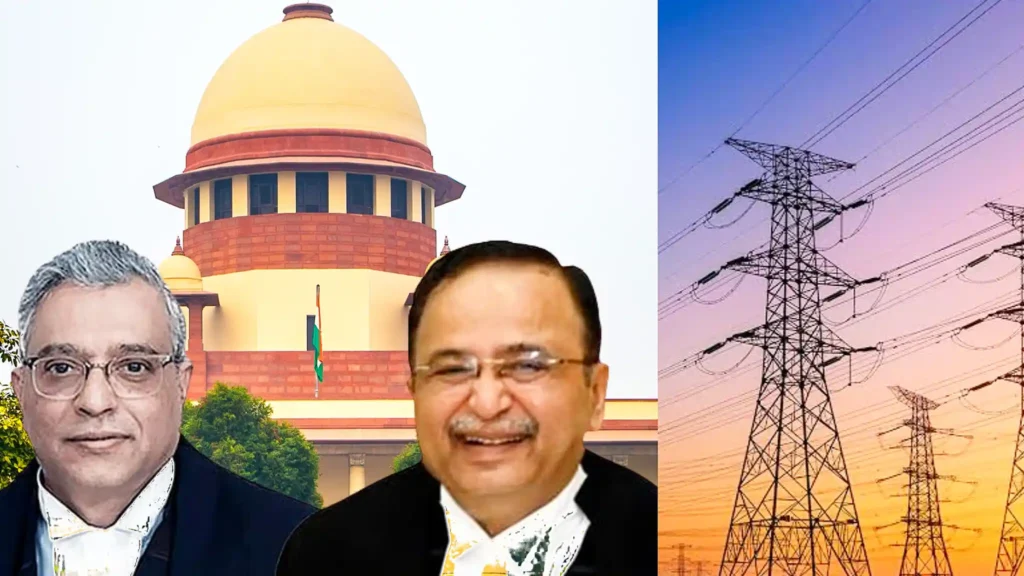
In an important verdict favouring electricity customers, the apex court in India has held that it would be unfair to make consumers pay for depreciation charges of a power station when there has been no supply of power to them during the relevant period. The decision was made on the case between the Delhi Electricity Regulatory Commission and Tata Power Delhi Distribution Limited concerning the Rithala Combined Cycle Power Plant in Delhi.
It is considered a significant step in ensuring the protection of consumer rights in India’s power industry. It is clear from the judgment that the determination of the tariff is more than a simple economic exercise; it is a “regulatory balancing act,” wherein consumer welfare should always take precedence.
Background of the Case
The conflict arose when the Rithala power station failed to supply power to customers in Delhi from March 2018 onwards. Despite the power plant having ceased operation for customers, depreciation cost recovery continued for the whole period of the 15 years of its economic life through electricity bills.
The Delhi Electricity Regulatory Commission used to permit depreciation recovery for only six years since the time when electricity was available to the consumers. As per reports, ₹83.34 crore depreciation was allowed as against the disallowance of ₹94.59 crore depreciation on account of consumers’ non-receipt of electricity in the latter period. But, subsequently, the Appellate Tribunal for Electricity decided that the company was entitled to claim depreciation over 15 years. The DERC took the matter further by appealing to the Supreme Court.
Supreme Court’s Judgment
A Bench comprising of Judges P. S. Narasimha and Alok Aradhe overturned the order of the tribunal and passed an order in favour of consumers. It was noted that consumers should not be forced to pay for services which are no more provided by them. The judgment emphasized that the purpose of electricity tariff regulations is not only to ensure financial recovery for companies but also to protect consumers from unfair financial burdens. The Court noted that if electricity was not supplied after March 2018, consumers could not be asked to continue paying depreciation costs linked to the inactive plant.
The Court also referred to the Power Purchase Agreement (PPA), observing that electricity supply obligations existed only for a limited period. Therefore, recovering costs for the plant’s entire technical life from consumers would be unreasonable.
Significance of the Judgement
The ruling is important as the tariffs related to electricity directly impact many Indian families and corporations. If the utility companies were permitted to recover their expenses even if they did not provide any services, the consumers would end up paying extra money for the electricity.
According to the legal scholars, the decision might serve as an example for future cases related to electricity tariffs. The regulatory bodies could become cautious while considering cost recovery from the consumers.
Another important lesson from the ruling is that consumer benefits take priority in the case of public utilities. The utility companies can no longer demand to receive compensation for each single expenditure regardless of service provision. Consumer welfare, the Court clarified, remains central under the Electricity Act, 2003.
The judgment of the Supreme Court has been hailed as a great relief for consumers of electricity. With its decision to hold that persons cannot be charged for electricity supplies which have not been supplied, the Court has reaffirmed the principle of equity in tariff regulation.
