







Until recently, the appointment of Election Commissioners was the kind of thing most people never discussed outside law classrooms or newspaper editorials. Even politically aware families rarely argued about it at the dinner table. Elections came and went, governments changed, and the Election Commission mostly stayed in the background doing its job.
That distance does not exist anymore.
These days, conversations about politics in India often drift toward institutions themselves not just politicians. People argue about courts, investigative agencies, governors, media channels, and now increasingly the Election Commission too. Somewhere between nonstop television debates and political battles on social media, institutional trust has become part of everyday conversation.
You can hear it in surprisingly ordinary places. A group discussing IPL scores suddenly moves into an argument about biased news channels. Someone complaining about rising vegetable prices casually brings up “system control.” Even relatives who once avoided politics entirely now speak confidently about constitutional bodies after watching two YouTube explainers and half a primetime debate.
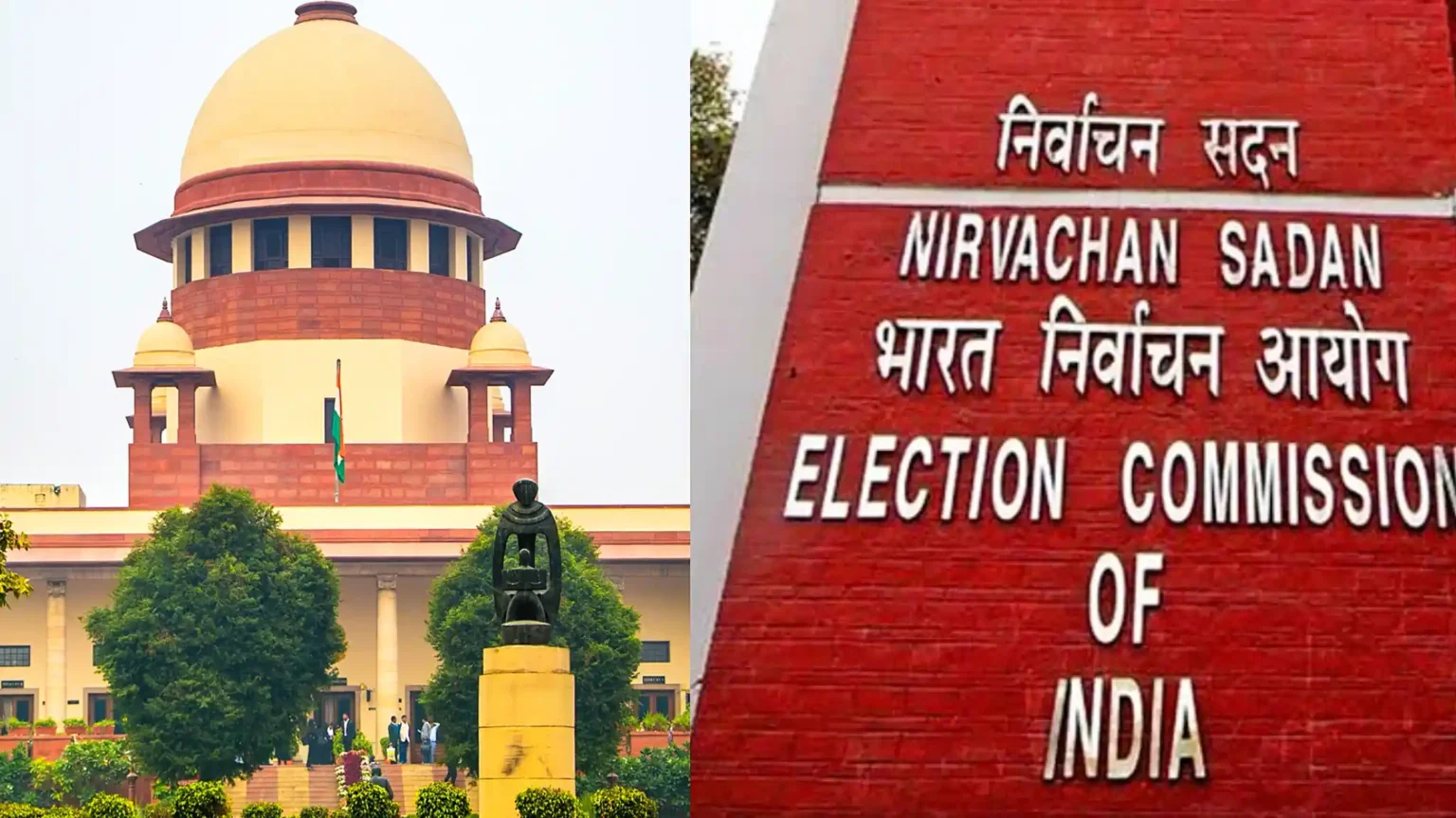
So when the Supreme Court recently observed that free and fair elections are possible only if Election Commissioners are independent, the statement travelled far beyond legal circles almost instantly.
On paper, the observation sounds straightforward. No democracy openly argues against independent election authorities. But the reaction to the statement reveals something larger happening in Indian public life right now: people are no longer debating only political parties. They are debating whether the institutions surrounding politics still feel neutral.
And neutrality, once questioned, becomes surprisingly difficult to restore.
The Election Commission sits in a complicated position during elections. It is expected to monitor campaign conduct, respond to complaints from rival parties, enforce the Model Code of Conduct, regulate speeches, and make administrative decisions that can influence political momentum all while convincing millions of people that it remains politically detached.
That expectation has become harder to maintain in an environment where almost every decision immediately turns into a partisan argument online.
A notice against an opposition leader becomes “selective targeting” for one side. Action against a ruling party politician becomes “politically motivated pressure” for another. Within minutes, hashtags begin trending, television panels start shouting, and everyone suddenly behaves like an expert in constitutional law.
A decade ago, many of these disputes would probably have remained inside newspaper columns or courtrooms. Now they spill directly into public consciousness.
For years, however, the Election Commission enjoyed a fairly strong reputation. India’s elections were often described as one of the country’s biggest administrative achievements, and honestly, that description was not exaggerated. Polling officials have travelled through forests, mountainous regions, flood-prone villages, and isolated settlements carrying voting equipment simply to ensure that citizens in remote areas could vote.
The scale of that exercise created public respect.
Most people never paid much attention to how Election Commissioners were appointed because the system itself appeared stable enough.
Earlier, Election Commissioners were formally appointed by the President, although the Union government effectively controlled the process. There was no independent statutory committee selecting candidates and no formal judicial role in appointments. Governments handled the process internally, and for decades it attracted relatively little public controversy.
That changed in 2023 when the Supreme Court ruled that, until Parliament enacted a law on the matter, Election Commissioners should be selected by a committee consisting of the Prime Minister, the Leader of Opposition, and the Chief Justice of India.
The court’s reasoning was difficult to miss. Since the Election Commission supervises elections involving the ruling government itself, the appointment process, according to the court, required some visible institutional distance from executive power. Including the Chief Justice was viewed as one way of creating that balance.
Opposition parties welcomed the judgment quickly. Organizations like the Association for Democratic Reforms (ADR) also strongly supported it, arguing that public confidence in election authorities depends not only on actual fairness but also on whether the process appears independent to ordinary citizens.
The concern was less dramatic than social media sometimes made it sound. Critics were not necessarily claiming that every past Election Commissioner had behaved improperly.
Their worry was subtler than that.
Once people begin believing the ruling side has too much influence in choosing the referee, suspicion slowly spreads into every controversial decision the referee later makes. Over time, even routine actions begin carrying political interpretations before explanations arrive.
Later, the Union government passed a law changing the committee structure. Under the current system, the selection panel consists of the Prime Minister, the Leader of Opposition (or leader of the largest opposition party), and a Union Cabinet Minister nominated by the Prime Minister. The Chief Justice of India was removed from the process.
During the May 14, 2026 hearing, the debate inside the Supreme Court became noticeably sharper. The bench questioned whether the current selection process genuinely creates the appearance of independence when two members of the committee effectively come from the government side. Justice Dipankar Datta openly asked why there was a “show of independence” if the executive could ultimately dominate the appointments anyway. Lawyers challenging the law, including senior advocates appearing for petitioners and groups like the Association for Democratic Reforms, argued that the 2023 law diluted the spirit of the Supreme Court’s earlier judgment by removing the Chief Justice of India from the panel. They insisted that institutions supervising elections must not only function independently but must also appear visibly insulated from political pressure.
The Centre, however, pushed back strongly. Solicitor General Tushar Mehta argued that Parliament had every constitutional right to frame a law once the court itself had said its earlier arrangement was temporary until legislation was enacted. That argument brought the discussion into the territory of judicial restraint the idea that courts should avoid excessively interfering in legislative decisions unless a clear constitutional violation exists. The bench itself acknowledged this tension at several points, observing that the 2023 judgment had only filled a temporary vacuum until Parliament acted. But the judges also repeatedly returned to a larger concern: in a democracy, public confidence in the neutrality of election authorities may matter almost as much as neutrality itself.
The government defended the move by arguing that appointments to constitutional positions naturally fall within executive functioning and that elected governments play central roles in such appointments across parliamentary democracies.
Critics disagreed almost immediately. Opposition leaders argued that replacing the Chief Justice with a Cabinet Minister tilted the balance too heavily toward the executive because two of the three members effectively came from the government side. ADR and other civil society groups raised similar concerns, warning that the appearance of neutrality matters enormously for an institution responsible for supervising elections.
And maybe that explains why this debate has become emotionally charged in ways constitutional procedure usually does not.
At its core, the argument is not really about one committee meeting or one individual appointment. It is about whether citizens still feel confident that institutions standing above politics are actually capable of remaining above politics.
Democracies can survive loud political fights. India has had those for decades.
What becomes harder to manage is the slow erosion of shared confidence in the rules of the fight itself.
Once enough people begin suspecting the referees, every close election starts carrying resentment long after the votes are counted.