



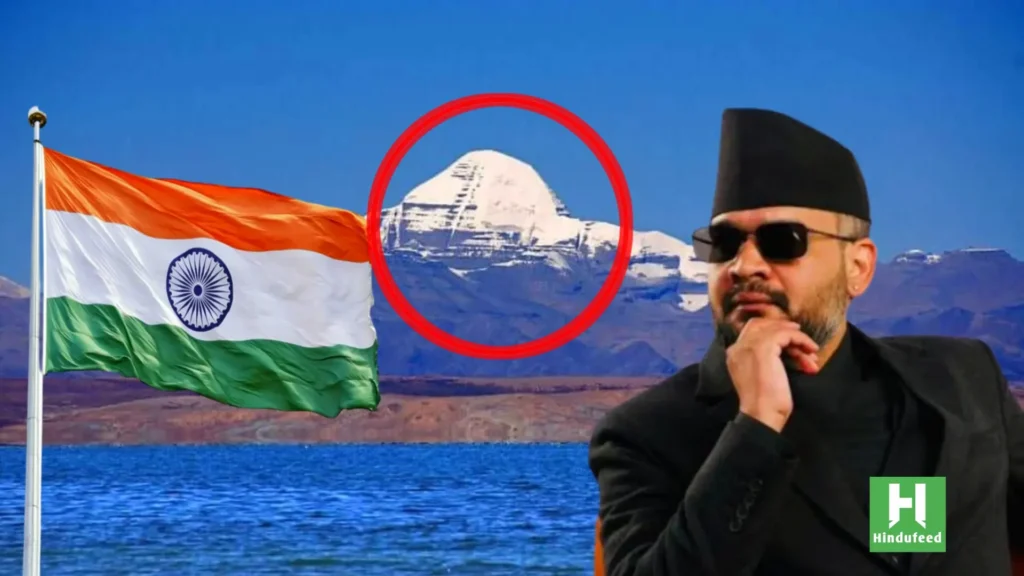
Up in the mountains in the cold wave, a familiar diplomatic disagreement has arisen. At the centre where India, Nepal, and China meet, is long standing territorial dispute.
In early May 2026, India responded officially to Nepal’s formal Objection, reiterating its position on the route to resume the Kailash Mansarovar Yatra via these high altitude regions. India officials describe the move as a continuation of established administrative practice. However, Nepal has called it a sensitive issue linked to its territorial claims.
The latest catalyst for this friction was a routine announcement by New Delhi regarding the 2026 Kailash Mansarovar Yatra. When the Ministry of External Affairs (MEA) confirmed the reuse of the pilgrimage via the Lipulekh route,
More Than Just A Route
The latest development follows India’s decision to resume the Kailash Pilgrimage via Lipulekh. Nepal’s Ministry raised the issue of a formal Objection, asserting that any activity took place in that region even in an infrastructure or tourism will require its consent .
The Past of 1816
To understand the “firm stand” India is taking today, we have to look at the history of a boundary defined over two centuries ago, The Treaty of Sugauli Signed in 1816 after the Anglo Nepalese War, the treaty established the Kali River as the western boundary of Nepal.
Now the problem is that geography in the Himalayas is ready for a straight line.Nepal argues that the river’s source lies fully at Limpiyadhura , which would place the Lipulekh Pass and the Kalapani territory inside its borders. Meanwhile, India states that the river originates from different sets of springs further east, keeping the pass firmly within the Indian state of Uttarakhand.
India’s primary argument is the status quo. Since 1954, Indian pilgrims and trades have been using Lipulekh with the tacit understanding of all regional players. To New Delhi, Some analysts say Nepal’s recent position reflects a stronger assertion of its territorial claims.
The Reality
Despite the sharp language coming from South Block and Kathmandu Singh Durbar, the broader reality often receives less attention. The relationship between Nepal and India has been like a true friendly neighborhood, reflecting deep cultural rooted and economic ties.
Millions of Nepalese citizens work in India and the army’s Gorkha regiments are famed for their bravery and remain a living symbol of this bond. When the political suitation heats up, it affects the people on the border who feel more anxious.
Both India and Nepal maintain that their claims are based on historical agreements and administrative practice .
The Road Forward
At the first release of pilgrims prepare for the 2026 season. The roads have been covered, the security posts are occupied, and the firm stand is the new permanent status.
The Lipulekh dispute is a gentle reminder in the Himalayas, history never truly stays hidden under the snow. It is the mountains where every rock has a story buried in it and infrastructure development in the region has given new dimensions to the diplomatic discussion.
As the sun sets over the top of the peaks of Uttarakhand, the caravans will continue to move towards Kailash, The diplomats will continue to trade notes. But for the very first time in decades, Officials maintain that India’s position remains consistent with it’s understanding of the boundary.
A local resident from Dharchula, who has worked along the route for over two decades, said the issue is less about geopolitical and more about livelihood. He also said “The flags change, the maps change, ” but the wind at the top? That stays the same with me, between the South Blocks firm statements and Kathmandu’s final Objections, there are thousands of people, locals, pilgrims, soldiers, etc who live inside this dispute rather than above it. They don’t have any luxury of viewing it from a diplomat’s attitude .
