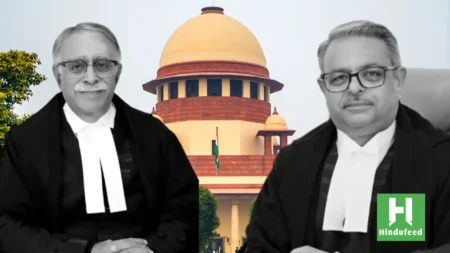










On May 12, 2026 the Supreme Court delivered a landmark judgement to the state of Rajasthan directing it to frame a policy that will implement the use of Rajasthanilanguage for educational purposes. The court directed the state to include Rajasthani language as a subject of study in all government and private schools across the state in a phased manner and also examine using it as a medium of instruction starting at the foundational level and extending it to the higher levels. In doing so, it sought to interpret Article 19(1)(a) of the Constitution – the right to freedom of speech and expression – and underscore the fact that the issue is not a matter of convenience but that of existential freedom, elevating it to the status of a ‘fundamental right’ and not mere ‘policy’. This judgement was in response to a petition filed by Padam Mehta, which was dismissed by the Rajasthan High Court. The petition sought the introduction of Rajasthani as a subject in the state’s primary and secondary schools. The Supreme Court set aside the High Court’s order and ruled that the state was lackadaisical and dragging its feet, citing the non-inclusion of Rajasthani in the Eighth Schedule of the Constitution as a reason for its exclusion from the school curriculum. Here, the Honourable Court pointed out that Article 350A of the Constitution clearly imposes that it is the duty of the state to ensure adequate infrastructure facilities for mother-tongue instruction.
Simply put, the judgement means that a child can exert the right to education in their ‘mother tongue’. By citing the provisions of Article 21A of the Constitution which stipulates that the ‘state will provide free and compulsory education to all children between the ages of 6 and 14’, the court asked what kind of education were the children receiving at the foundational level if that education was not in their preferred language. Despite Rajasthani being spoken widely across the state as the mother-tongue, and being taught at the Masters and Ph.D. levels, the state did not find it relevant to include Rajasthani at the foundational school level. At the time of entry into formal schooling, a child can feel the disconnect when receiving education in a language they are unfamiliar with. It further sought the inclusion of Rajasthani in the Rajasthan Eligibility Examination for Teachers (REET), which was introduced in 2011as a state-level qualifying exam for teachers wishing to teach in primary schools.
Let’s start with understanding what mother-tongue instruction means now that the judgement is in place.
Mother Tongue Education
At a basic level, this refers to the form of schooling that children acquire through the language or languages that they are comfortable with; the language that is at the forefront of communication at home among families and communities. Exposure to a second language begins when the child comes of school-going age and follows the practice of learning a language that may be different from the one that the child has all along been familiar with. Several studies have proved that children learn better and display better cognitive skills in addition to emotional stability and academic success if they learn in their mother tongue. While this may seem simple in countries such as France, Germany, Spain etc. where there is only one official language, in a country like India with several languages and dialects used in communication the challenges are complex. Although constitutionally there is no single language laying claim as ‘national language’, Hindi and English have been widely used for administrative and legal purposes handing them the titles of ‘official language’.
Across the country, students who receive education with English as the medium of instruction and the local language as a second or third language fare much better than their counterparts whose education is solely in the local or regional language. Against a backdrop of several languages that fall in the category of mother-tongue in India, learning goals can be severely affected if a common medium of instruction and learning is not used especially at middle and high school levels. Use of mother-tongue to communicate is a natural ability that we all display. But using that as a sole medium of instruction leaves children at a disadvantage from receiving good quality education in line with national and international standards.
While the bottom-line of the judgement emphasizes that “language barriers and unfamiliar mediums of instruction’ are a deterrent to students grasping the much needed education, it is expected to have a much larger impact on a national level giving credence to the argument that regional, non-scheduled languages must find place for integration in the educational system. Here, it is pertinent to point out that the Eighth Schedule of the Indian Constitution lists 22 officially recognized languages. Since it was adopted in 1950, it has been amended three times.
The South of India has consistently outperformed the North in terms of literacy rates, better educational infrastructure; these in addition to the use of English as a medium for communication lend weight to the evidence that bilingualism often leads to superior performances in education and language skills. The northern states have high dependency on Hindi and Sanskrit. The five southern states are fortunate to have their local languages included in the Eighth Schedule and each state has used this provision to further its own linguistic agenda, whether through politically motivated biases or otherwise. These local languages are offered as subjects of study and as mediums of instruction in schools.
Legal and Constitutional Interpretations
Broadly, the issues thrown up by the judgement are –
• Whether a state can quote the provisions of the Eighth Schedule for non-inclusion of local language as a medium of learning;
• Whether linguistic freedom and mother-tongue education together constitute a fundamental right, and not a matter of policy.
By quoting the provisions of Articles 19, 21, 21A and 350A the judgement has addressed the education rights of linguistic minorities and marginal communities and interpreted it in the context of multilingualism. Legal experts and constitutional scholars opine that the judgement scores a major victory for linguistic rights and mother-tongue education, highlighting several aspects of the judgement that are ground-breaking. Among them are:
• Judicial intervention by the top court clearly indicating that it will not remain a silent spectator involving a matter of fundamental rights,
• Elevation of mother-tongue education as a fundamental right to an inclusive, accessible and culturally relevant education,
• Enforcing Constitutional rights under Articles 350A and 21A as a unified mandate,
• Setting aside the Eighth Schedule language provisions of constitutionallyrecognized languages,
• Setting a powerful precedent for other states to demand instruction in their native languages, and
• Further strengthening of the National Education Policy 2020 that prescribes foundational learning in regional languages.
Proponents of linguistic chauvinism at state or regional levels may cite this judgement, that may have come as music to their ears, to push forward the local language agenda although their ideology stems from assumed linguistic and cultural superiority of their preferred language over another, rather than of any educational importance, and often breeds discrimination.